A roof workmanship warranty is your roofing contractor’s written promise that the roof was installed correctly. If an installation error shows up during the warranty term, the contractor comes back and fixes it. It covers labor and technique. It does not cover defective shingles, which fall under the manufacturer’s warranty, and it usually does not cover storm damage. At Stalwart Roofing in Baton Rouge, every project carries our five-year workmanship warranty.
TL;DR
- A workmanship warranty comes from the contractor and covers installation mistakes. A manufacturer’s warranty covers product defects. They are separate documents.
- Terms are set by the contractor. Five years is common, and our workmanship warranty runs five years.
- Storms, hail, high wind, falling limbs, later alterations and skipped maintenance are typical exclusions. In Louisiana, that matters a great deal.
- Warranty length is not the whole story. Installation quality and the way the contractor communicates decide whether a warranty is ever useful.
Table of Contents
- What a roof workmanship warranty actually is
- Workmanship warranty vs. manufacturer’s warranty
- What a workmanship warranty typically covers
- What is usually not covered
- How long a roof workmanship warranty lasts
- Can a workmanship warranty transfer to a new owner?
- How to make a claim
- How to keep your workmanship warranty valid
- What to look for before you sign
- Commercial roofs and property managers
- Our perspective on workmanship warranties
- Roofing backed by a five-year workmanship warranty
- FAQ
- Sources
What a roof workmanship warranty actually is
When a crew installs your roof, two different things can go wrong. The product can be defective, or the installation can be flawed. Each has its own warranty.
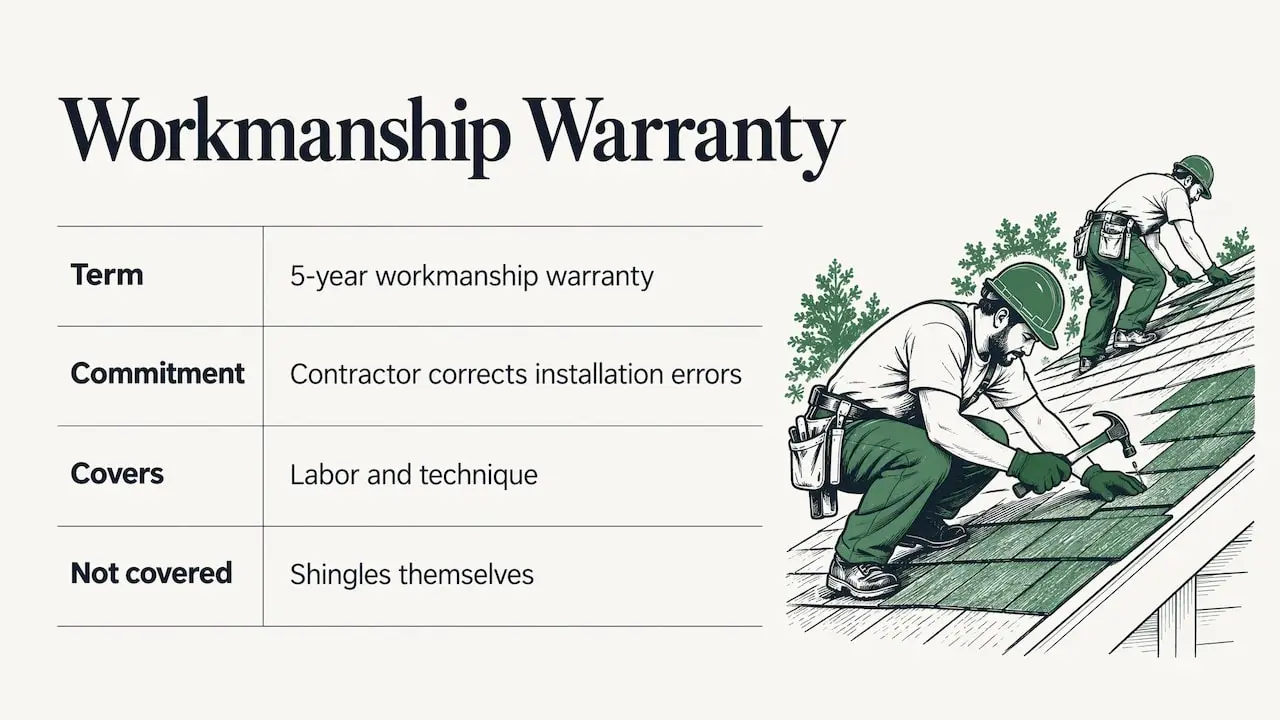
The National Roofing Contractors Association Institute describes a 5-year workmanship warranty as the contractor’s written commitment that the crew installed the roof correctly, and that the contractor will return and correct installation errors that surface within five years of completion. It concerns labor and technique and has nothing to do with the shingles themselves.
That is why you will see the same idea under several names: workmanship warranty, installation warranty, and the roof labor warranty or roofing labor warranty that homeowners often search for. In everyday use, these terms point to the same thing, the contractor standing behind the labor on your roof. The exact wording in your contract is what counts, so read the document itself instead of relying on the label.
Workmanship warranty vs. manufacturer’s warranty
The difference is simple. Owens Corning explains that the contractor’s workmanship warranty covers the installation, while the standard manufacturer’s warranty covers the products you purchased.
| Workmanship warranty | Manufacturer’s warranty | |
|---|---|---|
| Who issues it | Your roofing contractor | The shingle or material maker |
| What it addresses | Installation errors and labor | Manufacturing defects in the product |
| Who sets the term | The contractor | The manufacturer |
| Typical trigger | A leak or failure traced to how the roof was installed | A product that failed because of how it was made |
CertainTeed notes that a manufacturer’s warranty covers problems that occurred in the manufacturing process, for a time specified in the warranty. It also says manufacturers typically don’t insure workmanship, which is why many contractors offer their own installation warranty.
This gap matters. Owens Corning states that standard manufacturer warranties do not cover shingles that fail early because of installation mistakes, nor issues with other components the roofer installed, such as underlayment, flashing or ventilation products, though those parts may have their own warranties. Flashing around chimneys, vents and valleys is where many leaks begin. Strong workmanship coverage is what protects those details.
What a workmanship warranty typically covers
Coverage varies by contractor, but these are the common elements:
- Labor to repair the problem. Owens Corning says contractor workmanship warranties typically cover the labor and materials needed for repairs.
- Related interior damage, in some cases. Many warranties also address damage to the home’s interior, furnishings and personal effects, according to the same source. Whether yours does depends on the wording.
- Installation-related failures. Poorly sealed flashing, improperly fastened shingles, incorrect underlayment placement and bad ventilation details are all installation issues.
The key phrase is “surfaces within the term.” If a leak appears in year three because a flashing detail was done wrong, that is the kind of problem workmanship coverage exists for.
What is usually not covered
A workmanship warranty is not an all-purpose insurance policy. The NRCA consumer advisory addresses a common misconception: long-term warranties are not all-inclusive coverage for any roofing problem regardless of cause. Warranties typically repair leaks that result from specific causes named in the document.
The usual exclusions look like this:
- Storm damage. The NRCIA lists storm damage, hail, high wind, falling limbs and other events outside the contractor’s control.
- Damage by other trades or foot traffic. The same source includes damage caused by other trades or by anyone walking on the roof.
- Alterations after installation. Added penetrations, such as a new vent, satellite dish mount or solar rack, and other modifications are commonly excluded, along with normal wear and tear where maintenance was skipped.
- Ice-dam water damage and wind-driven debris. Owens Corning lists these among typical exclusions.
- Abuse, improper use or modification by someone other than the contractor. CertainTeed names these as well.
Why storm exclusions matter in Louisiana
In Baton Rouge, the roof faces hurricane-season winds, heavy rain bands, and thunderstorms with gusts that lift shingles. Because wind and impact damage generally fall outside a workmanship warranty, the right path after a storm is often a homeowner’s insurance claim, not a warranty claim.
We have written separate guides on what to check on the ground before an insurance claim and on wind damage insurance coverage for Louisiana roofs. If a storm has already hit, our storm damage restoration team handles repairs and temporary protection such as roof tarping.
Here is a practical way to sort the two:
- A leak appears after a named storm with documented wind or hail: start with your insurer.
- A leak appears in dry or mild weather at a flashing, seam or penetration the contractor installed: call your roofer, because this is workmanship territory.
- You are unsure: have the roof inspected so the cause is identified and documented before anyone decides who pays.
How long a roof workmanship warranty lasts
The contractor sets the term. NRCIA says some contractors offer one, five or ten years, and five years is common. CertainTeed observes that many contractors set their own term, most often one or two years. Some contractors advertise lifetime coverage, and Owens Corning notes that the length varies widely by contractor.
So a five-year term sits at the stronger end of what is typically offered. Still, the NRCA cautions that a roof should be chosen on the quality and suitability of the system, not on warranty length alone. Its consumer advisory says a long-term warranty may be of little value if the roof does not perform and leaks. A long number on paper only helps when the work behind it is good and the company is still around to honor it.
What Louisiana law adds
A question people often type is how long a contractor stays liable for a roof. Louisiana has its own rule. According to Baker Donelson’s summary of Louisiana construction law, a right of action against contractors for deficiencies in the construction of a building is extinguished five years after the registry of acceptance of the work in the mortgage office, or five years after the owner occupied the improvement if no acceptance is recorded within six months.
That statutory period is separate from your contractor’s written warranty. For specifics about your own situation, such as a dispute over a past job, speak with a Louisiana construction attorney.
Can a workmanship warranty transfer to a new owner?
Sometimes, and sometimes not. The NRCA advisory notes that warranty documents often contain restrictive provisions, including possible prohibitions on assignment or transfer. If you plan to sell, or you are buying a home with a roof that is still under warranty, check the transfer language and any steps required, such as notifying the contractor in writing.
Louisiana buyers often ask about roof condition during a sale, and an inspection is the best way to learn it. Our guide on roof inspection red flags in Louisiana real estate explains what inspectors look for.
How to make a claim
Exact steps are in your contract, but a sensible process looks like this:
- Find your paperwork. Locate the signed contract, the warranty document and any invoices.
- Document the problem. Take photos of ceiling stains, wet spots, and the roof area if you can see it safely from the ground. Note the date, and whether it had rained.
- Do not repair it yourself or hire someone else first. Modifications by another party are a common exclusion, so let the warrantor look first.
- Contact the contractor in writing. Describe what you found and when you found it.
- Keep a record. Save emails, photos and visit dates.
If water is coming in now, protect the home first. A temporary fix, such as a tarp, is reasonable, and our guide on fixing a roof temporarily explains how. Tell the contractor what you did and why.
How to keep your workmanship warranty valid
Most voided warranties come from a handful of causes, and all of them are avoidable.
- Don’t alter the roof without the contractor. Adding a vent, antenna or solar mount creates new penetrations. Have the original installer do it, or confirm in writing that the warranty stays intact.
- Limit foot traffic. Walking on shingles can damage them. Hire a professional for gutter cleaning, satellite work and similar jobs.
- Maintain the roof. Skipped maintenance and normal wear are common exclusions. Debris, clogged gutters and overhanging branches cause problems in a state with this much rain and tree cover.
- Schedule annual inspections. Our annual roof inspection guide explains what is covered and when to book. A yearly record also gives you documentation if you ever need to make a claim.
- Keep your documents. File the contract, warranty and receipts together, digitally and on paper.
The same logic applies to any contractor warranty. Why repair warranties matter is a good example from another trade: the paper is only as useful as your understanding of its terms and your upkeep.
What to look for before you sign
Whatever contractor you choose, compare warranties on these points:
| Question | Why it matters |
|---|---|
| How long is the term, and does it start at completion? | Defines when installation errors are covered |
| Does it cover labor only, or labor and materials? | Determines your out-of-pocket cost for a repair |
| Is interior damage addressed? | Water stains and ruined belongings can cost more than the roof fix |
| What are the exclusions? | Storm, alterations and maintenance are the usual ones |
| Is it transferable? | Affects resale value |
| Is it in writing and signed? | A verbal promise is hard to rely on |
| Is the company local and established? | A warranty depends on the contractor still being there |
If you are comparing bids, our guide on choosing the right roofing contractor walks through what else to weigh. For deciding whether you need a repair or a full job, see roof repair vs. replacement in Baton Rouge.
Commercial roofs and property managers
If you manage a commercial or multi-family building, the same two-warranty structure applies, but the stakes are higher. A single leak can disrupt tenants and damage interiors. Flat roof systems such as TPO, and commercial metal roofing, depend on careful seams, flashing and terminations, which is precisely what a workmanship warranty addresses. Our commercial roofing services include installation and ongoing maintenance, and our guide to common commercial and multi-family roofing problems shows where trouble tends to start. For metal systems, see metal roofing installation mistakes to avoid.
Our perspective on workmanship warranties
After more than 25 years of roofing in Louisiana, we have learned that a warranty is a statement about how a contractor works. We back our installations with a five-year workmanship warranty because we believe the work should be done so carefully that the warranty is rarely needed.
Louisiana roofs take a lot: heat, humidity, heavy rain, and wind during storm season. That is why we build around local conditions and pay attention to the details that decide whether a roof stays dry: flashing, penetrations, underlayment and ventilation.
We also think homeowners deserve honesty about what a warranty is. It covers installation. It does not replace insurance for storm damage. When we inspect a roof, we tell you what we see, whether the cause is workmanship, wear or weather, and we do it without pressure. Clear communication up front prevents most of the disputes people fear.
That is also why we offer free inspections. Catching a small issue early is cheaper than repairing the damage that follows, and a documented roof history makes every future conversation, with us or your insurer, simpler.
Roofing backed by a five-year workmanship warranty
We handle roof repairs, full replacements, storm damage restoration and inspections for homes and businesses in the Baton Rouge area, and every project is backed by our five-year workmanship warranty. If you are planning a roof replacement or want a clear read on your current roof, we start with an honest assessment and explain your options plainly.
You can also start with a roof inspection to learn the condition of your roof before storm season or before a sale. For active leaks, our roof repair team handles emergency calls. Visit Stalwart Roofing to get in touch.
FAQ
How long is a workmanship warranty on a roof?
The contractor sets the term. NRCIA reports that some offer one, five or ten years, with five years common. Our workmanship warranty is five years.
What is the difference between a labor warranty and a workmanship warranty?
In everyday roofing talk, the two terms usually describe the same thing: the contractor’s responsibility for the installation labor. Wording differs by company, so read the actual document. Check whether it covers labor only, or labor plus materials and related interior damage.
Does a roof workmanship warranty cover storm damage?
Typically no. Both the NRCIA and Owens Corning list storm, hail and high wind damage among common exclusions. For storm damage in Louisiana, homeowner’s insurance is usually where a claim begins.
How long is a contractor liable for a roof in Louisiana?
Louisiana law extinguishes the right of action against contractors for construction deficiencies five years after acceptance of the work is registered, or after owner occupancy if no acceptance is recorded, per Baker Donelson’s summary. For a specific dispute, consult a Louisiana construction attorney.
Does the manufacturer’s warranty cover installation mistakes?
Standard manufacturer warranties cover product defects, not installation errors, according to Owens Corning. That is why the contractor’s workmanship warranty matters.
Sources
- Owens Corning: Understanding the 3 Main Types of Roofing Warranties
- NRCIA: Your 5-year workmanship warranty for roofing, explained
- CertainTeed: Understanding Roof Warranties
- NRCA: Roof System Warranties consumer advisory
- Baker Donelson: Construction Laws and Customs, Louisiana