An exposed fastener roof is screwed through the face of the panel, so every screw head sits in the weather. A standing seam roof hides its fasteners under raised seams. Exposed fastener costs less and goes up faster. Standing seam costs more up front, but it removes thousands of roof-field penetrations and lets the metal move with Louisiana’s heat. For most homes in Baton Rouge, we recommend standing seam. For barns, sheds and workshops, exposed fastener can make sense.
TL;DR
- Exposed fastener panels are screwed through the metal face and sealed with washers. They are the lower-cost, faster option, and they need periodic screw and washer checks.
- Standing seam panels use concealed clips and raised seams, so there are no fasteners in the roof field. They cost more and need an installer with real seam experience.
- Louisiana’s UV, heat swings and hurricane-season wind favor the concealed-clip design on a house you plan to keep.
- Wind and leak performance depends on the exact assembly and the installation, not the label “metal roof.”
- Corrugated is a type of exposed fastener panel, so “standing seam vs corrugated” is the same comparison.
Table of Contents
- How the two systems are built
- Cost: what you pay up front
- Leaks and maintenance: where water gets in
- Wind and storm performance
- Lifespan
- Side-by-side comparison
- Which one fits your Louisiana roof
- Installation details that decide the outcome
- Our perspective
- Talk to us about your roof
- FAQ
- Sources
How the two systems are built
The difference is how the panel attaches to the roof deck.
Exposed fastener panels are secured by screws driven through the panel face into the substrate, and the screw heads stay visible, according to Sheffield Metals’ comparison. A neoprene washer under each head seals the hole. The panels are wide, typically 36 inches, and are often made in thinner gauges than standing seam, per Metal Sales. Corrugated and R-panel profiles belong in this family.
Standing seam panels have raised vertical legs. Clips hold the panel to the deck without a screw through the panel itself, as SFS USA explains. The next panel’s leg covers the clip, then the seam is snapped or mechanically locked. From the ground you see clean vertical lines and no screw heads.
Snap-lock vs mechanically locked seams
Standing seam is not one product. In its ICC-ES evaluation report, Petersen Aluminum lists a snap-lock profile with 1¾-inch seams and mechanically locking profiles with 2-inch seams as distinct products. Snap-lock panels press together by hand. Mechanically locked seams are crimped closed with a seaming tool. The locked seam is the more demanding option to install, and it is the one that tends to be specified where wind exposure is highest.
Cost: what you pay up front
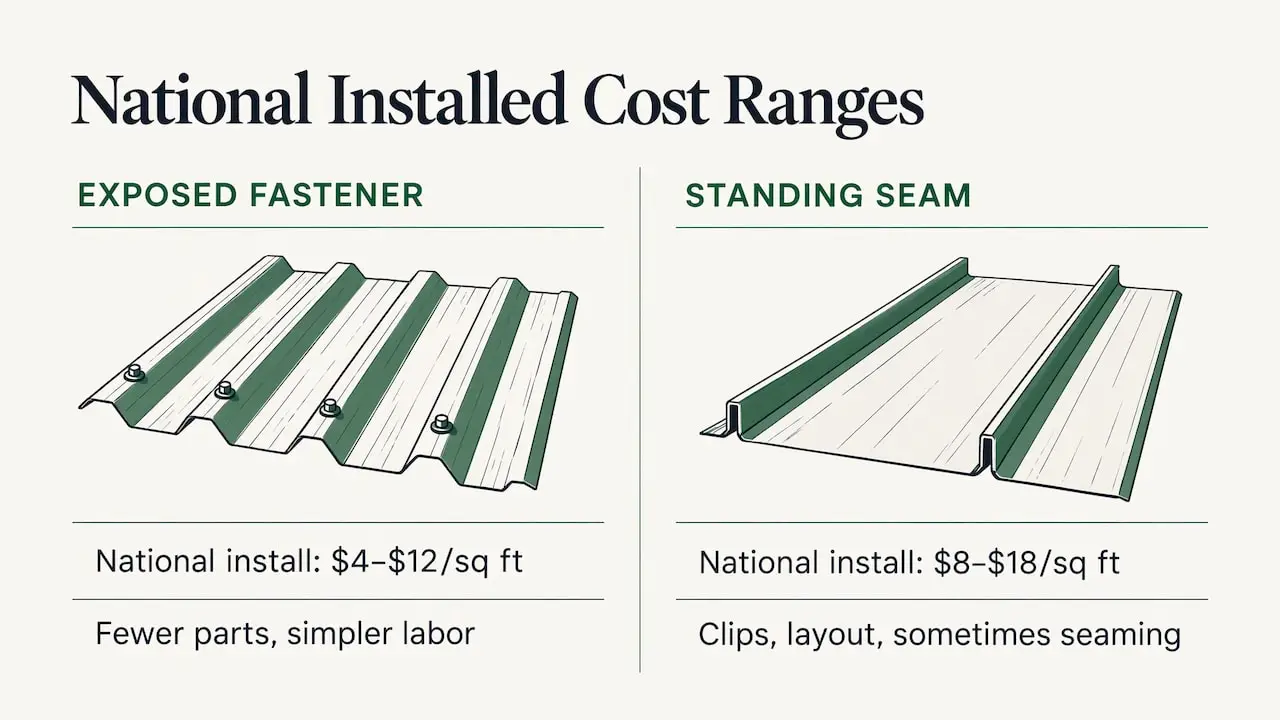
Exposed fastener is generally less expensive and faster because it uses fewer components and simpler labor. Standing seam adds panel-specific clips and clip screws, plus layout and sometimes seaming, according to SFS USA. MBCI notes that exposed fastener systems are low-cost and easy to install, while standing seam needs attention to panel alignment, engagement and squareness of the substrate.
For a sense of scale, one 2026 national guide gives indicative installed ranges of $8 to $18 per square foot for standing seam and $4 to $12 for corrugated exposed fastener. It notes that region, gauge, coating and roof complexity move those numbers. These are national figures, not Louisiana quotes. Roof shape drives price as much as panel type. A cut-up roof with valleys, dormers and a chimney costs more per square foot than a simple gable, whichever system you choose.
We publish no flat price for either, because a fair number only comes after someone looks at your roof. A written estimate from us lists the panel system, the underlayment, the flashing and the warranty terms, so you can compare line by line.
Leaks and maintenance: where water gets in
This is where the two systems separate most.
An exposed fastener roof relies on a washer at every screw. Metal expands and contracts with temperature, and that movement stresses the screws and washers. Metal America reports that UV exposure, temperature swings and freeze-thaw cycles speed up gasket wear, so periodic inspection and re-fastening may be needed. Leaks on these roofs most often start at backed-out screws or failed washers.
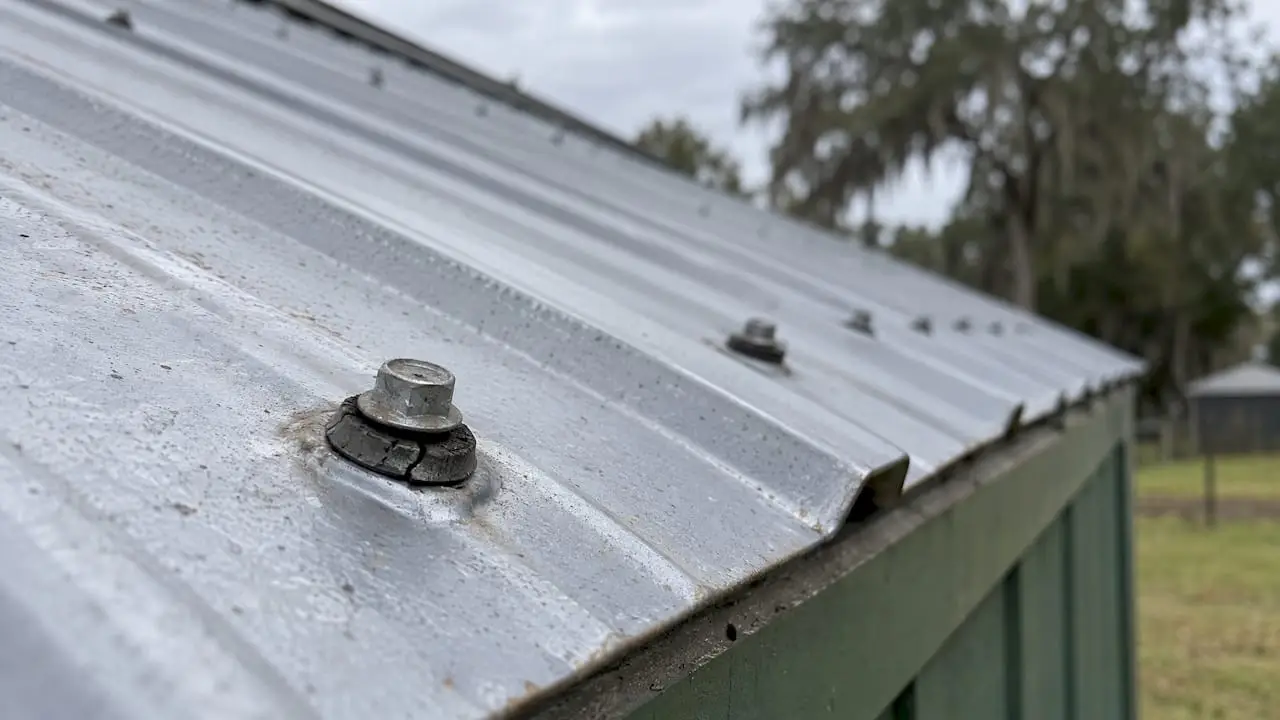
The screws are also in the path of the metal’s movement. Panels can expand and contract roughly 3/4 inch over a 40-foot length, and screws through the face restrict that movement. Clips on a standing seam roof let the panel slide instead. MBCI describes the clip design as letting the panel move independently of the substrate, which supports panel durability on large roof surfaces.
Do standing seam roofs leak?
They can. Leaks on a standing seam roof tend to show up at seams, terminations and flashings rather than in the field of the panel. The AIA and FEPFA design guide on standing seam lists poor detailing, failed closures, lap seams, through-fasteners and inadequate seam-sealant isolation as leak concerns. It also points to ASTM and AAMA test methods for checking performance.
So the panel is only part of the answer. Chimneys, valleys, wall tie-ins and penetrations decide whether a standing seam roof stays dry. That is why we treat metal roof flashing as a core part of every metal job, and why seam experience matters when you choose a crew.
Maintenance you should expect
With exposed fastener, plan on checking screws and washers on a schedule, and after major storms. With standing seam, the routine is lighter: keep debris off, check flashings and sealant at terminations, and look at the seams. Our metal roofing maintenance tips cover what to look at and how often. A roof inspection from us after hurricane season is an easy way to catch small problems before they reach the deck.
Wind and storm performance
Baton Rouge sits in hurricane country, so wind rating matters more here than in most of the country.
One Gulf Coast metal roof survey reports the lowest failure rates for mechanically locked standing seam. It reports more snap-lock failures at corners and edges, and pull-through failures in exposed fastener panels. It gives approximate, non-laboratory failure thresholds by assembly:
| Assembly (example from the survey) | Approximate failure threshold |
|---|---|
| 24-gauge mechanically locked standing seam | 150 to 180+ mph |
| 24-gauge snap-lock standing seam | 120 to 140 mph |
| 26-gauge exposed fastener | 110 to 130 mph |
| 29-gauge exposed fastener | 80 to 100 mph |
Treat these as field-style estimates for specific assemblies, not guarantees. Allowable uplift pressures are tied to the full assembly. Petersen’s ICC-ES report says uplift values are assembly-specific, and the deck and framing must be designed separately for the wind loads on the building. S-5! also cautions that exposed fastener performance depends on the profile and its testing, and that holes and installation errors can reduce it.
The practical takeaway: ask for the tested assembly, the gauge, the clip or fastener spacing and the deck attachment, not just “metal roof, 120 mph.” If a storm has already hit your roof, our storm damage restoration team handles tarping and repair.
Lifespan
Service life depends on gauge, coating, climate and upkeep. One 2026 guide puts typical ranges at about 40 to 70 years for standing seam and 20 to 50 years for corrugated. Read these as ranges, not promises. Our own commitment is a five-year workmanship warranty on the installation we do. Manufacturer coating and panel warranties are separate documents, so ask for both in writing.
Side-by-side comparison
| Factor | Exposed fastener | Standing seam |
|---|---|---|
| Fasteners | Screws through the panel face, visible | Concealed clips, none in the roof field |
| Upfront cost | Lower | Higher |
| Installation | Faster, simpler | More technical: seams, clips, alignment |
| Thermal movement | Screws restrict panel movement | Clips let panels slide |
| Maintenance | Periodic screw and washer checks | Lighter, focused on seams and flashings |
| Minimum slope | Not below 3:12 | Can go as low as 1:12 with butyl sealant |
| Common fit | Barns, sheds, workshops, outbuildings | Homes, low-slope sections, high-wind areas |
The slope figures come from Western States Metal Roofing. The “common fit” row reflects The Roofing Brief’s guidance. Exact slope limits come from the manufacturer’s instructions and local code, so confirm them for your product.
Which one fits your Louisiana roof
Choose standing seam if
- It is your home and you plan to stay for years.
- Your roof has low-slope sections or complex flashing areas.
- You want the fewest possible penetrations through the hurricane and thunderstorm seasons.
- You want a cleaner look with less ongoing screw maintenance.
Exposed fastener can work if
- The building is a barn, shed, workshop or similar outbuilding.
- The budget is tight and the roof is simple, with a steep enough pitch.
- You will commit to regular screw and washer checks.
Louisiana adds a few local pressures. Summer heat and strong sun mean large daily temperature swings in the metal. Humidity and heavy rain make any weak point show up fast. Color and coating also matter for heat, which is why we wrote about metal roofing colors in Louisiana heat and metal roof coatings in Baton Rouge. For a closer look at attachment, see our guide to metal roof fasteners and performance.
Installation details that decide the outcome
Standing seam is a more technical install. Seam alignment, clip spacing and panel expansion all have to be right, so the installer needs real standing seam experience. Ask any contractor how many standing seam roofs the crew has finished, and how they detail chimneys, valleys and wall transitions.
Decking matters too. For Petersen’s standing seam assemblies, the solid deck must be at least 15/32-inch plywood or lumber sheathing, or 7/16-inch non-veneer APA-rated OSB. Underlayment and flashing must comply with code. Other manufacturers have their own requirements, so the product’s installation instructions rule. On a re-roof, we check the deck before panels go on, because hidden rot found later is a bigger problem than rot found now.
For slope, one 2026 guide summarizes the 2021 International Residential Code: lapped nonsoldered metal roofs generally need 3:12 without lap sealant, can use 1/2:12 with properly applied sealant, and standing seam systems may reach 1/4:12. It adds that product instructions and local code control. Your parish or city building office has the final say on what applies to your address.
Our metal roof installation guide walks through the process from tear-off to final inspection.
Our perspective
We have more than 25 years of roofing experience in Baton Rouge, and we have watched what Louisiana weather does to roofs. Heat, UV, driving rain and tropical storms all test attachment points first.
That is why we recommend standing seam for most homeowners who want a metal roof that lasts. Concealed clips let the panels move with the temperature, and there are no screw heads in the roof field to loosen or lose a washer. The result is a roof with fewer places for water to get started.
We also know a roof is only as good as its details. That is why we put as much care into flashing, underlayment and decking as into the panels. We give you an honest assessment and a clear written scope, with no pressure, and our work carries a five-year workmanship warranty.
If an exposed fastener panel suits a shed or outbuilding on your property, we will tell you plainly what to expect from it and how to look after it.
Talk to us about your roof
If you are weighing a metal roof, we can look at your roof and explain what each system would mean for your house, with clear communication and no pressure. Start with a roof inspection, or see our standing seam metal roof installation in Baton Rouge. Business owners can explore commercial roofing and metal roofing.
If your current roof is leaking or storm damaged, our roof repair team can respond, and our residential roofing crew handles full replacements.
FAQ
Is standing seam better than exposed fastener?
For most homes in Louisiana, yes. Standing seam has concealed fasteners, allows panels to move with temperature, and has fewer leak points in the roof field. It costs more up front and needs a skilled installer. Exposed fastener remains a practical choice for simple outbuildings.
Is standing seam the same as snap-lock?
No. Snap-lock is one type of standing seam, with panels that press together. Mechanically locked standing seam has seams that are crimped closed with a tool. Petersen’s ICC-ES report treats them as distinct profiles.
How does standing seam compare with corrugated metal?
Corrugated is an exposed fastener panel, screwed through its face. It generally costs less and goes up faster. Standing seam hides its fasteners and is commonly chosen for homes and high-wind areas, while corrugated is common on barns and workshops.
Can a metal roof go directly over plywood?
Metal roofs are installed over solid decking with underlayment, and the manufacturer sets the requirements. One standing seam assembly calls for at least 15/32-inch plywood or 7/16-inch non-veneer APA-rated OSB, plus code-compliant underlayment. We inspect the deck before installation.
Why is standing seam so expensive?
It takes more components, including clips and clip screws, and more skilled labor for layout and seaming. Panels are also often made in heavier gauges. You pay more at the start and get a system designed to need less attention later.
Sources
- Sheffield Metals: standing seam vs exposed fastener
- Metal Sales: exposed fastener vs standing seam panels
- SFS USA: exposed vs concealed roofing screws
- MBCI: metal roofing installation methods
- The Roofing Brief: standing seam vs corrugated
- The Roofing Brief: metal roof leak repair
- Metal America: standing seam vs exposed fastener
- RoofQuotes: standing seam installation guide
- AIA and FEPFA: standing seam design considerations
- Gulf Coast Metal Roof Guide: hurricane performance
- Petersen Aluminum ICC-ES ESR-4173
- S-5!: standing seam vs exposed-fastened roofs
- Western States Metal Roofing: pros and cons
- Indiana Metal: standing seam vs exposed fastener
Recommended
- Metal Roof Fasteners & Performance in Baton Rouge
- Best Standing Seam Metal Roof Installation Baton Rouge, LA
- Metal Roofing Hail Resistance Louisiana Performance
- Standing Seam vs Corrugated Metal Roofing: Which Is Better?
Related reading: