An infrared roof scan uses a thermal camera to find areas of a roof that hold or release heat differently, which often points to trapped moisture in the insulation underneath. It works best on low-slope and flat commercial roofs, it is done at night after a sunny, dry day, and it only tells you where to look. A core sample or moisture probe still has to confirm what the camera suggests. Below, we explain how a scan works, what Louisiana weather does to it, what the report can and cannot tell you, and what drives the cost.
TL;DR
- An infrared roof scan maps temperature patterns across a roof. Wet insulation holds heat longer after sunset, so it shows up as a warm area on the image.
- The best results come from a clear, dry, low-wind night after a hot, sunny day. Humid Gulf Coast weather can shorten the usable window.
- A scan finds suspected wet insulation. It does not show the leak’s source or the condition of the membrane, and the findings must be verified with cores or moisture probes.
- Scans suit flat and low-slope roofs with insulation under the membrane. Ballasted and highly reflective roofs need other methods.
- Cost depends mainly on roof size, complexity and access, so ask for a written scope before you compare quotes.
Table of Contents
- What an infrared roof scan actually shows
- How a scan is performed
- Weather that makes or breaks the results
- What a scan can reveal, and what it cannot
- Roofs where infrared works poorly
- When an infrared moisture survey makes sense
- How to read an infrared scan report
- What affects the cost of an infrared roof scan
- Our perspective on infrared scans
- Talk to us about your roof
- FAQ
- Sources
What an infrared roof scan actually shows
A roof is a layered system: a membrane on top, insulation below it, then the deck. When water gets into that insulation, it changes how quickly the layer heats and cools. During the day the sun heats the whole roof. After sunset, wet insulation keeps its heat longer than dry insulation, so the wet areas read warmer on the thermal image. That is the principle behind the NAIS roofing standards of practice for infrared surveys.
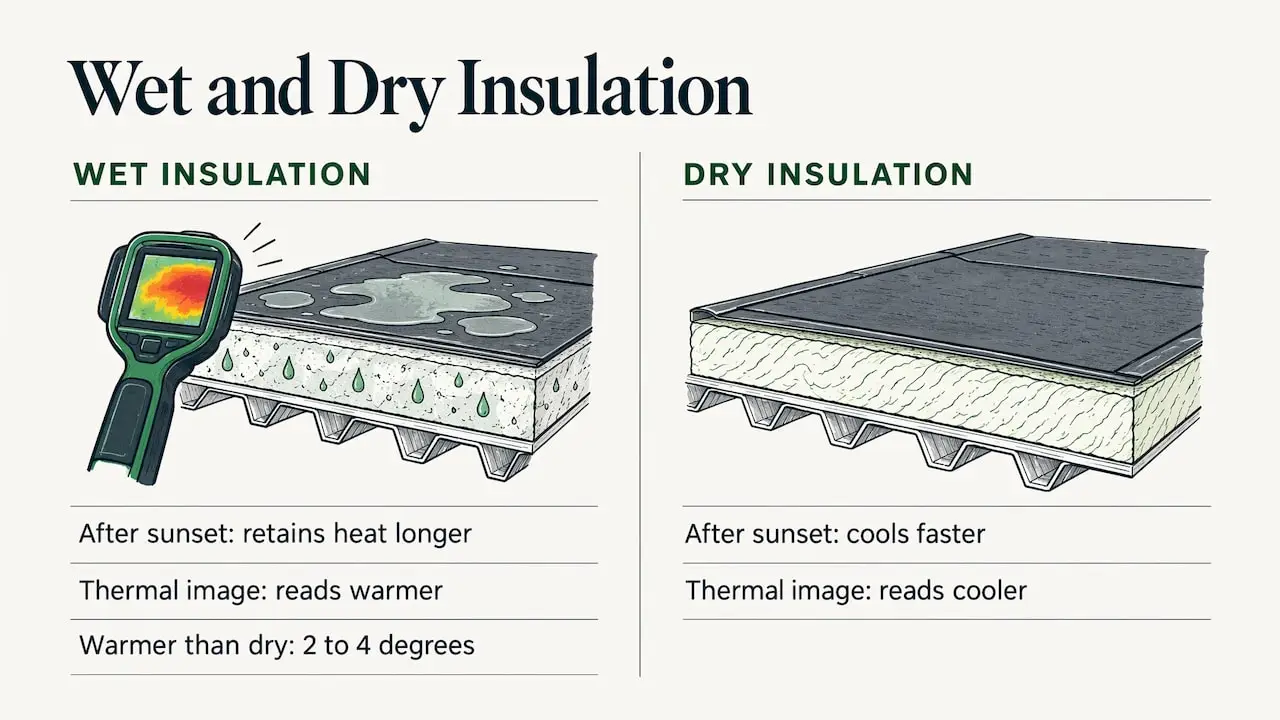
The differences are small. According to IKO’s guidance on thermal imaging for commercial roofs, the gap between wet and dry roofing material may be only 2 to 4 degrees, which is why the camera has to be very sensitive and the person reading it has to be trained.
The same page notes that other things can look warm without being wet. Rooftop HVAC equipment and drains on flat roofs are common examples. A good thermographer walks the roof, marks every anomaly and rules out those other causes before calling anything suspected moisture.
Thermal imaging, infrared inspection, moisture survey: same thing?
You will see several names for closely related work: infrared roof inspection, thermal imaging roof inspection, infrared roof moisture survey. In practice they describe the same method, a thermal camera used to locate suspected wet insulation. What differs is how the camera is carried: by a person walking the roof, from the ground, or on a drone. ASTM C1153-23, the standard practice for locating wet insulation with infrared imaging, covers both ground-based and aerial inspections.
How a scan is performed
The process follows a fairly standard order, and knowing it helps you judge a proposal.
- Planning and roof review. The inspector reviews the roof type, age, drawings if they exist and any known leak history.
- Daytime heating. The roof needs strong sun and has to stay dry. Per the NAIS standard, the roof must be dry through the preceding daytime and the sun strong enough to heat it.
- The night survey. The scan is conducted 1 to 4 hours after sunset on a clear, low-wind night, per NAIS.
- Grid or lane coverage. The operator covers the roof in a grid or marked lanes so nothing is skipped.
- Marking anomalies. Warm patterns are marked on the roof and photographed in thermal and visible light.
- Report. A usable report includes a roof plan showing where each anomaly sits. If the weather did not heat the roof properly, the report should say how that affects the results.
- Verification. Cores or probes are taken at selected points to confirm.
The last step is not optional, and we come back to it below.
Weather that makes or breaks the results
A thermal camera is only as good as the conditions. Sources agree on the basics, with small differences in the numbers:
| Condition | What the guidance says |
|---|---|
| Timing | 1 to 4 hours after sunset (NAIS) |
| Wind | Below 15 mph (InterNACHI) |
| Sky | Sunny and clear the day before, with a quick drop in air temperature before imaging (InterNACHI) |
| Roof surface | Dry, with no standing water, dew, frost, ice or snow, and no rain on the inspection day (one published inspection procedure) |
| Daytime high | Above 40°F in that same procedure |
The same sources note that a night with an indoor-to-outdoor temperature difference of at least 10°C (18°F) can substitute when the sun has not done its job, because heat then moves through wet insulation faster. That is more of a cold-season workaround than a Louisiana one.
If you are planning a night survey, the crew also needs to work safely on a dark roof. A rooftop safety guide for working at heights covers the precautions that apply to anyone on a roof after dark.
What this means in Louisiana
None of the guidance above is written for the Gulf Coast, so here is how we read it for roofs around Baton Rouge.
- Frequent rain. The roof has to be dry through the preceding daytime. After one of our regular afternoon storms, or a tropical system, a roof can stay damp long enough to ruin a scan. Scheduling around the forecast, with a few dry sunny days behind you, matters more here than in a drier climate.
- Humidity and dew. Heavy evening dew is a real issue in our climate. Dew on the surface is one of the conditions to avoid, so surveys are timed to dry, clear nights.
- Strong sun. Long, hot, sunny days heat a roof well, which helps the method. The challenge is usually moisture on the surface, not too little heat.
- After a storm. Scans are most useful once the roof has dried, not the night after the water hits. Right after a storm, the first job is stopping water entry, which is what roof tarping and storm damage restoration is for.
For more on how heat affects flat roofs in our region, see our guide to commercial flat roof heat damage in Louisiana.
What a scan can reveal, and what it cannot
The most common misunderstanding about infrared roof leak detection is that the camera finds the leak. It finds suspected wet insulation. Those are related but not identical.
What it can do
- Show the extent and pattern of wet insulation across a large roof in a short time
- Help you target the few spots that need cores, rather than cutting at random
- Give you a map you can compare year to year
- Help you decide between a localized repair and a bigger project, once verified
What it cannot do
The NAIS standard excludes from an infrared survey any roof condition or warranty evaluation, leak-source identification beyond suspected moisture, structural evaluation and the design of repairs. A 1988 guide on infrared inspections makes the same point: opinions about leak sources and membrane integrity need skills beyond thermography. Water can travel along a deck or through insulation before it drips inside, so the wet area can sit well away from the actual opening.
Verification is part of the job
ASTM C1153 calls for anomalies that suggest wet insulation to be verified by cores, or by cores combined with moisture-meter probes. Nuclear and capacitance meters can complement that work but not replace it, as summarized in Professional Roofing’s article on surveying roof moisture. A federal research report from 1981 reached a similar conclusion: cores at selected points are needed to confirm what non-destructive methods suggest.
This is what protects you from unnecessary work. The same Professional Roofing article warns that moisture-meter technology used without following standards can produce false positives, and false positives can lead to roofing material being removed that did not need to be. If you want to understand how direct testing and attic-side checks fit into a repair decision, this overview of spotting insulation problems in a home is a helpful companion.
Roofs where infrared works poorly
Not every roof suits a thermal scan. According to Building Enclosure’s article on moisture surveys:
- Infrared cameras cannot see through roofing covered in rock ballast, the 1 to 1.5-inch stones used on some flat roofs.
- Newer reflective membranes and coatings are poor emitters of infrared radiation, so highly reflective roofs need nuclear or capacitance methods.
- Every non-destructive technique can produce both false positives and false negatives, and many roof assemblies call for nuclear or capacitance instruments to get a reliable result.
ASTM C1153 also scopes the method to roofs with insulation above the deck, in contact with the waterproofing. A roof with a different build-up may need a different approach. This matters in Louisiana, where many commercial buildings carry white or reflective single-ply membranes such as TPO to fight heat. If that describes your roof, ask what method will be used before you agree to a night survey. Our guides to commercial flat roofing types and the best materials for commercial roofing explain how these systems differ.
When an infrared moisture survey makes sense
Consider a scan when:
- You manage a commercial or multi-family building with a flat or low-slope roof and want to know whether insulation is wet before budgeting for repair or replacement.
- Interior stains keep returning and visual checks have not located the entry point.
- The roof has been through a major storm and has dried out, but you suspect water got under the membrane.
- You are buying a building and want a clearer picture of roof condition than a walk-over gives. Our commercial roof inspection guide for Louisiana investors covers that situation.
- You want a baseline to track roof health over time as part of a maintenance plan.
The stakes are real. InterNACHI ties premature roof failure to moisture intrusion and undetected wet insulation. Finding wet areas early can mean replacing a section instead of the whole roof, once the findings are verified.
For a typical pitched shingle roof on a house, a scan is rarely the first step. Those roofs usually have ventilated attics and no insulation sitting directly under the covering, so a careful hands-on inspection of flashing, penetrations, shingles and the attic is usually more informative. Our roofing inspection guide for homeowners and annual roof inspection checklist describe what that covers.
How to read an infrared scan report
When the report arrives, look for these items:
- A roof plan with each anomaly located and numbered.
- Paired images, thermal and ordinary photos of the same spot.
- The conditions on the night: date, wind, sky, and any comment on how well the roof heated.
- Other causes ruled out, such as equipment, drains or surface debris.
- A recommendation for verification, with core or probe locations.
- A clear statement of scope, so you know the scan is not a warranty evaluation or a repair design.
Then follow the order that protects your budget: scan, verify, decide. Do not approve removal of insulation based on the thermal images alone. After cores confirm wet insulation, the repair plan can be written around real findings. Depending on the result, that might be sealing a flashing, replacing a limited section or planning a full re-roof. Our guide to commercial roof leaks and what to do about them walks through the common causes.
What affects the cost of an infrared roof scan
We do not publish a price for scans, because the cost turns on the roof, not a flat rate. The factors that move a quote are:
- Roof size. More area means more survey time and more image analysis.
- Complexity. Many penetrations, parapets, levels and equipment slow the walk and the interpretation.
- Access and safety needs. Night work on a roof with limited access takes more planning.
- Method. Walking, ground-based and drone surveys differ in setup and coverage.
- Verification. Cores and probe readings are typically separate from the scan itself, and the number needed depends on how many anomalies appear.
- Weather rescheduling. In Louisiana, a rained-out night is common, so ask how rescheduling is handled.
When comparing proposals, compare scopes, not just totals. Ask whether the price includes a roof plan, a written report, verification and a rain date. A low number that leaves out those items is not lower.
Our perspective on infrared scans
We have been working on Louisiana roofs for over 25 years, and the lesson that repeats is simple: water finds the path you did not expect. A stain on a ceiling is the end of the story, not the beginning. That is why we favor honest assessments over quick answers.
Infrared is a good tool when it is used for what it does well. On a large flat roof, it can narrow a hard search down to a handful of spots. But we do not treat a thermal image as a verdict. We want to see the roof, understand how it was built and confirm suspected moisture before anyone talks about tearing out material.
Our customers tell us they value clear communication and pricing without pressure, and that shapes how we handle findings. We explain what we see, what we do not yet know and what the options are, from a targeted repair to a full replacement. Our work is backed by a five-year workmanship warranty, so we would rather recommend the smallest fix that solves the problem properly.
Louisiana adds its own demands: heat, humidity, heavy rain and named storms. A roof here has to do more, so we look at the whole system, not one image.
Talk to us about your roof
If you manage a commercial building, or you have a roof with leaks you cannot trace, we can help you work out whether a thermal scan is the right first step or whether a hands-on inspection will answer the question faster. We offer free inspections that help identify problems before they escalate, and we repair, restore and replace roofs across the Baton Rouge area.

Start with our roof inspection service, or see our commercial roofing services for maintenance, metal roofing and flat roof TPO. If water is coming in now, our emergency roof repair team can help stop it. We also have a guide to thermal imaging roof inspections in Louisiana.
FAQ
Can an infrared scan find the exact spot a roof leaks?
Not reliably. It shows patterns that suggest wet insulation, and water often travels before it shows up inside. The NAIS standard excludes leak-source identification beyond suspected moisture from the survey. Finding the opening takes a hands-on inspection of seams, flashings and penetrations.
When is the best time to do a thermal roof scan in Louisiana?
Choose a clear, low-wind night 1 to 4 hours after sunset, following a hot, sunny and dry day. The roof must be dry the whole day before. Because of frequent afternoon storms and evening dew, expect to reschedule if conditions slip.
Does an infrared scan work on every roof?
No. Rock-ballasted roofs block the camera, and highly reflective membranes emit poorly, so those roofs need nuclear or capacitance methods instead. The method is best suited to roofs with insulation directly under the waterproofing layer.
Do I still need core samples after a scan?
Yes. ASTM C1153 calls for verification by cores, or cores with moisture-meter probes, before repair or replacement is recommended. This keeps you from paying to remove dry material that only looked warm.
Is a scan worth it for a house?
Usually a thorough hands-on inspection is the better first step for a pitched shingle roof. A scan makes more sense for flat or low-slope roofs with insulation under the membrane, which are more typical of commercial and multi-family buildings.
Sources
- Commercial Roofing Standards of Practice (RoofSOP), NAIS
- ASTM C1153-23, Standard Practice for Location of Wet Insulation in Roofing Systems
- IR Cameras: Inspecting Roofs, InterNACHI
- Using Thermal Imaging Cameras to Detect Commercial Roof Leaks, IKO
- Conducting a Roof Moisture Inspection using Infrared Thermography
- Using an IR-InSight to do an infrared roof inspection
- Surveying roof moisture, Professional Roofing
- Moisture detection in roofing by nondestructive means, NIST
- Performing infrared inspections, AIVC
- Moisture Surveys and Roofing Forensics, Building Enclosure