For most Louisiana homes, 26 gauge is the standard metal roofing thickness, and 24 gauge is the step up for standing-seam systems, commercial buildings and roofs that need extra stiffness. Gauge is a thickness number, and a lower number means thicker steel. So 24 gauge is thicker than 26, and 26 is thicker than 29. The right choice depends on the panel profile, the roof deck, your wind exposure and your budget, not on the number alone.
TL;DR
- Lower gauge number, thicker steel: 22 is heavier than 24, 24 is heavier than 26, and 26 is heavier than 29.
- 26 gauge is the common residential choice. 24 gauge is common for standing seam and commercial work.
- Moving one gauge thicker typically adds roughly 8 to 15 percent to the panel material cost, before installation.
- Gauge is only one part of performance. Coating, finish, panel profile, fasteners and installation matter just as much in Baton Rouge weather.
- Careful foot traffic is possible on many panels, but it depends on the profile, the deck and whether the surface is dry.
Table of Contents
- What metal roof gauge actually means
- 24 gauge vs 26 gauge: the decision most people face
- What does the extra thickness cost?
- How to choose the right gauge for a Louisiana roof
- 26 gauge vs 29 gauge: which is thicker?
- Can you walk on a 26-gauge metal roof?
- Questions to ask before you sign
- Protecting the gauge you choose
- Get a metal roof recommendation for your property
- FAQ
- Sources
What metal roof gauge actually means
Gauge is a sheet-metal thickness designation. The Metal Construction Association’s installation manual explains that a lower gauge number means thicker material, and it lists common metal roofing gauges from 20 through 29. The exact thickness behind each number varies with the type of metal, so a gauge number on steel does not match the same number on aluminum.
That backwards numbering trips up a lot of homeowners. A quote that says 29 gauge is not a premium upgrade over 26 gauge. It is the thinner product.
Gauge thickness at a glance
Published figures differ a little by manufacturer because coatings and paint add to the measured thickness, and because nominal and minimum thickness are not the same thing. A minimum is a floor. A nominal thickness allows a stated tolerance around a target, as one panel manufacturer explains. Gauge is checked with a micrometer.
| Gauge | Typical use | Published thickness |
|---|---|---|
| 22 | Heavy-duty commercial, mechanically seamed systems | Thicker than 24 |
| 24 | Standing seam, commercial, high-wind projects | About 0.023 inch minimum |
| 26 | Residential, exposed-fastener and many standing-seam roofs | About 0.018 inch minimum (Sheffield); other manufacturers list about 0.017 to 0.020 inch |
| 29 | Light-duty, agricultural, economical through-fastened roofing | Roughly 0.014 to 0.018 inch range |
The 24 and 26 minimums come from Sheffield Metals, which puts 24 gauge about 27.8 percent thicker than 26. The 26 and 29 ranges come from a panel manufacturer’s gauge guide, which notes the variation from metallic coating and paint.
24 gauge vs 26 gauge: the decision most people face
These are the two gauges that come up for nearly every Louisiana home and small commercial building. Here is how they compare.
| Factor | 24 gauge | 26 gauge |
|---|---|---|
| Thickness | Thicker, heavier | Slightly thinner, lighter |
| Stiffness | Generally stiffer, resists denting and bending | Strong for typical residential spans |
| Handling | Less prone to damage on site, though heavier to move | Easy to handle and install |
| Typical use | Standing seam, commercial, extreme-weather projects | Residential, exposed-fastener, agricultural, some standing seam |
| Material cost | Higher | Lower |
Sheffield describes 24 gauge as standard for many standing-seam systems and often used on commercial or extreme-weather projects, while 26 gauge is standard for exposed-fastener roofing and often used on homes. It also notes the thicker panel is generally more resistant to denting, bending, handling damage and visible oil canning.
Oil canning is the slight waviness you can sometimes see in flat areas of a metal panel. Heavier gauges generally reduce it, according to another panel manufacturer. If you have a large, flat, sunlit roof plane and the look matters to you, that is a real reason to look at 24 gauge.
Is 26 gauge enough for a house?
For most residential roofs, yes. A trade publication on residential steel notes that single-family homes have historically used 26 gauge, and that a properly installed 26-gauge standing-seam roof is generally adequate in ordinary residential conditions. Homes typically have solid plywood or OSB sheathing under the metal, which supports the panel and takes the structural span out of the equation. The same source says severe coastal or marine exposure and other special circumstances may justify 24 gauge.
That last point is worth a thought on the Gulf Coast. A home in a tree-heavy neighborhood, or one rebuilt after storm damage, may be a candidate for the heavier panel. We look at each roof before recommending one.
What does the extra thickness cost?
Heavier steel costs more. Sheffield reports 26-gauge Galvalume coil or sheet at about 8 to 15 percent less than 24 gauge, and that figure covers the material only, not installation or other project costs. A second manufacturer gives roughly 15 percent as a rule of thumb between adjacent gauges.
Two things follow from that:
- The panel is only part of a roof replacement bill. Underlayment, flashing, trim, fasteners, tear-off, deck repairs and labor all sit on top of it, so a one-gauge step moves the total by less than the panel percentage suggests.
- The cost of the heavier gauge is a one-time cost, while the benefits (stiffness, fewer handling dents, a flatter look) stay with the roof for its whole life.
We do not publish set prices because every roof is different in size, pitch, deck condition and detail work. We give written, itemized estimates after an inspection.
How to choose the right gauge for a Louisiana roof
Gauge selection is an engineering and budget decision. One manufacturer’s guidance lists appearance, cost, loads, dead load, testing, roof structure, inventory and environment as factors. Here is how those play out for roofs in and around Baton Rouge.
Wind and storm exposure
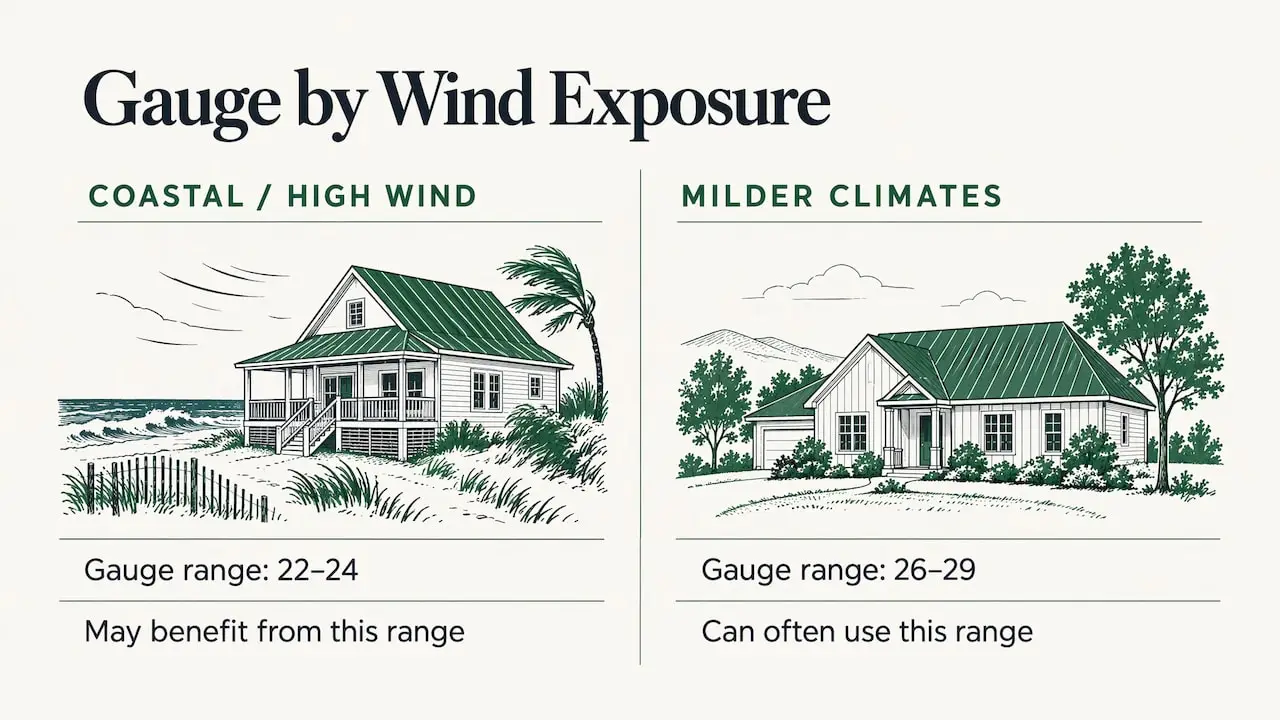
Hurricane season is the biggest design question for a Louisiana roof. Manufacturer guidance says coastal and high-wind areas may benefit from 22 to 24 gauge, while milder climates can often use 26 to 29 gauge. Inland Baton Rouge is not the open coast, but straight-line winds, tornado-producing storms and tropical systems all stress a roof.
The selected gauge should be checked against the panel manufacturer’s published load tables and the building documents. The same guidance warns against assuming that heavier gauges of the same profile always carry more load without the data. For a deeper look at wind performance, see our guide to wind-resistant roofing materials for Louisiana homes.
Hail and falling limbs
Hail is less common here than in the Plains, but it happens, and oak and pine limbs come down in every big storm. A thicker panel is less susceptible to kinks, dings and creases, and the same trade source names large branches and hail exposure as reasons to consider heavier material. Our page on metal roofing hail resistance in Louisiana goes into this further.
Humidity, coating and finish
Baton Rouge is hot and humid most of the year, so the metallic coating and paint system protect the roof as much as the steel does. One manufacturer stresses that gauge alone does not determine performance: substrate, yield strength, metallic coating, finish system, panel geometry, testing and engineering all count. When you compare two quotes, compare the coating and finish, not just the gauge. Heat also affects color choice, which we cover in our guide to metal roofing colors for Louisiana heat.
Panel type and fasteners
Exposed-fastener panels and standing-seam panels behave differently, and so does the gauge you pair with each. Fastener selection and placement matter a great deal in heat and wind, and we explain them in our article on metal roof fasteners and performance in Baton Rouge.
Residential or commercial
Guidance from a coil coater’s specification summary describes 29 gauge as common in agricultural and light-commercial work, 26 or 24 gauge for residential roofs, and 24 or 22 gauge for commercial roofing and siding. Larger spans between supports, rooftop equipment and foot traffic all push commercial buildings toward the heavier end. If you manage a warehouse, retail center or multi-family property, our commercial roofing services include metal roofing and maintenance, and our page on industrial roofing and metal buildings covers larger structures.
26 gauge vs 29 gauge: which is thicker?
26 gauge is thicker. One manufacturer gives 26 gauge as about 0.017 to 0.020 inch and 29 gauge as about 0.014 to 0.018 inch. The ranges overlap because of coating and paint, but a 26-gauge panel is the sturdier one.
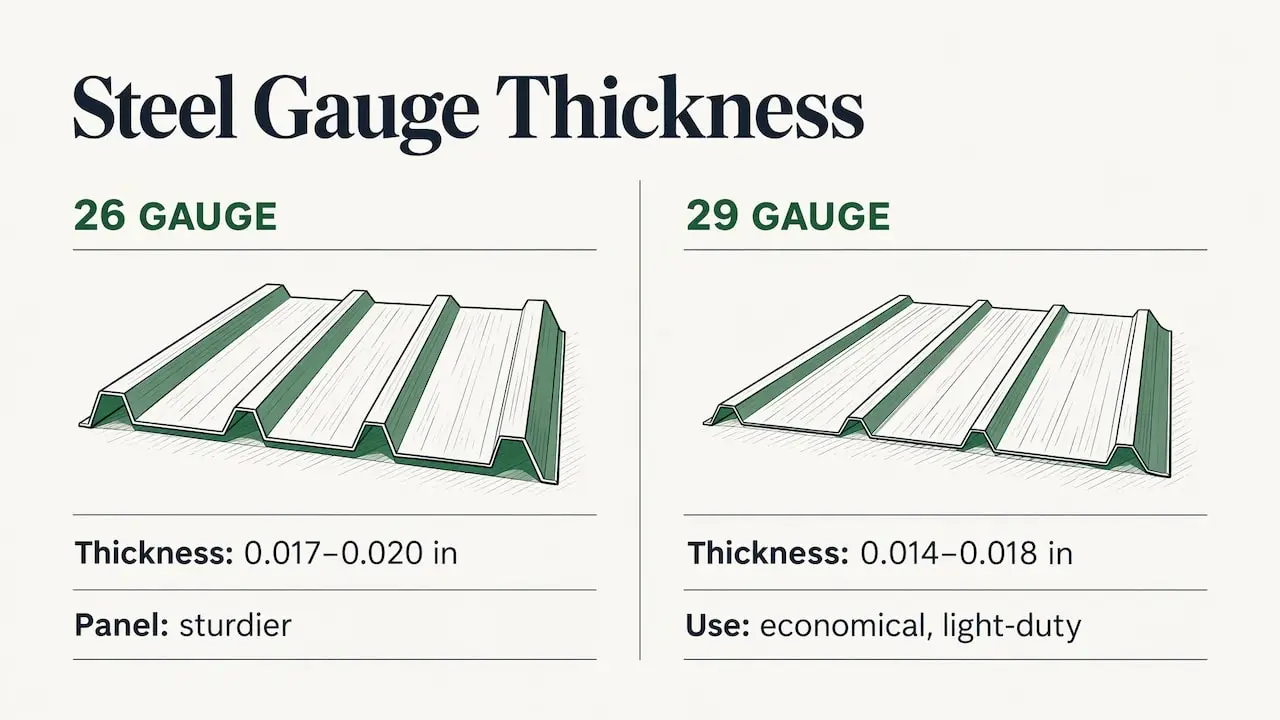
In practice that means a 26-gauge panel is less likely to pick up kinks, dings and creases during handling and installation. In buildings where panels span between supports, 24 or 26 gauge can stay structurally sound over longer spans than 29 gauge. 29 gauge is most often used for economical, through-fastened and light-duty applications. For a home in Louisiana’s storm climate, we generally point homeowners toward 26 gauge or heavier.
Can you walk on a 26-gauge metal roof?
Often yes, carefully, but the answer depends on the panel profile, what is under it and the conditions. It is not a gauge-only question.
- Standing seam: Panels lie relatively flat to the deck, and careful foot traffic while avoiding the seams is unlikely to cause significant damage.
- Ribbed through-fastened panels: A thin panel can be crushed at the rib. The same source says a 200-pound person could crush a rib on a 29-gauge through-fastened panel.
- Manufacturer instructions: One 26-gauge tile-profile system’s installation manual advises minimizing traffic, wearing rubber-soled footwear, walking in valleys or on panel steps rather than on crowns, and never walking on wet panels.
- Wet or dewy surfaces: A panel installation guide calls walking on metal roofs hazardous when wet and recommends non-slip footwear. Louisiana mornings are often damp, so this matters here.
Roofs are also falls waiting to happen, on any material. If something needs to be checked up there, leave it to a crew with fall protection. Our roof inspections keep you off the roof entirely.
Our perspective on gauge
People call us asking for a specific number, as if gauge were a score. We look at it differently. A roof is a system: the deck, underlayment, panels, coating, fasteners, flashing and the hands that install them. A thick panel fastened badly will still leak, and a well-installed panel of the right gauge can serve a home for decades.
Louisiana is hard on roofs. Heat and humidity work on coatings, tropical systems push wind under edges, and fallen limbs find the weakest spot. That is why we build our recommendations around Louisiana weather, not a generic chart.
For most homes, we start the conversation with 26 gauge and look at whether the roof, the location or the owner’s goals call for something heavier. For commercial buildings, we look at spans, equipment and traffic first. In both cases, we give you honest assessments, clear communication and no pressure, and our workmanship is backed by a five-year warranty.
With more than 25 years of roofing experience, we have learned that the best way to choose a gauge is to see the roof first.
Questions to ask before you sign
Bring these to any metal roofing estimate, ours included:
- What gauge is the panel, and is it a minimum or nominal thickness?
- What is the metallic coating and paint system?
- Which panel profile is being installed, and how will it be fastened?
- What does the manufacturer’s load data say for this profile and gauge on my roof?
- What does the workmanship warranty cover, and for how long?
- What is the full scope: tear-off, deck repair, underlayment, flashing and cleanup?
If you want a broader walkthrough, our guide to choosing a residential metal roof covers profiles, finishes and what to expect from the process, and our metal roof installation guide explains how installation works.
Protecting the gauge you choose
Even the right gauge needs care. Debris in valleys, loose fasteners, sealant wear at penetrations and scratched finishes are the usual trouble spots in our climate. Our metal roofing maintenance tips walk through a seasonal routine, and after a major storm a professional look is the safest way to catch problems early. If a storm has already hit, we handle storm damage restoration, including tarping to keep water out until permanent work starts.
Get a metal roof recommendation for your property
We serve homeowners, business owners and property managers in Baton Rouge. We inspect the roof, explain what we find in plain language and recommend a panel, gauge and system that fit your building and budget. Our roof inspections are the place to start, and if you are planning a new roof, see our roof replacement and residential roofing page.
For a commercial building, our commercial metal roofing team can walk the roof with you and review the options.
FAQ
What gauge should my metal roof be?
For most homes, 26 gauge is the usual choice, and 24 gauge is common for standing-seam systems and commercial buildings. Wind exposure, panel profile, roof structure and budget all affect the answer. We check the roof in person and recommend a gauge based on those factors.
What is better, 24 or 26 gauge?
24 gauge is thicker, stiffer and more resistant to denting and visible oil canning. 26 gauge is widely used on homes and costs less. Better depends on the roof: a large standing-seam installation or a commercial building often calls for 24, while a typical house may be well served by 26.
What is thicker, 26 or 29 gauge?
26 gauge is thicker. Published ranges put 26 gauge at about 0.017 to 0.020 inch and 29 gauge at about 0.014 to 0.018 inch. Remember that a lower gauge number always means thicker metal.
Can you walk on a 26-gauge metal roof?
Careful foot traffic is possible on many 26-gauge panels, but it depends on the profile, the support underneath and whether the panels are dry. Manufacturers advise rubber-soled footwear, stepping on supported areas and never walking on wet panels. For inspections or repairs, have a trained roofer do it.
Sources
- Metal Roof Installation Manual, Metal Construction Association
- Metal panel gauges podcast
- 24 vs. 26-gauge metal roofing
- Selecting the right gauge of metal for your next project
- 8 things to consider when selecting the gauge for metal roof and wall panels
- Making the case for using 26-gauge steel for residential roofs
- Metal roofing and siding gauge guide
- Metal roof gauge and coating basics
- Architect material specification summary
- Tile-profile metal roof installation manual
- 5V installation guide