
Most chimney leaks come from failed flashing, the metal that seals the joint where your chimney meets the roof. A lasting repair means rebuilding that seal, not smearing sealant over it. Nationally, chimney leak repair runs $200 to $3,500, depending on whether the fix is a small cap or major flashing and masonry work. In Baton Rouge, where heavy rain and hurricane winds push water sideways into every joint, we recommend a roofer inspect the chimney as soon as you see a stain, because a leak at the chimney rarely stays small.
Key Takeaways
- Flashing failure is the most common cause of chimney leaks. The fix is a proper two-layer seal of step flashing and counterflashing, not roof cement alone.
- Water stains on a ceiling are often far from the actual entry point, so trace the leak uphill from the stain before anyone repairs anything.
- Nationally, chimney leak repair costs $200 to $3,500, with labor about 60% of the bill. Flashing and mortar work sits in the middle of that range.
- Insurance generally covers sudden storm damage, not wear or long-term seepage, so document the damage and the date quickly after a storm.
- Roof cement and caulk are temporary measures. We offer free inspections and chimney leak fixes backed by a five-year workmanship warranty.
Table of Contents
- Why Chimneys Leak
- Signs Water Is Getting In Around Your Chimney
- How a Chimney Leak Is Properly Repaired
- What Chimney Leak Repair Costs
- Repair or Replace the Roof?
- Does Insurance Cover a Chimney Leak?
- Preventing Chimney Leaks Before the Next Storm
- Our Perspective
- Get a Chimney Leak Looked At
- FAQ
- Sources
Why Chimneys Leak
A chimney is a masonry tower poking through a sloped roof. Wherever two materials with different movement meet, water finds the gap. The usual suspects are below.
Failed or poorly built flashing
This Old House says its team gets more calls about leaks around chimneys than any other roof problem, and the culprit is most often the flashing. Proper chimney flashing has two layers. L-shaped step flashing is woven into the shingle courses. Counterflashing is set into the chimney’s mortar joints and folds down over the step flashing. Water that runs down the brick is shed onto the roof, not behind it.
Flashing fails when it rusts, pulls loose, or was surface-sealed with caulk instead of being built into the mortar joints. Louisiana’s heat and humidity swing the roof and the masonry at different rates, which works those joints open over the years.
Missing or damaged cricket
On the uphill side of a wide chimney, water piles up against the brick. A cricket, a small peaked structure behind the chimney, splits that flow and sends it around both sides. This Old House recommends covering a cricket with a self-adhesive rubberized-asphalt membrane and a metal cap on chimneys below the ridge. Without one, the uphill joint carries all the load.
Cracked mortar, crown or brick
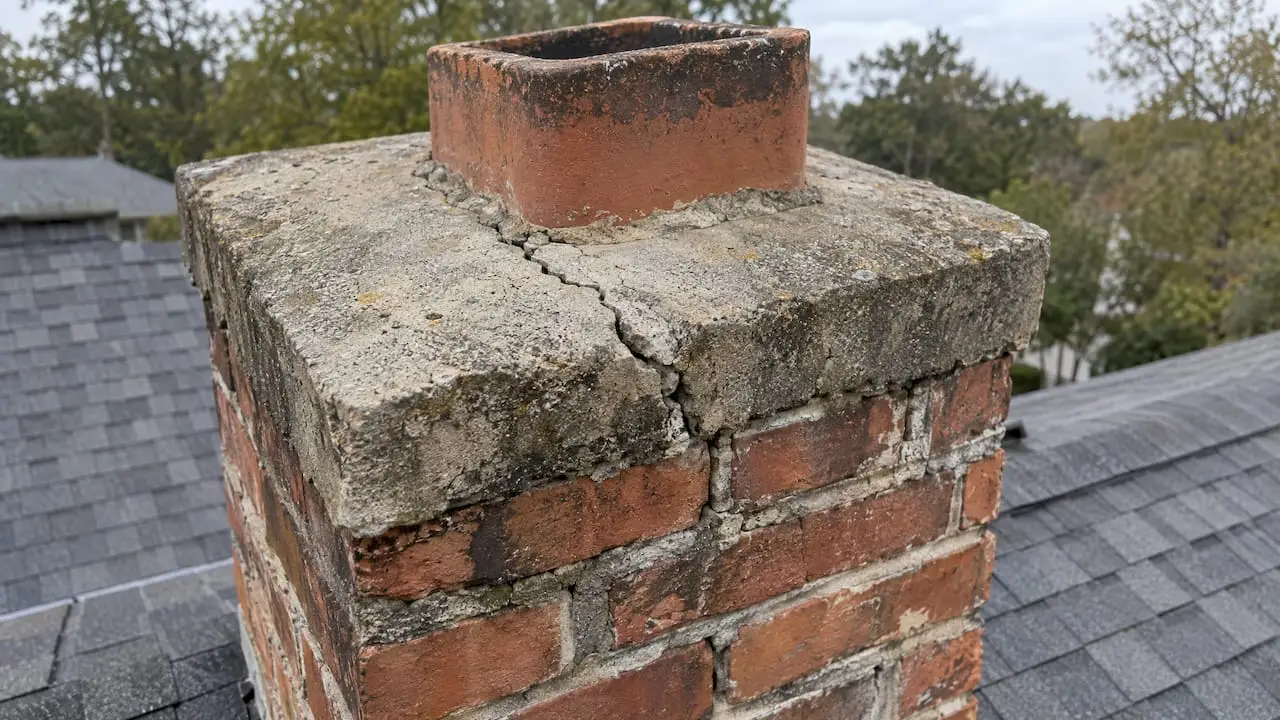
Brick and mortar are porous. Once mortar joints crack or the concrete crown on top of the chimney splits, water soaks into the masonry and can show up inside as a stain on the wall beside the fireplace, with no roof leak at all. A damaged or missing chimney cap lets rain drop straight down the flue.
Wind-driven rain
The U.S. Department of Energy notes that connecting the roof’s water control layer to the chimney’s is critical for keeping rain out during high-wind events such as hurricanes. That means base flashing sealed to the underlayment, step flashing integrated with shingles, and counterflashing embedded in the brick mortar joints, overlapping both. A chimney that stayed dry in ordinary rain can leak the first time a tropical storm blows water upward under the flashing.
Signs Water Is Getting In Around Your Chimney
Watch for these, especially after a storm:
- Brown or yellow stains on the ceiling or wall near the chimney
- Peeling paint or damp drywall next to the fireplace
- A musty smell in the attic or room around the chimney
- Rust on the damper or firebox, or white powdery deposits on the brick
- Daylight, rusty flashing or loose metal visible at the base of the chimney from the ground
- Dark spots or mold on rafters and sheathing in the attic
To find the source, take a flashlight into the attic after a rain. This Old House suggests looking for water stains, dark spots, mold or moisture trails along rafters and sheathing and following the signs uphill to pinpoint the entry point. Water often runs along a rafter before it drips, so the ceiling stain and the leak can be several feet apart. The same logic applies to any hidden leak, as this guide on tracing a leak to its source explains. Staying on the roof is unnecessary and risky: a wet, steep Louisiana roof is a fall hazard, so look from the ground and the attic.
How a Chimney Leak Is Properly Repaired
The right repair depends on where the water enters. A thorough job follows this order.
- Find the actual entry point. Inspect flashing, cricket, crown, cap and mortar joints, and check the attic for the water trail. Fixing the wrong spot is the main reason leaks come back.
- Remove failed flashing. Old step flashing and counterflashing are lifted out so the roof deck and surrounding shingles can be checked for rot.
- Rebuild the layers. New step flashing goes in with each shingle course, and new counterflashing is set into cut mortar joints and folded over it. For chimneys that need a cricket, a membrane and metal cap are installed on the uphill side. This matches the layered approach This Old House describes: membrane, metal flashing and counterflashing.
- Repair the masonry. Cracked mortar is repointed, the crown is patched or rebuilt, and the cap is replaced if it is damaged.
- Waterproof the brick if needed. This Old House recommends a breathable siloxane water repellent, since film-forming sealers can trap moisture inside the masonry.
- Check the result. The attic is inspected after the next rain, and any damaged insulation or decking is addressed.
At Stalwart Roofing, chimney leak fixes are one of the repairs we do, and each one comes with our five-year workmanship warranty. We also keep the repair explained in plain terms: what failed, why, and what we replaced.
What you can do as a temporary measure
If rain is coming and no one can reach you yet, a short-term patch limits damage. Today’s Homeowner describes inspecting the flashing, applying roof cement to gaps or cracks, reattaching loose flashing with masonry nails, and dabbing caulk on nail and screw heads. Treat this as a stopgap for a dry day with safe footing, not a repair. Roof cement over a failed joint hides the problem and can trap moisture. Inside, move belongings, put a bucket under the drip, and poke a small hole in a bulging ceiling stain to let water drain in a controlled way.
After storm damage, we also offer roof tarping and emergency roof repairs, which keep the opening covered until a permanent fix is possible. Our guide on fixing your roof temporarily goes through what holds up and what doesn’t.
What Chimney Leak Repair Costs
We don’t publish fixed prices, because the scope of a chimney repair depends on what the inspection finds. National figures give a useful frame. Fixr’s 2026 guide puts chimney leak repair at $200 to $3,500, with a replacement cap at the low end and major work on damaged brick, mortar or flashing at the high end. Labor is about 60% of the bill.
Bob Vila breaks the pieces out, with a national average chimney repair cost of $455 and these typical ranges:
| Repair | Typical national cost |
|---|---|
| Flashing repair | $200 to $300 |
| Chimney cap repair | $100 to $250 |
| Mortar or crack repair | $150 to $500 |
| Labor | $50 to $150 per hour plus a $50 to $100 base fee |
| Scaffolding (if needed) | $50 to $200 |
These are national figures from published guides, not our quotes. Four things push a job up or down:
- Severity. A resealed joint costs far less than rebuilt flashing and a new cricket.
- Roof material. Shingle, metal and tile roofs each need different flashing methods. Our page on tile roof repairs after a storm covers that material.
- Access. A tall or steep roof may need scaffolding.
- Hidden damage. Rotted decking or wet insulation around the chimney adds to the scope. Catching a leak early is the cheapest way to avoid this.
For a deeper look at the most common line item, see our chimney flashing repair cost guide.
Repair or Replace the Roof?
A chimney leak does not always mean a new roof. If the shingles around the chimney are in good shape, reflashing is usually the right scope. If the leak has soaked the decking, or the roof is near the end of its life, it can make sense to repair the chimney area as part of a larger project. Our guides on roof repair versus replacement in Baton Rouge and signs it’s time to replace your roof help you weigh that. Our inspection gives you an honest assessment of which one applies, without pressure.
Does Insurance Cover a Chimney Leak?
It depends on the cause. Insure.com explains that home insurance covers sudden, accidental damage, not deterioration, so a leak traced to a worn roof is typically denied. It also notes that some policies require annual chimney servicing to keep a wood-burning fireplace covered. In practice:
- A hurricane or windstorm that tears off flashing or drops a limb on the chimney is the kind of event a claim can follow.
- Flashing that has rusted out over a decade, or mortar that has slowly crumbled, is usually treated as maintenance.
Policy wording, deductibles and exclusions differ, so read yours and call your insurer or agent about a specific claim. Photograph the damage, note the date of the storm, and keep any receipts for temporary repairs. Our guides to roof insurance claims after storm damage and hurricane roof damage walk through the documentation.
Preventing Chimney Leaks Before the Next Storm
Louisiana’s storm season makes prevention practical, not optional.
- Schedule an annual roof inspection, and another after any major storm. Flashing is checked along with the shingles. Our page on the annual roof inspection explains what it covers.
- Keep the crown and cap intact. A cracked crown or missing cap lets rain into the flue and masonry.
- Re-waterproof brick every few years with a breathable siloxane repellent, as This Old House advises.
- Clear debris from behind the chimney and from gutters so water can drain away.
- Check the attic after heavy rain for stains, damp insulation or musty smell near the chimney.
- After a repair, look again after the next two or three hard rains. A properly rebuilt joint should leave the attic dry.
Our Perspective
We’ve spent more than 25 years working on Louisiana roofs, and the chimney is where we most often find a small problem hiding a big one. A homeowner sees a ceiling stain, a handyman puts a bead of sealant on the joint, and the stain is back after the next storm. The sealant was never the issue. The layers were.
That’s why our approach is built on a clear explanation of what failed and an honest assessment of what it takes to fix it, with no pressure to buy more than the roof needs. Reflashing done right, with step flashing, counterflashing and a cricket where the chimney calls for one, is designed to handle the wind-driven rain that Baton Rouge and the surrounding parishes get every season. We stand behind that work with a five-year workmanship warranty.
If you’re seeing a stain, start with an inspection. It’s free, and it tells you whether you need a small repair now or a plan for later.
John
Get a Chimney Leak Looked At
If water is showing up near your fireplace, our team can inspect the chimney, flashing and roof around it, find where the water is entering and fix it. We handle roof repairs, emergency repairs and tarping after storms, and chimney leak fixes for homes and commercial buildings across the Baton Rouge area. Our inspections are free, and our work carries a five-year workmanship warranty.

Book a roof inspection or request a roof repair and we’ll tell you plainly what the chimney needs.
FAQ
Why does my chimney leak only when it rains hard?
Heavy or wind-driven rain pushes water into small gaps that stay dry in light rain. Loose flashing, cracked mortar and a damaged crown are the usual openings. If it happens repeatedly, the seal between roof and chimney needs inspection.
Can I fix a chimney leak with roof cement or caulk?
Roof cement and caulk can slow a leak for a short time, and are meant as a stopgap until a roofer can do a real repair. A lasting fix rebuilds the step flashing and counterflashing, and repairs any cracked masonry. Our free inspection will show which applies.
How long does chimney leak repair take?
A small repair such as a cap or a section of mortar can often be done in a visit. Reflashing a whole chimney takes longer, and rotted decking found along the way adds time. We explain the scope after inspecting.
Is a chimney leak an emergency?
Treat active water coming in as urgent, since wet insulation, drywall and framing can lead to mold and bigger repairs. We provide emergency roof repairs and tarping to cover the area until the permanent repair is done.
Will homeowners insurance pay for it?
Insurance generally pays for sudden, accidental damage such as storm damage, not for wear or long-term seepage. Check your policy wording and contact your insurer about your specific situation.
Sources
- Leakproof Flashing, This Old House
- How To Find and Fix a Roof Leak, This Old House
- How to Find and Repair Chimney Roof Leaks, Today’s Homeowner
- Waterproofing Chimneys, U.S. Department of Energy Building Science Education
- How Much Does It Cost to Repair a Roof Leak in 2026, Fixr
- Chimney Repair Cost, Bob Vila
- Fall Home Maintenance, Insure.com
- How to Find and Fix a Water Leak in Your Home Fast