Thermal cracking, usually called thermal splitting, is a split that runs completely through an asphalt shingle because the shingle expands in heat and shrinks as it cools. It tends to show up where a shingle bridges a joint in the layer beneath it. A small number of splits can be repaired shingle by shingle. Widespread splitting across a slope usually means that slope needs replacing. If you have splits on a Baton Rouge roof, we can inspect it and tell you which of the two you have.
Key Takeaways
- Thermal splitting is a full-depth split caused by temperature-driven expansion and contraction, not by wind. It typically forms where a shingle crosses a joint in the layer below (InterNACHI).
- Weak fiberglass mat, strong sealant bonding and poor attic ventilation all add to the problem, and the hot attics common in Louisiana put heat stress on shingles.
- A split goes all the way through the shingle. A crack stays in the surface asphalt. The difference decides whether a roof needs a quick repair or a bigger job.
- Check from the ground with binoculars or a phone zoom. Do not climb onto a hot or wet roof.
- Isolated splits can be replaced or sealed. Many splits across a slope usually point to replacement.
Table of Contents
- What thermal cracking in shingles actually is
- Why shingles split: the causes
- What it means for a Louisiana roof
- How to check your roof for thermal splitting safely
- Split, crack or something else: a quick comparison
- Repair or replace: how the decision gets made
- Preventing splitting on a new or existing roof
- Perspective: why we look at the attic before we quote the shingles
- Get a clear answer on your roof
- FAQ
- Sources
What thermal cracking in shingles actually is
Asphalt shingles are a fiberglass mat coated in asphalt and covered in granules. Like most building materials, they get bigger in heat and smaller as they cool. Over thousands of daily and seasonal cycles, that movement puts stress on the shingle.
InterNACHI, the home inspectors’ association, defines thermal splitting as splitting caused by temperature-related expansion and contraction. It typically happens where shingles bridge the joints in the layer of shingles underneath. As the roof cools and shrinks, those joints widen, and the shingle above is pulled across the gap until it tears.
Two terms get mixed up, so here they are plainly:
- Split: a break that goes entirely through the shingle.
- Crack: a break limited to the asphalt surface layer.
That distinction comes from the same InterNACHI inspection guidance, and it matters because only a split opens a direct path for water.
How it differs from other shingle damage
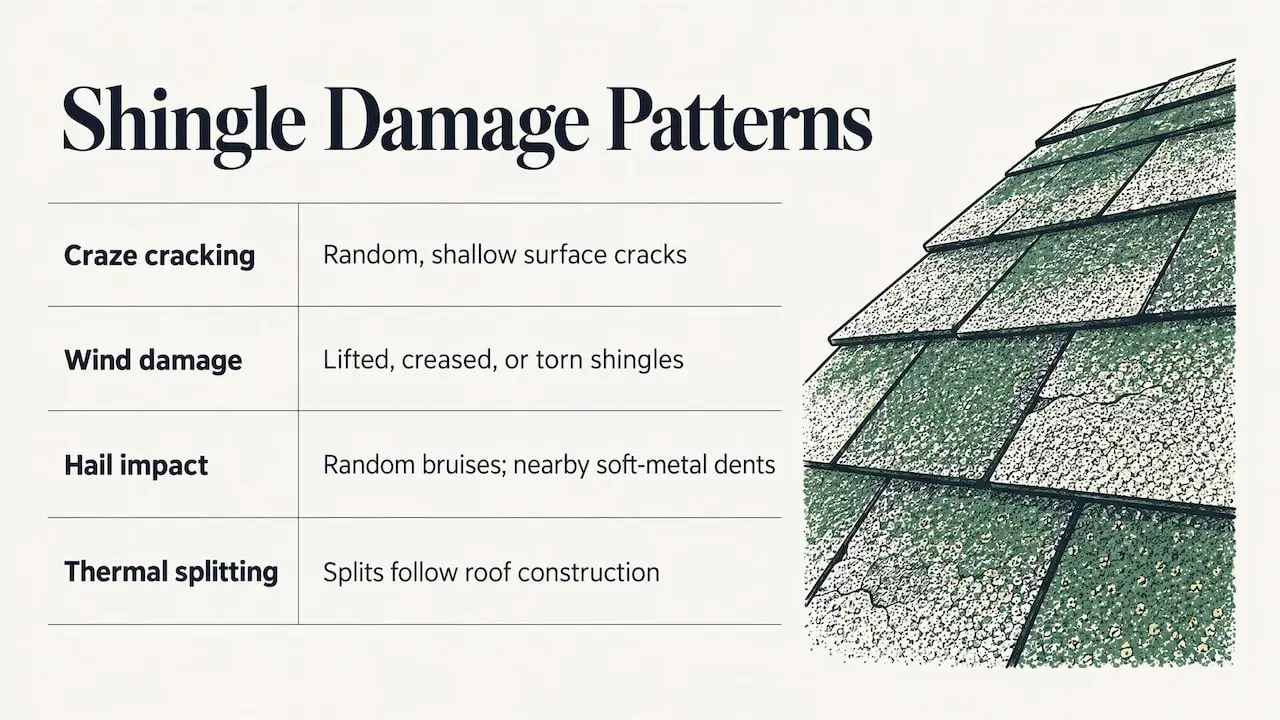
Craze cracking is a pattern of random, shallow surface cracks. It can expose more asphalt to ultraviolet light, according to InterNACHI, and it speeds up aging, but it is not the same as a through-split.
Wind damage looks different. Wind lifts, creases or tears shingles away, and it does not cause thermal splitting. Haag Engineering, a forensic engineering firm, states that shingle splitting is not caused by wind. If you suspect wind, our guide to wind damage to shingles walks through the ground checks.
Hail impact leaves bruises and fractures in a random spread, usually with dents on soft metals nearby such as vents, flashing and gutters, as CCDocs describes. Thermal splits follow the roof’s construction instead of a storm track.
Why shingles split: the causes
No single cause explains every split. Haag Engineering describes it as a combination of three factors: not enough tensile strength in the fiberglass mat, thermal expansion and contraction, and a self-sealer strip that has bonded fully across the end joints. When the shingle is held at two points and shrinks between them, it pulls apart horizontally.
The tug of war between sealant and mat
InterNACHI explains the balance this way. If the adhesive strip bond is stronger than the tensile strength of the shingle, the shingle splits and leaks can follow. If the shingle is stronger than the bond, the bond fails and wind resistance drops sharply (InterNACHI Part 39). Roofs sit between those two failure modes, which is why installation and material quality both matter.
Tear strength of the shingle itself
A shingle’s resistance to tearing is a measured property. Under ASTM D3462, the standard for fiberglass shingles, the minimum tear resistance is 1,700 grams, tested with the Elmendorf method, and shingles with higher tear resistance are less likely to split. In a later study, seven of eight new shingle samples fell below that minimum even though their wrappers claimed compliance (IIBEC, 2011). The takeaway for a homeowner is simple: the product on your roof and the way it was installed are part of the story, and you rarely know either without an inspection.
Heat, ventilation and exposure
An attic without balanced airflow runs hotter. The Roofing Brief reports attic temperatures of 150 to 170°F and shingle surface temperatures of 180 to 200°F on a sunny 90-degree day, when shingles age and turn brittle faster. InterNACHI also notes that poor ventilation shortens shingle life by failing to keep shingles cool, which means faster loss of volatiles and more thermal cycling.
Orientation plays a part too. IIBEC’s review of early fiberglass shingle problems found splitting predominantly on western and southern exposures, the slopes that take the most sun.
What it means for a Louisiana roof
Most writing on thermal splitting talks about cold climates and freeze-and-thaw swings. Louisiana’s version is different: long, hot, humid summers, intense afternoon sun on south and west slopes, and attics that bake. Heat cycling, not freezing, is the stress we look for on Baton Rouge roofs.
That is why attic ventilation deserves as much attention as the shingles. The International Residential Code, section R806.2, sets a default of 1 square foot of net free vent area per 150 square feet of attic, with a 1:300 exception under specified conditions. Shingle makers also tie ventilation to warranty coverage. Atlas Roofing’s installation instructions, for example, say it will not be responsible for shingle damage from inadequate ventilation, and they name shingle distortion and cracking from deck movement among the results.
One common failure is insulation pushed against the underside of the deck at the eaves, which blocks the airway from soffit to attic, according to The Roofing Brief. Gulf Coast storm seasons also complicate diagnosis. A roof can have splits that predate a storm, and splits are often only noticed afterward. Haag Engineering notes that such age-related defects are often discovered after a hailstorm without having been created by it. Knowing which damage is which matters when you are deciding what to repair and what to report. For the climate side of material choice, see our page on the best roof for a hot climate.
How to check your roof for thermal splitting safely
You do not need to climb up. In fact, you should not: shingles are slick when damp, hot enough to burn in summer sun, and a fall is a far bigger risk than a split shingle. Do the following from the ground and from inside.
- Walk the perimeter with binoculars or your phone’s zoom. View each slope from more than one angle and in side light, early or late in the day, when splits cast tiny shadows.
- Look at the south and west slopes first. They take the most heat.
- Look for straight lines. Thermal splits often run in line with the shingle’s length or run down the shingle at a joint. Randomly scattered marks with dented vents or gutters point toward hail instead.
- Check your gutters and downspouts for heavy granule buildup, which suggests an aging surface.
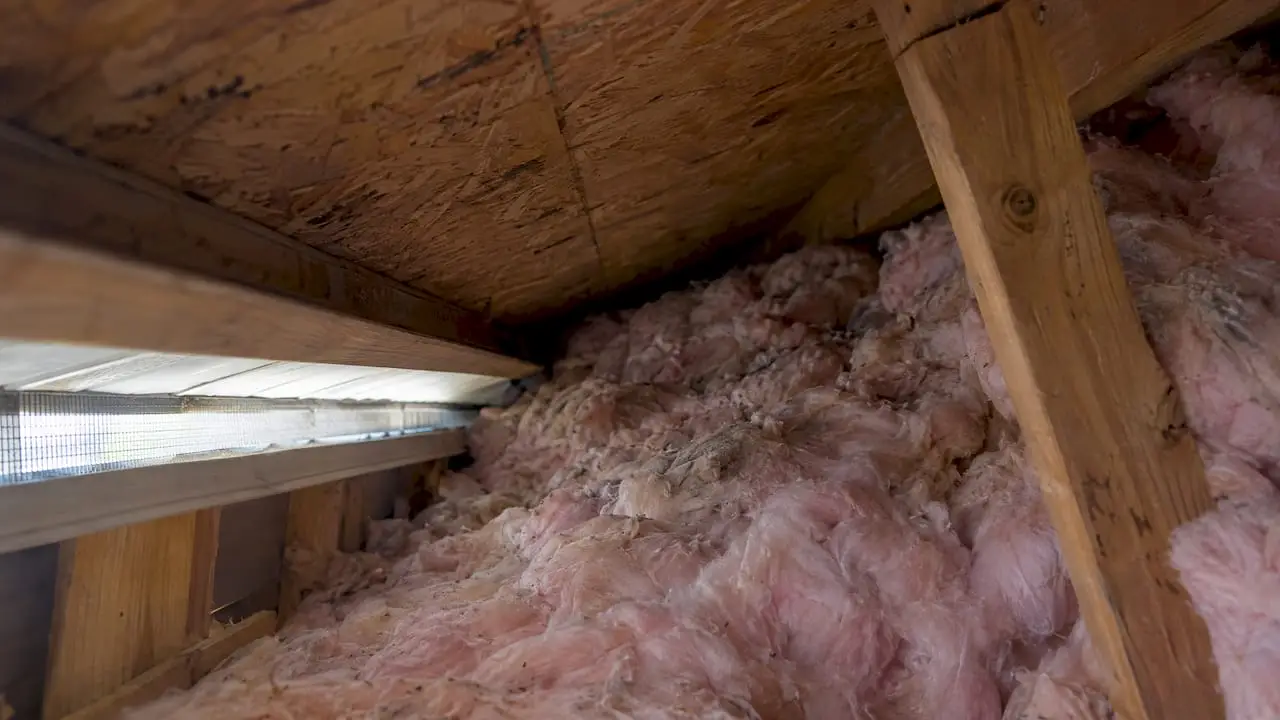
- Go into the attic on a bright day. Look at the underside of the deck for daylight through the shingle layer, stains, damp insulation or dark streaks around the area under a suspected split.
- Check that the soffit vents are clear and that insulation has not been packed against the eaves.
- Photograph everything with dates. Photos help any later conversation with an inspector, contractor or insurer.
If you see splits, do not press on them or walk the roof to “test” them. A split shingle is a leak path, and anyone on the roof can widen the damage. Call a roofer to look at it instead. Our free residential roof inspection guide explains what happens during a visit.
Split, crack or something else: a quick comparison
| What you see | Likely cause | What it means |
|---|---|---|
| Full-depth split, often straight, at a joint, mostly on sunny slopes | Thermal splitting | Leak path. Repair or replace depending on how many |
| Shallow, random surface cracking | Craze cracking from aging and UV | Surface aging. Have it inspected at the next visit |
| Bruises or fractures spread randomly, with dented vents or gutters | Hail impact | Storm damage. Document before repair |
| Creased, lifted or missing shingles | Wind | Wind damage. Repair soon |
| Raised bumps or blisters | Manufacturing blisters or trapped moisture | Follows the roof, not the storm |
The hail and blister distinctions come from CCDocs, and the split-versus-crack definition from InterNACHI. A table helps, but a roofer on the roof can tell far more than photos can.
Repair or replace: how the decision gets made
Haag Engineering states that individual shingles or groups can be repaired with standard insert techniques, or whole slopes removed and replaced, and that the choice typically comes down to economics. Shingles that have come unbonded can be sealed with quarter-sized dabs of asphalt roofing cement, following ARMA guidelines.
In practice, we weigh these points:
- How many splits, and where. A handful on one slope is a repair. Splits across most of a slope is a pattern.
- Roof age and condition. A young roof with a few splits is a different case from an aged roof with splits, granule loss and brittle shingles.
- The attic. If ventilation is the root cause, replacing shingles without fixing airflow invites the same result.
- Water already inside. Stained decking or wet insulation changes the job.
One public-sector example shows how seriously this is taken. The Arizona State Facilities Board specification classifies a shingle roof as failed when conditions such as splitting shingles exist, and treats replacement as the required action when repair conditions are not met. That is an Arizona state standard, not a Louisiana rule, but it shows how widespread splitting is treated.
For a small number of splits, see our page on cracked or broken shingles repair in Baton Rouge. If you are weighing the bigger step, our roof repair vs. replacement guide lays out the factors, and signs of asphalt shingle replacement covers what a worn-out roof looks like. If water is already coming in, tarping and emergency repairs are the fast first step.
Preventing splitting on a new or existing roof
You cannot stop a roof from heating up, but several choices reduce stress.
Choose shingles with attention to tear resistance. Tear resistance is a listed physical property under ASTM D3462, and some manufacturers publish it. Ask your contractor which product they install and why.
Nail correctly. ARMA’s residential manual says proper nailing is essential: the right type and size, corrosion-resistant nails, the required number per shingle, and nails driven straight and flush without breaking the shingle surface with the nail head.
Balance the attic ventilation. Ridge plus soffit ventilation is the default modern installation, and the biggest residential mistake is an unbalanced system. ARMA also advises examining ventilation during any remodel, not only a reroof.
Inspect every year. ARMA recommends annual roof inspections to catch problems before leaks develop. In Louisiana, we suggest booking one before hurricane season and another after any major storm. Our page on the annual roof inspection explains what is covered, and roof and attic care tips go further on airflow.
Perspective: why we look at the attic before we quote the shingles
When a homeowner calls about split shingles, the shingles are only half the picture. We look at the slope, the pattern of the splits, the roof’s age and what the attic is doing, because a repair that ignores the cause can be a short-lived one.
Our approach is simple: honest assessments, clear communication and no pressure. We explain what we see in plain terms, tell you whether a few shingles need attention or a slope needs more, and stand behind our work with a five-year workmanship warranty. With more than 25 years of experience, we build our repairs and installations around Louisiana’s heat, humidity and storms.
Our free inspections exist so you can find a problem while it is still small. A split caught early is a repair. A split ignored through a wet season can become a decking and insulation job.
John
Get a clear answer on your roof
If you have spotted splits, or you want to know whether your roof is heading that way, our roof inspection service is the place to start. We look at the shingles, the flashing and the attic, then tell you plainly what needs repair and what does not. Homeowners, business owners and property managers across Baton Rouge use us for repairs, replacements and storm restoration, and we offer free inspections to help find issues before they escalate.

For an active problem, our roof repair team handles repairs, including emergency repairs. For commercial buildings, see our commercial roofing services.
FAQ
Is thermal cracking in shingles covered by insurance?
Coverage depends on your policy and on what caused the damage. Insurers generally treat sudden storm damage differently from wear, aging or manufacturing issues, so the cause matters. Photograph the damage, get a written inspection, and read your policy or call your insurance agent before filing.
Can thermal splitting be fixed without replacing the roof?
Yes, when it is limited. Individual shingles or small groups can be replaced with standard insert techniques, and unbonded shingles can be re-sealed with roofing cement, as Haag Engineering describes. When splits are widespread on a slope, replacing the slope is typically the better value.
Does a split shingle always leak?
Not immediately, but a split goes entirely through the shingle, so it can let water reach the layers below. Leaks often start small and show up later as stained decking or damp insulation. Have it looked at before the next heavy rain season.
How is thermal splitting different from wind damage?
Thermal splits come from heat cycling and tensile stress, and run through the shingle at joints. Wind damage shows as lifted, creased or missing shingles. Haag Engineering states that wind does not cause shingle splitting.
Sources
- InterNACHI, Mastering Roof Inspections Part 39
- InterNACHI, Mastering Roof Inspections Part 30
- Haag Engineering, wind effects on asphalt shingles
- Haag Engineering, hail damage to asphalt shingles
- IIBEC, Performance Attributes of Fiberglass Shingles (2007)
- IIBEC, Correlation Between Wind Resistance and Physical Properties (2011)
- CCDocs, Hail Bruising on a Roof
- The Roofing Brief, Attic Ventilation Guide
- Atlas Roofing, Pinnacle Pristine Installation Instructions
- ARMA, Residential Asphalt Roofing Manual
- Arizona State Facilities Board, Asphalt Shingles specification