A metal roof installed over solid decking, underlayment and insulation is not meaningfully louder than asphalt shingles. Measured rain noise comes out around 52 decibels on metal versus 46 on shingles, a gap most people cannot pick out. The roofs that really are loud are bare panels over open framing, like a barn. Here in Baton Rouge, where we get heavy downpours and fast thunderstorms, the difference comes down to how the roof is built under the metal, and that part is entirely in your control.
TL;DR
- Metal over a solid deck, underlayment and insulated attic measures about 6 dB louder than shingles in rain, below the point where most ears notice a clear change.
- The “loud metal roof” reputation comes from barns and sheds with panels fastened straight to open purlins.
- Decking, underlayment, insulation and attic air space do most of the quieting. The metal itself matters least.
- If you want even less sound, damping compounds, extra insulation and sealed panel seams can cut rain noise sharply.
- Ask about the whole assembly before you sign, not just the panel profile.
Table of Contents
- Are metal roofs noisy? What the measurements say
- Where the loud-metal-roof myth comes from
- What makes a metal roof quiet
- How different roofs compare for rain noise
- Rain, hail and storms on a metal roof
- Other metal roof sounds that are not rain
- How to reduce metal roof noise
- Our perspective: quiet is a design decision
- What to ask before you install a metal roof
- Plan a quieter roof with Stalwart Roofing
- FAQ
- Sources
Are metal roofs noisy? What the measurements say
The number most often quoted comes from research at Sweden’s Luleå University of Technology, summarized by Angi: rain on asphalt measured 46 dB and rain on metal measured 52 dB. That 6 dB difference sits below the roughly 8 dB change at which people typically perceive a significant shift in volume.
For a sense of scale, a University of Arizona write-up on a study of ambient noise puts about 50 dB in the range of birdsong or moderate rain. So a metal roof in a steady rain sounds like rain, not like a drum.
Two caveats we always give homeowners:
- Those figures describe a complete roof assembly. They do not describe bare metal on open framing.
- Decibels are not the whole story. Metal tends to carry a slightly crisper, higher-pitched patter, and some people love it while others find it more noticeable at night. Neither reaction is wrong.
Where the loud-metal-roof myth comes from
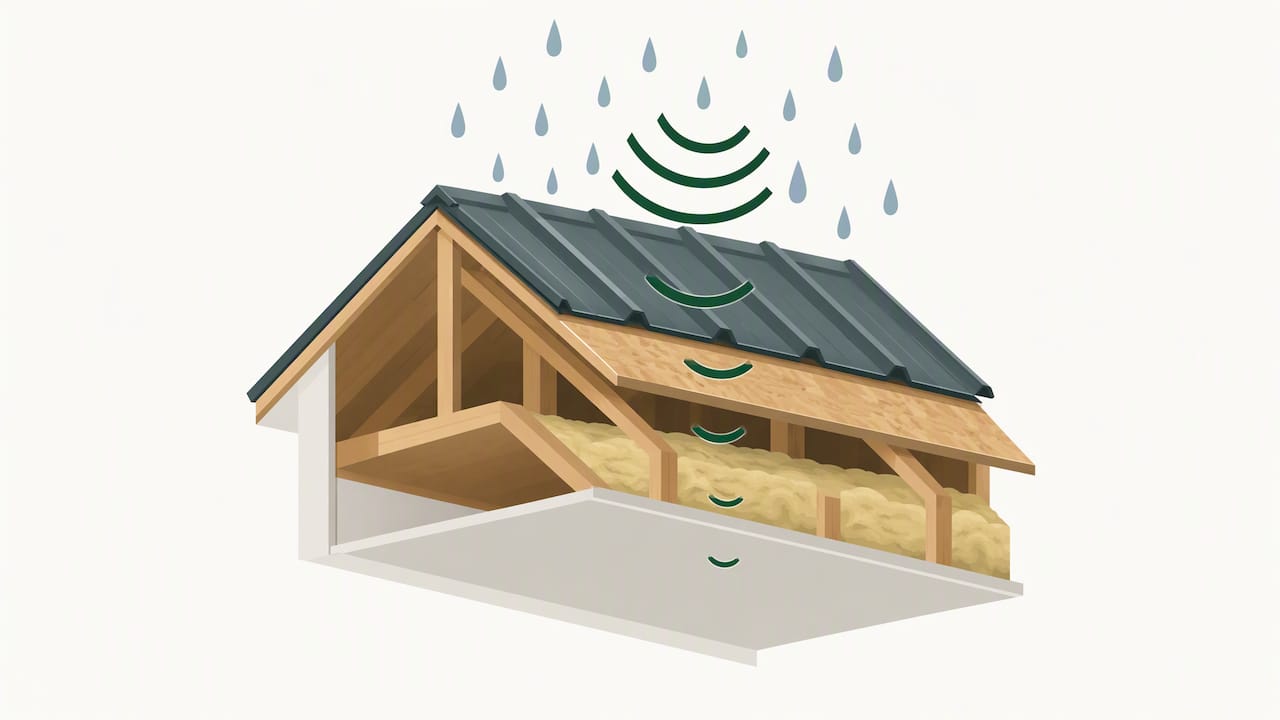
Most people’s memory of a noisy metal roof is a barn, a carport or a workshop. In those buildings the panels are screwed to open purlins with nothing beneath them. Acoustic engineers describe the assembly as the real sound control system: decking, underlayment, attic air space and insulation all absorb or block the energy of raindrops before it reaches a ceiling.
When a metal roof sits over open framing with no insulation or decking, the panel resonates like a drum skin. That is a construction problem, not a material problem. A shingle roof with nothing under it would be loud too.
It also helps to know what the sound actually is. Rain noise comes from drops striking a thin, stiff sheet and setting it vibrating. Anything that adds mass, adds damping or breaks the path of vibration into your house reduces what you hear inside.
What makes a metal roof quiet
Think in layers, from the top down.
Solid roof decking
Plywood or OSB decking under the panels gives raindrops something heavy to hit through. A residential metal roof on a solid deck behaves very differently from the same panel on spaced boards or purlins. This is why the question of installing metal over existing shingles or tearing off matters for sound as well as for weight and warranty: an extra layer under the metal adds mass and a cushion.
Underlayment
A quality synthetic or self-adhered underlayment sits directly under the panels. It damps vibration where the metal meets the deck and is also your last line of defense against wind-driven rain, which is a real concern on the Gulf Coast.
Attic insulation and air space
Insulation is the single biggest lever below the deck. It absorbs airborne sound in the attic before it reaches your ceiling. Building codes also call for ventilated roof assemblies; the International Building Code language on roof ventilation sets requirements for ventilated attics and rafter spaces, and that open air gap does double duty as a buffer between the roof and the room below. We cover the thermal side in our guide to metal roof insulation for climate and efficiency and the airflow side in metal roof ventilation.
Panel type and fastening
Standing seam panels hide their fasteners and are typically formed in heavier gauges than the thin agricultural tin people remember. Panel thickness has a smaller effect than people expect. A thicker sheet resists denting and flexing, but the assembly underneath still decides what you hear.
How different roofs compare for rain noise
| Roof build | What you can expect in rain |
|---|---|
| Bare metal on open purlins (barn, shed) | Loud. The panel resonates with nothing to absorb it. |
| Metal on solid deck, underlayment and insulated attic | About 52 dB in the Luleå comparison, near shingles at 46 dB |
| Asphalt shingles on solid deck | About 46 dB in the same comparison |
| Metal with added damping and thicker insulation | Lower still. Lab work shows large further reductions (see below) |
The research cited above is a good reference point, but your actual result depends on your attic. A home with a vaulted ceiling and little insulation will sound different from one with a full attic and a thick blanket of insulation over the ceiling.
Rain, hail and storms on a metal roof
Rain is the usual worry, but Louisiana homeowners also ask about hail and about the thunderstorm that hammers the roof at 2 a.m.
- Steady rain: a soft, even patter indoors on a properly built roof.
- Heavy downpours: louder than gentle rain on any roof, and metal’s sound is a little sharper. With attic insulation it is a hum, not a roar.
- Hail: larger stones are noticeable on any roof. Impact is the concern here, and we look at dents and finish damage as much as the sound. If a storm has hit, our storm damage restoration team can inspect the roof.
- Wind: a rattling or whistling sound in wind usually points to loose trim, flashing or panels, not normal behavior.
Other metal roof sounds that are not rain
Some complaints come from the roof moving, not from rain hitting it.
Ticking or popping on warm days and cool evenings. Metal expands and contracts with temperature. Panels need to slide slightly on clips or through slotted fastener holes. If fasteners are driven too tight, or panels are pinned where they should float, you can hear creaks as the roof warms up in the morning sun. Louisiana’s big swing between a hot afternoon and a cooler evening makes this more likely. It is usually an installation fix, which is one reason we point homeowners to our write-up on metal roofing installation mistakes to avoid.
Rattling in wind. Loose flashing, ridge caps or trim. A repair, not a replacement.
Drips and running water. A trickling sound after rain can be a drainage issue. See our notes on metal roof water drainage.
Condensation noise and moisture. Condensation can cause dripping inside the assembly, which is both a sound and a sign of a problem. Read metal roof condensation causes and prevention in Louisiana if you see damp spots.
And not every roof-time noise comes from the roof. When a storm knocks out power in Baton Rouge, a backup generator can be the loudest thing on your property. If that bothers you, it is worth reading about sound enclosures for backup generators, including why airflow and exhaust cannot be sacrificed for quiet.
How to reduce metal roof noise
The best time to soundproof is during installation, when everything is open. If you already have a metal roof, you still have options from the attic side.
Start with the assembly
- Use a solid deck. Skip open framing for any occupied building.
- Choose a quality underlayment over the whole deck.
- Insulate the attic or rafter cavity fully. Add depth if your insulation is thin, aged or compressed.
- Keep the ventilation air space intact. Do not fill it in a way that blocks airflow. Rigid connections that bridge the gap can carry vibration into the framing, so ask about isolation details for sound-sensitive rooms.
Add damping where it counts
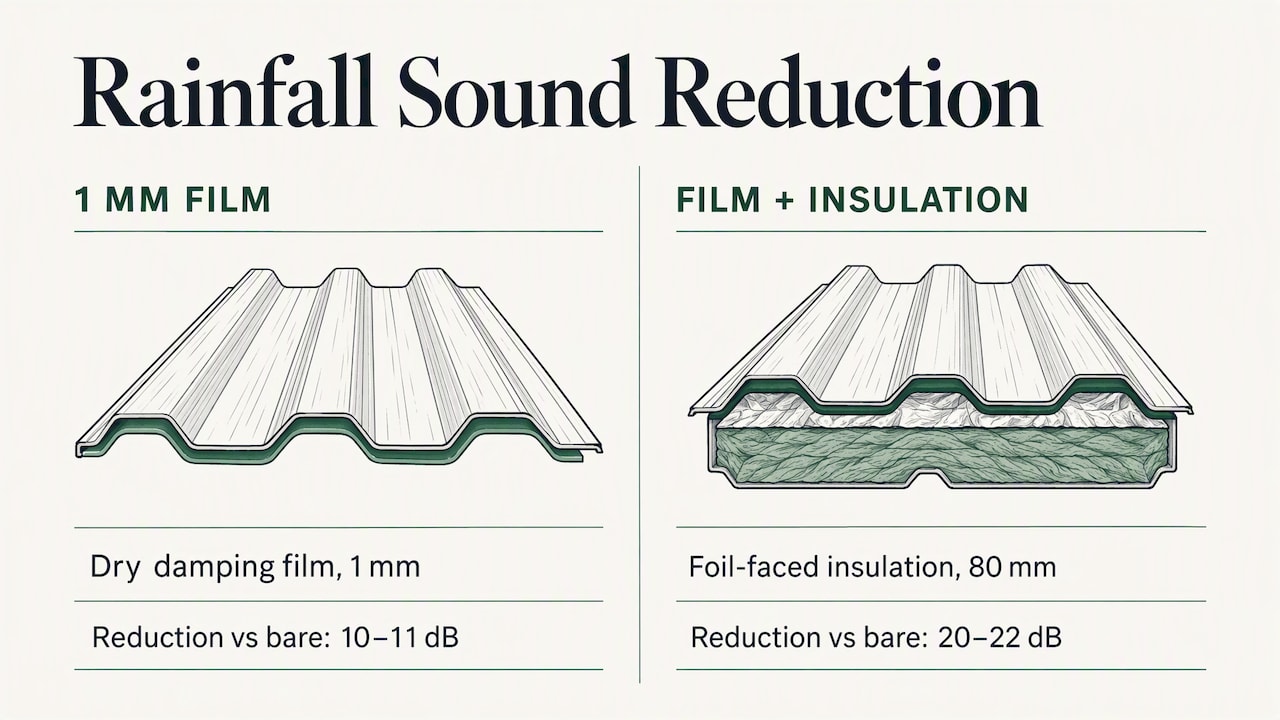
A 2018 study in the Proceedings of Acoustics tested a sprayable damping compound on the underside of corrugated metal roofing. A 1 mm dry film cut rainfall sound intensity by 10 to 11 dB, and pairing it with 80 mm of foil-faced insulation reached a 20 to 22 dB reduction against bare metal. The same paper found that sealing panel overlaps and edges matters, since sound leaks through the joints. This was corrugated sheeting in a lab setting, so treat it as proof of principle, not a promise for any specific home.
For flat and low-slope metal roofs
Commercial buildings with low-slope metal decks have their own approach. Acoustic consultant Jon Mooney’s research on flat metal assemblies found that ballasted roofs measured about 10 dB quieter than non-ballasted ones, because the mass and standing water absorb the raindrop energy. If you manage a building with sound-sensitive spaces below, such as classrooms, offices or a church sanctuary, tell us early. Our commercial roofing team can talk through assemblies with that goal in mind.
What the experts say about the whole system
The New Zealand metal roofing industry’s code of practice treats roof noise as a whole-system issue, where insulation is the primary tool and mass-loaded barriers or damping layers come into play for demanding situations. That matches what we see on the roof.
Our perspective: quiet is a design decision
When a homeowner in Baton Rouge asks us about metal roof noise, we start by asking what is under the panels now, and what is in the attic. In most cases the answer to “will it be loud?” is already in those two things.
We have more than 25 years of roofing experience in this market, and we have learned that the complaints we hear about noise rarely trace back to the metal itself. They trace back to a shortcut: panels over old, uneven decking, thin or missing insulation, fasteners driven without room for movement. Fixing those during installation costs far less than fixing them afterward.
We also tell people honestly that a little sound is part of the appeal. Many customers like hearing a Louisiana thunderstorm. What matters is that it should be your choice. If you want the sound turned down, we plan the assembly that way, and if you want to keep the patter, we build a roof that is quiet enough to sleep through the heaviest storms and still let you notice the rain.
Our approach is simple: a clear explanation of what is under your current roof, an honest recommendation, no pressure, and workmanship backed by a five-year workmanship warranty.
What to ask before you install a metal roof
Use this checklist with any contractor, including us.
- What will the panels be fastened to: solid decking or open framing?
- Which underlayment is going on, and over what area?
- What is the current attic insulation, and does it need topping up?
- How will ventilation be maintained?
- Are fasteners and clips designed to allow panel movement?
- How will flashing, trim and ridge caps be secured against wind rattle?
- Are there sound-sensitive rooms, like a nursery, home office or bedroom under a vaulted ceiling, that need extra attention?
Our metal roof installation preparation guide for Baton Rouge walks through what to expect before the crew arrives.
Plan a quieter roof with Stalwart Roofing
If you are weighing a metal roof, or a loud one is bothering you, we can look at the decking, attic and fastening and tell you what is realistic. We offer roof inspections for homeowners, and you can see how a full job works on our roof replacement and residential roofing page. If the noise is a rattle or a drip, our roof repair team can usually trace it.
FAQ
Is it normal for a metal roof to make noise?
Some noise is normal. Rain gives a soft patter, and panels can tick as they warm and cool. Persistent rattling, banging in wind or dripping is not normal and usually points to loose trim, over-tightened fasteners or a drainage problem. A roof inspection can find the source.
Are metal roofs noisier than shingles?
Slightly, but usually not enough to notice. One comparison measured 52 dB for rain on metal against 46 dB on shingles, a difference under the level where most people perceive a clear change.
Can you soundproof a metal roof after it is installed?
Often, yes. Adding attic insulation is the simplest step. Damping compounds and sealed seams have also performed well in lab testing, though they are easier to apply during installation. Ask for an attic assessment first.
Does a thicker metal panel reduce rain noise?
A thicker panel helps a little with stiffness and dent resistance, but the assembly beneath it has the larger effect. Solid decking, underlayment and insulation do far more to quiet the roof than panel gauge alone.
Sources
- Are Metal Roofs Noisy When It Rains? | Angi
- The effectiveness of utilising a damping compound for attenuating rainfall noise on metal roofing
- Rainfall noise on flat metal roof assemblies, J. W. Mooney (INCE)
- Sound emission of metal roofing (ATAS)
- Roof noise, NZ Metal Roofing Manufacturers code of practice
- Optimize your workspace for sound and comfort, University of Arizona News