When you file a roof claim, your insurer subtracts depreciation, a deduction for the age and wear of the roof, from the cost of the work. If your policy pays replacement cost value (RCV), that withheld amount is usually released after you finish the job and send in proof of cost. If it pays actual cash value (ACV), the deduction is generally permanent. Which one you have decides whether a roof claim covers most of the bill or only a fraction of it. Below, we explain how the math works, what to look for in your policy, and how to get every dollar you are owed.
TL;DR
- Depreciation is the insurer’s estimate of value your roof has already lost to age and wear. It is subtracted from the replacement cost before you are paid.
- With RCV coverage, depreciation is typically held back and paid after repairs are done and documented. With ACV coverage, you get the depreciated amount and no more.
- Many insurers calculate depreciation as a share of the roof’s expected life. A 10-year-old roof on a 25-year schedule would be 40% depreciated.
- Keep contracts, invoices and photos. Recovering withheld depreciation depends on proof that the work was completed.
- Read your declarations page before storm season so you know which coverage you carry, and ask for the insurer’s depreciation breakdown in writing.
Table of Contents
- What roof depreciation means on an insurance claim
- How insurers calculate depreciation on a roof
- Recoverable vs. non-recoverable depreciation
- ACV vs. RCV on a roof: what changes for you
- Why roof age changes the coverage you are offered
- How to recover withheld depreciation, step by step
- Common mistakes that cost homeowners money
- What we do at Stalwart Roofing
- Get your roof documented before you need it
- FAQ
- Sources
What roof depreciation means on an insurance claim
Depreciation is a reduction in a property’s value over time because of wear and tear. TWIA, the Texas windstorm insurer, notes that it can sharply reduce payments on ACV claims and has a smaller effect on RCV claims. The reasoning from the insurer’s side is simple: your 12-year-old shingles were not worth the price of brand-new shingles the day before the storm, so a payout for new shingles would leave you better off than before the loss.
From your side, it feels different. The storm did real damage, you still have to buy a whole new product, and the check is smaller than the estimate you got from a contractor. That gap is depreciation, plus your deductible.
Two terms cause most of the confusion:
- Replacement cost value (RCV): what it costs to repair or replace the damaged roof at today’s prices.
- Actual cash value (ACV): replacement cost minus depreciation.
The National Association of Insurance Commissioners explains that RCV coverage pays to repair or replace damaged property without deducting depreciation, while ACV pays the depreciated cost. In practice, many RCV policies still start with an ACV payment and release the rest later, which is where “recoverable depreciation” comes in.
How insurers calculate depreciation on a roof
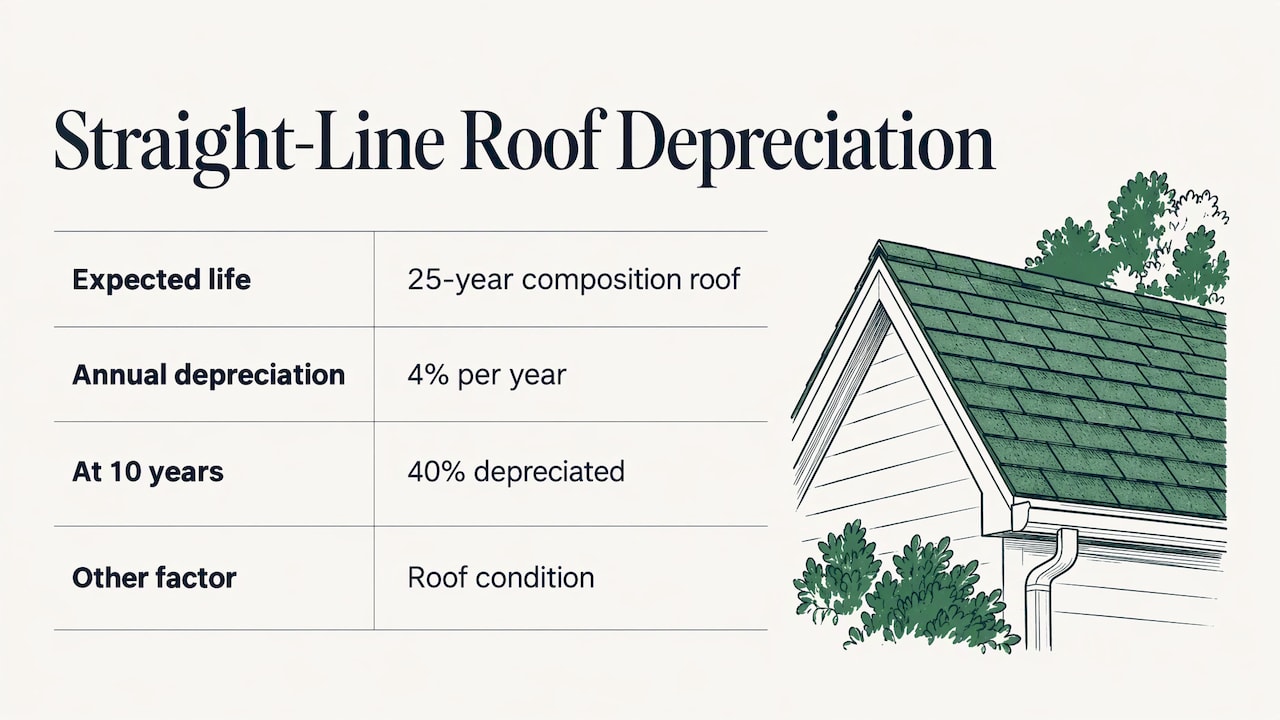
There is no single national formula, but the most common method is straight-line: replacement cost multiplied by the share of the roof’s expected life that has been used up. Travelers gives an example in which a 25-year composition roof depreciates 4% per year, so a 10-year-old roof is 40% depreciated. Condition can also enter the calculation, so a roof that was well maintained may be treated differently from one with existing wear.
TWIA’s guidelines say depreciation should be applied item by item, using reasonable methods that may include depreciation tables, life expectancy, the roof’s condition at the time of loss and market value. That matters because a roof is not one line item. Shingles, underlayment, flashing, vents and drip edge can each carry their own life expectancy.
A worked example
Here is a simple illustration with made-up numbers, not a quote or a promise of any payout:
| Item | Amount |
|---|---|
| Replacement cost of the roof | $15,000 |
| Roof age / expected life | 10 years / 25 years |
| Depreciation (40%) | $6,000 |
| Actual cash value | $9,000 |
| Deductible | $2,000 |
| First check from the insurer | $7,000 |
Under an RCV policy, the $6,000 of depreciation is recoverable once the work is complete and documented, so your total payment (before any other policy limits or conditions) would approach $13,000 after the deductible. Under an ACV-only policy, you stop at $7,000 and cover the remaining $8,000 yourself.
That difference is the reason we tell homeowners to check coverage type well before a storm, not after.
Does depreciation apply to labor?
This is contested. Some state regulations and courts prohibit depreciating labor, while others allow it, according to a coverage law firm’s overview. The rule depends on your state and your policy language, so if your estimate shows labor being depreciated, ask your insurer to point to the policy provision or state rule that permits it.
Transparency rules also exist in some states. In California, for example, the Department of Insurance guide requires written explanations for depreciation deductions so they are based on measurable differences in value rather than arbitrary figures. Your own state may have different requirements, so check with your state’s department of insurance.
Recoverable vs. non-recoverable depreciation
Recoverable depreciation is the amount an insurer holds back from your first payment and agrees to pay later if you complete the repair or replacement and submit proof of the costs. Insurance and legal explainers describe it this way, and it is the standard mechanism on replacement cost policies.
Non-recoverable depreciation is the part of the deduction you never get back, no matter what you spend on the repair. It typically shows up in three places:
- ACV-only policies. The payout is the depreciated value, and the policy has no mechanism to release the difference.
- Roof payment schedules. Some policies pay a roof on a schedule that reduces the percentage paid as the roof ages, even if the rest of the home is covered at replacement cost. Look for an endorsement or a roof surfacing clause on your declarations or policy forms.
- Items outside the replacement cost terms. Some policies exclude certain components or cosmetic damage from replacement cost treatment.
If you are unsure which category your roof falls in, ask your agent or insurer directly: “Is depreciation on my roof recoverable under this policy, and what must I submit to recover it?” Get the answer in writing.
ACV vs. RCV on a roof: what changes for you
| ACV coverage | RCV coverage | |
|---|---|---|
| What the insurer pays | Replacement cost minus depreciation | Replacement cost, often in two payments |
| Depreciation | Generally not paid back | Held back, then released after repairs and proof |
| Out-of-pocket on an older roof | Can be large | Usually limited to the deductible and any exclusions |
| Premium | Typically lower | Typically higher |
| Best fit | Older roofs where cost savings matter most | Homeowners who want a new roof paid for after a covered loss |
The deductible comes off either way. TWIA, for instance, subtracts the deductible from the claim payment. In Louisiana, wind and hail deductibles are often set as a percentage of the home’s insured value rather than a flat dollar amount, so read that line on your declarations page. Our guide to wind damage insurance coverage for Louisiana roofs covers that in more detail.
Some homeowners also carry extended or guaranteed replacement cost coverage. According to the Triple-I homeowners insurance handbook, these options go beyond standard RCV and can, in some cases, cover restoration costs that exceed the policy limit. They apply to the dwelling as a whole, so ask your agent how they interact with roof-specific terms.
Why roof age changes the coverage you are offered
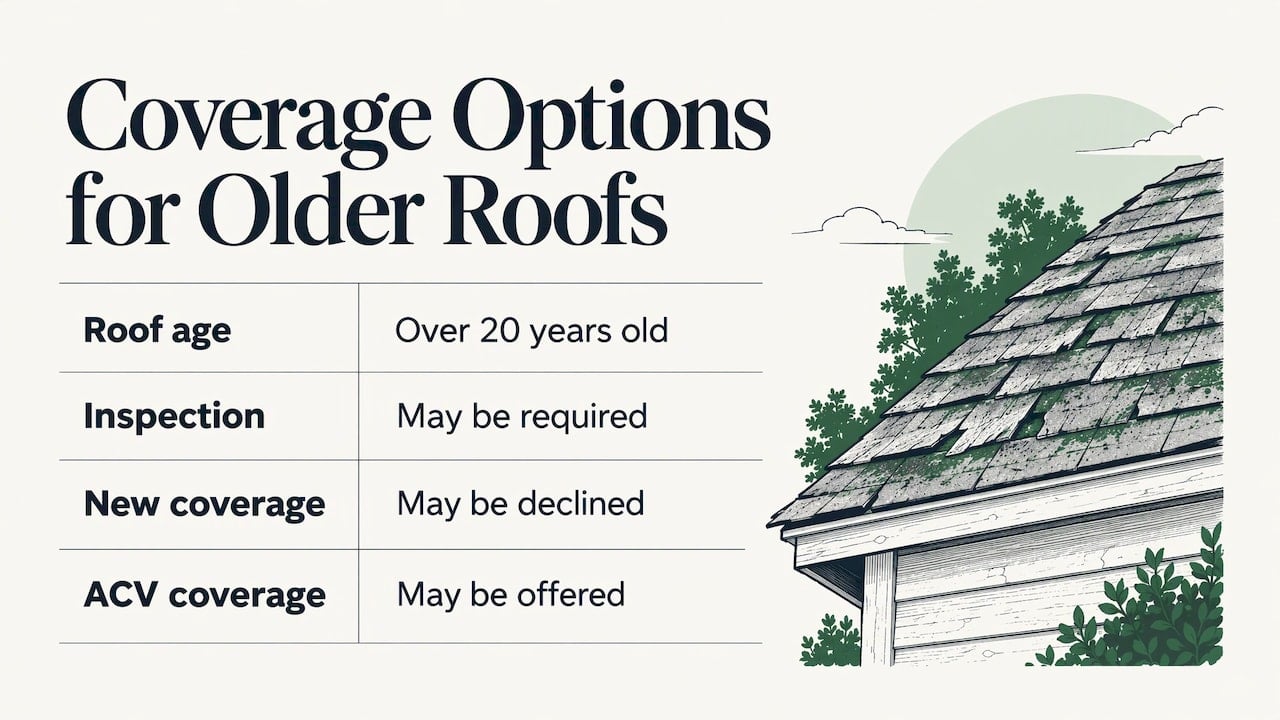
Depreciation is not the only way age enters the picture. The Insurance Information Institute reports that for roofs over 20 years old, insurers may require an inspection, decline new coverage, or offer ACV coverage. So an older roof can hit you twice: a reduced payout when it is damaged, and fewer options when you shop.
In Baton Rouge, that combination is worth taking seriously. Heat, humidity, heavy rain, tropical storms and hurricane-season winds work shingles harder than in milder climates, and a roof’s real condition can differ from its calendar age. If you own a house with a roof near the 15 to 20-year mark, our page on evaluating an older roof on a Louisiana home explains what we look at beyond the date on the permit.
An older roof can also affect a sale. If you are weighing that angle, see how an old roof can affect appraisal value.
How to recover withheld depreciation, step by step
Exact rules are set by your policy and your state, so treat this as a general workflow and confirm the details with your insurer.
- Read the first payment letter. It should show replacement cost, depreciation, deductible and the net payment. Check that the roof’s age, material and square footage are correct. A wrong age inflates depreciation.
- Ask for the depreciation basis in writing. Which life expectancy was used, and was it applied to materials only or to labor too?
- Get a detailed contractor estimate. It should itemize materials, tear-off, underlayment, flashing, ventilation, code-required items and disposal, so it can be compared with the insurer’s line items.
- Complete the work. Most RCV policies release depreciation only after the repair or replacement is finished.
- Submit documentation. That usually means the signed contract, final invoice, proof of payment, and photos of the finished roof. Send it by a trackable method.
- Watch the deadline. Policies set a time limit for claiming recoverable depreciation. As one example, TWIA says that when repairs cost more than the initial ACV payment, documentation must be submitted within 545 days of that payment. That is a TWIA rule for Texas coastal policies, not a universal figure, so find the deadline in your own policy.
- Report supplemental damage promptly. If tear-off reveals rotted decking, tell your adjuster before continuing so the extra cost is documented and can be reviewed.
Our step-by-step walkthrough for filing a roof insurance claim in Louisiana covers the front end of this process, from first photos to adjuster meeting.
Common mistakes that cost homeowners money
- Cashing the first check and assuming it is final. On an RCV policy, the first check is often only part of what you are owed.
- Skipping the final invoice. Without proof the work is complete, the insurer has no reason to release the holdback.
- Waiting too long. Both claim filing and depreciation recovery have time limits.
- Not documenting the roof before a storm. Dated photos of a well-kept roof help support a condition argument if the insurer applies heavy depreciation.
- Assuming repair equals replacement. An adjuster may approve a repair of one slope while you believe the whole roof needs replacing. Having the roof inspected by a licensed roofer gives you a second opinion on scope.
What we do at Stalwart Roofing
We are a Baton Rouge roofing contractor, not an insurer and not a public adjuster, so we do not decide coverage or negotiate your claim. What we can do is the part of the process that sits on the roof.
Our view on depreciation
Most of the depreciation disputes we see start with unclear paperwork, not bad faith. The adjuster measures one thing, the homeowner’s contractor measures another, and nobody can tell which line explains the gap.
Our approach is to keep things plain. We inspect the roof, explain what we find, and write the scope in itemized detail so you can compare it with your insurer’s estimate line by line. After more than 25 years of working under Louisiana weather, we have seen how fast wind, rain and humidity age a roof, and why age on paper does not always match condition on the roof.
We also believe that a homeowner should never feel pushed. Our inspections are free, our assessments are honest, and the finished work carries our five-year workmanship warranty. If the work is documented well, it is much easier to recover what your policy promises.
Get your roof documented before you need it
A current inspection gives you a dated record of your roof’s condition, which helps in any conversation about age, wear and depreciation. If you have already had storm damage, we can inspect it, tarp it if needed, and provide an itemized estimate you can share with your insurer.

Start with a roof inspection from our team, or if damage is already done, see our storm damage restoration services. If your roof needs to be replaced, our roof replacement and residential roofing page explains how we work.
FAQ
Is depreciation always deducted from a roof claim?
No. It depends on your policy type and how your insurer settles the claim. Under RCV coverage, depreciation is generally held back at first and paid after you complete the work, while under ACV coverage it is a permanent deduction. Your declarations page and policy forms show which applies.
How do I know if my roof depreciation is recoverable?
Look at the coverage section for your dwelling and any roof-related endorsement, then ask your insurer or agent in writing. Recoverable depreciation is usually described as a holdback paid after you submit proof of completed repairs. If your policy has a roof payment schedule or ACV-only roof endorsement, the depreciation is generally not recoverable.
Can I dispute the depreciation amount?
Yes, you can ask the insurer to explain how it calculated the figure and to correct errors such as the wrong roof age or material. Provide your contractor’s itemized estimate and photos showing the roof’s condition. Some states require insurers to explain depreciation in writing, so check your state’s department of insurance for local rules.
Does a new roof lower my insurance premium?
It can improve how insurers view the property, since roof age and condition affect how insurers assess risk. The size of any change depends on your insurer, your location and the roof material, so ask your agent for a quote after the work is done and bring documentation of the new roof.
Should I replace an old roof before filing a claim?
Usually not. Replacing first can make it harder to prove the storm damage. Have the damage inspected and photographed, file the claim, and wait for the insurer’s evaluation before starting a full replacement unless emergency protection such as tarping is needed.
Sources
- Factors that Affect the Claim Payment Amount, TWIA
- Understanding Depreciation, Travelers
- TWIA & TFPA Property Damage Evaluation Guidelines
- NAIC: Know the difference between replacement cost and actual cash value
- 2026 Guide for Adjusting Property Claims in California, California Department of Insurance
- Replacement Cost Value, Actual Cash Value overview
- What Is Recoverable Depreciation on an Insurance Claim
- Triple-I Homeowners Insurance Handbook, 2023
- How Your Roof Influences Your Home and Business Insurance, Triple-I