
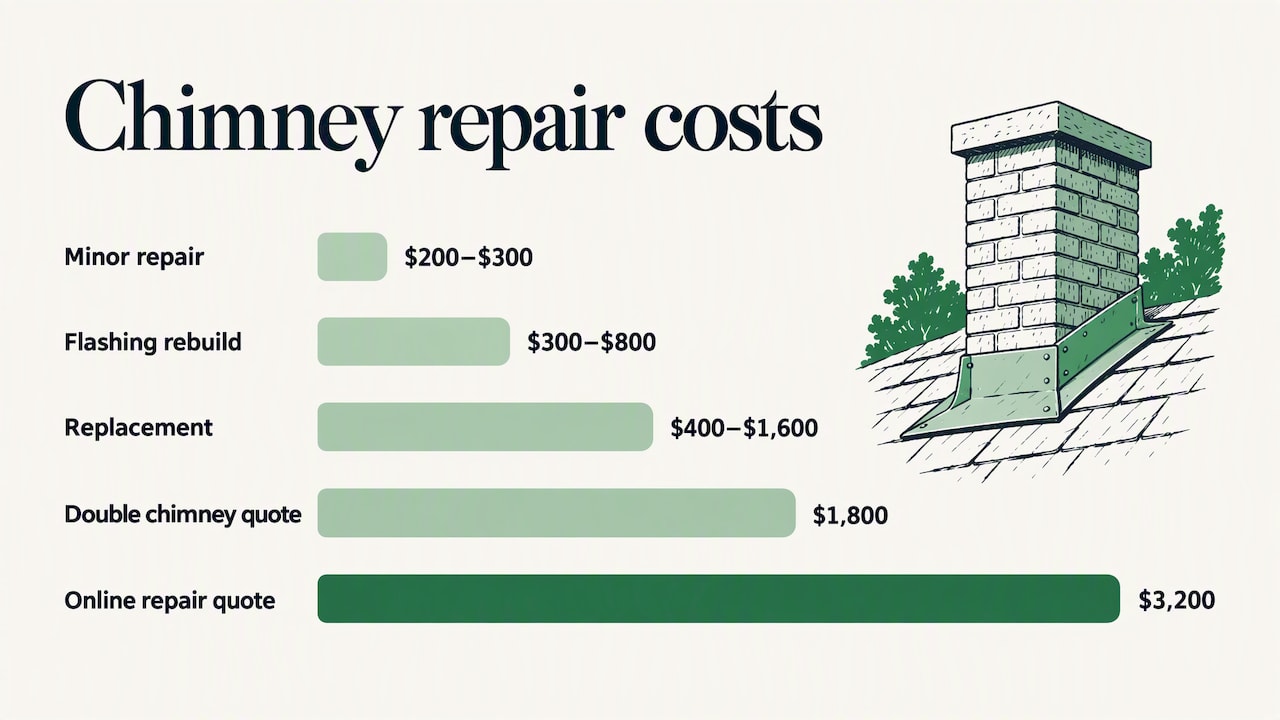
Most chimney flashing repairs cost between $200 and $300, according to This Old House. A full rebuild of the flashing runs roughly $300 to $800 on the same page. Replacing the whole system can reach about $400 to $1,600, with an average near $1,000, per Forbes Home. Where you land depends on the chimney’s size, the roof’s pitch and height, the metal, and whether the old flashing can be saved. Below, we explain each of those so you can read a quote with confidence.
TL;DR
- A simple flashing repair or reseal typically costs about $200 to $300. A rebuild is about $300 to $800, and a full replacement about $400 to $1,600.
- Flashing work is mostly labor and access. The metal is a small share of the bill unless you choose copper.
- Steep roofs, tall or double chimneys, and hidden wood rot push the price up.
- Old, rusted or nail-riddled flashing should be replaced, not caulked.
- Ask for a line-item quote that names the metal, whether a cricket is included, and a written workmanship warranty.
Table of Contents
- What chimney flashing repair costs in 2026
- What drives the price up or down
- Repair or replace: how to decide
- Signs your chimney flashing is leaking
- How to read a flashing estimate
- Why Louisiana roofs put flashing under extra stress
- Our perspective on flashing repair
- Get your chimney flashing checked
- Frequently asked questions
- Sources
What chimney flashing repair costs in 2026
Published figures differ, because each source defines “repair” a little differently. Here is how the main ones line up.
| Type of work | Typical cost | Source |
|---|---|---|
| Flashing repair (minor fix or reseal) | $200 to $300 | This Old House, Bob Vila |
| Flashing rebuild | $300 to $800 | This Old House |
| Flashing replacement | $400 to $1,600 (average about $1,000) | Forbes Home |
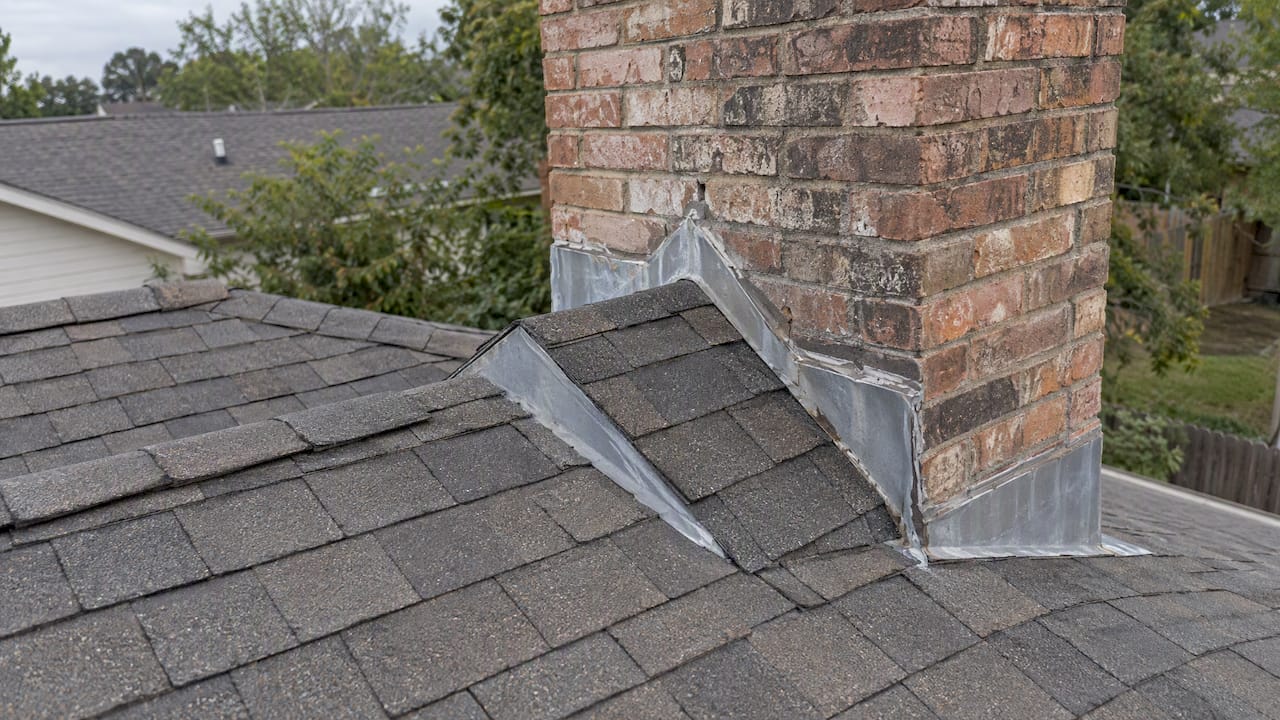
The gap between the low and high ends is wide for a reason. A low-cost repair uses fewer materials. A replacement may mean building a more complicated system of step, counter and continuous flashing around every side of the chimney, as Forbes Home explains.
You will also see quotes above these ranges. Homeowners in online price-check threads report quotes of $1,800 for a simple double chimney and $3,200 for a repair. Those figures are not typical, but they are not impossible either. A double chimney, a steep roof, or a job that includes decking repair and a new cricket can get there. That is why the next section matters more than any average.
What drives the price up or down
Labor and access
Flashing is detail work done at the roof’s most awkward spot. Labor for chimney flashing replacement commonly runs $25 to $175 per hour, which Forbes Home translates to about $100 to $700 for a four-hour job. Bob Vila notes that steep or high roofs, difficult access and scaffolding raise the price, with scaffolding adding roughly $50 to $200. A chimney in the middle of a steep, two-story roof takes more time and more safety equipment than one low on a ranch-style home.
Metal and materials
The metal matters less than most people expect. Forbes Home puts materials anywhere from about $10 for a tube of caulk to roughly $200 for a roll of copper flashing. Copper is the most expensive option and galvanized steel the cheapest. Aluminum and lead-coated options sit in between. A quote that is mostly labor is normal. A quote that is mostly metal should make you ask why.
Chimney size and number
Flashing is measured around the perimeter. A wide masonry chimney needs more linear feet than a narrow one, and a double chimney can cost noticeably more. A chimney on a roof slope also needs a cricket, a small peaked structure on the uphill side that diverts water around the chimney. Whether a cricket is included should be spelled out in your estimate.
Hidden damage under the flashing
This is the variable that surprises people. When old flashing comes off, the roofer sees the decking and framing beneath it. Years of slow leaks can leave soft or rotted wood that has to be replaced before new metal goes down. The Roofing Brief lists secondary costs such as $300 to $1,000 for masonry crack repair and $150 to $400 for chimney sealing or waterproofing, which can reach $850.
Repair or replace: how to decide
The honest answer depends on the condition of the metal, not on the price you hope to pay.
Reseal or patch is reasonable when:
- The metal is flat, sound and free of rust.
- There are no torn nail holes or bent sections.
- The only problem is dried or cracked sealant along a short stretch.
- The roof is relatively young, so the flashing will last as long as the shingles around it.
Replace when:
- The flashing is rusted, bent, pitted or full of old nail holes.
- A previous repair failed and the leak came back.
- You are replacing the roof anyway. Reusing old flashing under new shingles is a common reason repairs do not last.
- There is no step or counter flashing at all, only a bead of caulk or roofing cement.
Caulk on its own is a stopgap. Roofing sealant dries and cracks as the chimney and roof expand and contract through hot, humid summers and cooler winters. Metal that is sound can often be resealed. Metal that is failing cannot be rescued with sealant.
One related point: step and kick-out flashing should be installed where a roof meets a wall, so water is diverted away and does not run down behind siding, as InspectApedia describes with reference to the International Residential Code. If your chimney sits near a wall or dormer, ask whether that detail is part of the scope.
Signs your chimney flashing is leaking
Water rarely drips straight down from the leak point, so the symptom often shows up far from the cause. According to Forbes Home, leaks around the chimney, especially in attic insulation, joists, ceilings or walls, often point to damaged or missing flashing.
Look for these:
- Brown stains on the ceiling or wall near the chimney breast.
- Damp or darkened insulation and wood in the attic around the chimney.
- Rust streaks, gaps or lifted edges on the metal where the chimney meets the roof.
- Cracked, shrunken or missing sealant along the flashing.
- Leaks that appear only during wind-driven rain, which is common during Gulf Coast storms.
Not every chimney leak is flashing. A cracked crown, failing mortar joints or a missing cap can let water in too. A proper inspection looks at the flashing, the masonry and the roof around it so you pay to fix the right thing once. If your estimate includes mortar or sealing work, chimney masonry repair and sealing is the kind of work to ask about as a separate, itemized line.
How to read a flashing estimate
Compare quotes line by line. The Roofing Brief advises checking these points, and we agree they are the ones that separate a solid quote from a vague one:
- Replace or reuse: Does the quote say the old flashing comes out, or that it will be “sealed”?
- Metal and thickness: Galvanized steel, aluminum, copper or lead-coated copper, and the gauge.
- Cricket: Included or not, especially on wide chimneys on a slope.
- Related repairs: What happens if rotted decking is found? Is there a per-sheet price?
- Permits and fees: Whether any apply in your parish or city.
- Warranty: A written workmanship warranty, with the length stated.
If you are already getting a new roof, flashing should be part of that estimate, not an add-on you discover later. Ask whether each chimney is priced separately and whether the flashing is new metal. Our guide to roof replacement in Baton Rouge covers what a complete estimate should include.
Why Louisiana roofs put flashing under extra stress
In Baton Rouge, flashing works hard. Summer heat expands the metal and masonry, afternoon thunderstorms push rain sideways, and tropical systems can drive water into every seam. Flashing that was fine in a dry climate can fail early here. Poorly sealed chimney joints are usually the first place a Louisiana roof shows its age.
This is also why the cheapest fix is not always the cheapest outcome. A $250 patch that fails after the next hurricane season leaves you paying for the repair, the interior drywall and the second visit. We cover the details of local flashing in our article on Baton Rouge roofing flashing, and our roof repair vs replacement guide helps if you are weighing a bigger decision.
Our perspective on flashing repair
In our experience, the most expensive flashing job is the one done twice. We have been working on roofs for more than 25 years, and the pattern is familiar: a homeowner gets a quick, low bid that covers a bead of sealant over tired metal, the next storm finds the same gap, and the repair has to be redone with water damage added.
Our approach is simple. We inspect the flashing, the masonry, the decking you can see and the attic side of the leak. Then we tell you plainly whether a reseal is enough or whether the metal needs to be replaced. We believe a quote should name the metal, the scope and the warranty so you can compare it fairly with any other. Our work comes with a five-year workmanship warranty, and we aim to explain every line of the estimate without pressure.
If your chimney leaks, do not wait for a perfect dry day to start asking questions. Water follows the framing, and the longer it runs, the more it costs.
Get your chimney flashing checked
If you have a stain near the chimney, or you are not sure whether your flashing is sound, we can look at it. Our team offers roof inspections that identify small problems before they become interior damage. If you already know there is a leak, our roof repair service covers flashing and chimney leak fixes, including emergency calls after storms.

We give honest assessments and clear written scopes. You decide what happens next. For storm-related damage, our storm damage restoration team handles tarping and repairs to stop water entry quickly.
Frequently asked questions
Does chimney flashing need to be replaced?
Not always. If the metal is flat, rust-free and free of damage, a reseal can be enough. If it is corroded, bent, or full of old nail holes, replacement is the more reliable fix. If you are installing a new roof, replacing the flashing at the same time is the usual practice.
Is $500 expensive to replace roof flashing?
No. Replacement figures commonly run from $400 to $1,600 for chimney flashing, according to Forbes Home, so $500 falls at the low end. Check that the quote names the metal, covers every side of the chimney and includes a warranty.
How much does a chimney leak repair cost if there is water damage?
Flashing is only part of it. The Roofing Brief lists masonry crack repairs at $300 to $1,000 and sealing or waterproofing at $150 to $400. Rotted decking or ceiling repair is additional, so ask any contractor how they price it before work starts.
Can I fix chimney flashing myself?
Small sealant touch-ups are a common DIY task, but working at a chimney on a roof means height risk and a detail that is easy to get wrong. A flashing that looks sealed can still leak behind the metal. We recommend having a roofer handle anything beyond a visual check from the ground. Our piece on professional repair versus DIY explains why.
How long does chimney flashing last?
That depends on the metal, the workmanship and the weather. Well-installed metal flashing can outlast the shingles around it, while sealant usually needs attention sooner. An annual inspection, especially after storm season, is the practical way to catch wear early. See our guide on inspection frequency in Louisiana.
Sources
- This Old House: How Much Does Chimney Repair Cost?
- Forbes Home: Cost To Replace Flashing Around A Chimney
- Bob Vila: Chimney Repair Cost Budget Guide
- The Roofing Brief: Cost to Replace Chimney Flashing
- InspectApedia: Kickout Flashing on Roofs