Attic baffles are rigid channels, usually foam, plastic or cardboard, that sit between the rafters at the eaves. They hold insulation back from the soffit vents so outside air can flow up the underside of the roof deck toward the ridge. Without them, insulation slumps into the vents and wind blows through it. With them, your attic can breathe the way it was designed to. Below we cover how baffles work, how to pick the right type, how to install rafter baffles and how to tell whether the ones you have are doing their job.
TL;DR
- Baffles keep the soffit-to-ridge air path open and stop insulation from blocking the vents or being blown around.
- Choose a baffle that fits your rafter spacing, and look for a wind dam or flap at the lower edge if your eaves are low.
- Install by pulling back insulation, stapling the baffle to the roof deck with heavy-duty staples and sealing the bottom edge when eaves are tight.
- Check with a flashlight at the eaves. Fallen baffles can often be re-stapled instead of replaced.
- The 2015 IECC/IRC calls for baffles next to soffit vents when air-permeable insulation is used in a vented attic, so confirm what your local code requires.
Table of Contents
- What attic baffles do
- How baffles work with soffit vents
- Choosing the right baffle
- How to install rafter baffles
- Check the baffles you already have
- What the building code says
- Baffles, insulation and your roof’s lifespan
- When to call a roofer
- Get your attic checked by our team
- FAQ
- Sources
What attic baffles do
The Building America Solution Center describes attic vent baffles as foam or cardboard channels installed between rafters. They give ventilation air a path from the soffit vents up along the underside of the roof deck. They do two jobs at once: they keep insulation from covering the soffit vents, and they keep air from blowing through the insulation.
The second job matters more than most homeowners expect. Insulation works by trapping still air. When wind enters a soffit vent and moves through the insulation at the attic edge, the material loses much of its value there. That is why you will see baffles called “insulation stops,” “rafter vents” or “vent chutes.” The names differ, and the purpose is the same.
In a Louisiana attic, the stakes are practical. Summer heat bakes the roof deck, and humid air is always looking for a cool surface to condense on. A clear airflow channel along the deck helps carry heat and moisture out through the ridge. Our attic ventilation guide for Baton Rouge homes covers the whole intake-and-exhaust system. Baffles are the small part that keeps the intake side honest.
How baffles work with soffit vents
A vented attic is a simple loop. Cool air enters low, at the soffit. Warm air leaves high, at the ridge or gable. The roof deck sits between the two, and the airflow along it is what pulls heat and moisture out.
The weak point is the eave, where the roof slopes down to meet the top of the exterior wall. Space there is tight, and insulation tends to get pushed over it. A baffle holds a channel open at exactly that spot. According to the Building America Solution Center, baffles work together with wind dams so that air entering the soffit goes up along the roof deck rather than into the insulation. That keeps a 2-inch air gap for steady flow toward the ridge and keeps wind from displacing the insulation.
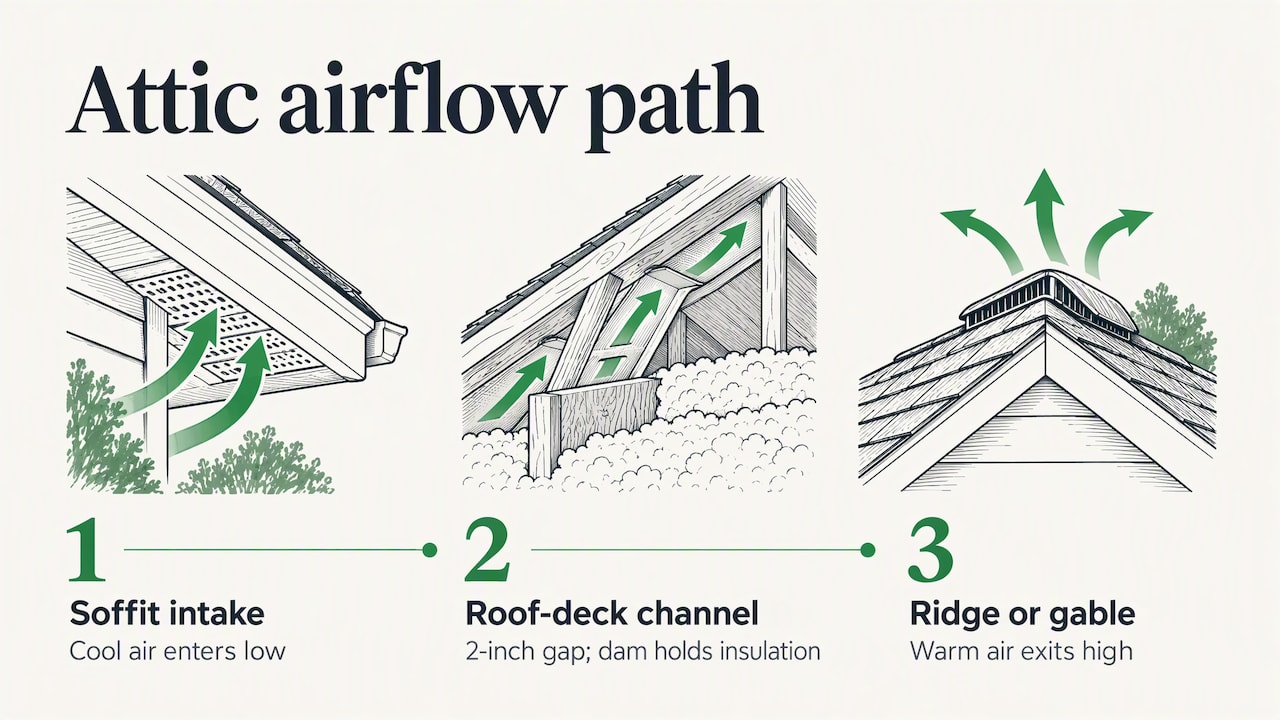
A wind dam is a rigid piece, such as foam, OSB or plywood, set vertically at the top plate. It works as a backstop for the insulation. Many baffles have this built into their lower edge as a flap. If yours does not, you can add a dam separately.
Why the most common mistake is at the eaves
ENERGY STAR says the most common mistake when installing insulation is blocking airflow at the eaves. It happens when a crew or a DIYer blows in or rolls out insulation until it touches the roof deck and covers the soffit openings. The attic looks well insulated, but the intake is dead. If you recently added insulation, this is the first place to look.
What wind washing looks like
When air bypasses the insulation at the edge, the result is called wind washing. The Building America Solution Center notes that it can cause energy losses, comfort problems and humidity concerns by letting outside air slip past the thermal boundary into floor cavities or knee walls. Its authors point out that it is often overlooked, especially in two-story homes. Signs inside the house include rooms over the garage or along the eaves that never feel right, even after you adjust the thermostat.
Choosing the right baffle
Most baffles look alike on the shelf, so it helps to know what to compare.
| What to compare | What to look for |
|---|---|
| Material | Plastic, molded foam and cardboard are all common. Foam and plastic hold their shape better in humid attics. |
| Width | Made to fit standard rafter bays. Measure the space between your rafters before you buy. |
| Length | Usually 2 to 4 feet, which is long enough to reach past the insulation depth you plan to install. |
| Lower edge | A wind dam or flap gives insulation a backstop, which helps most at low eaves. |
| Fit with trusses | In webbed truss attics, baffles between the rafters can run into the web members, so check clearance first. |
Match the baffle to your insulation depth
The baffle should extend past the top of the finished insulation. If you plan to add more insulation later, buy for the deeper level now. A baffle that is only a few inches tall will end up buried, and then it does nothing.
The Building America Solution Center also recommends, for new construction, designing homes with raised-heel energy trusses so full-height insulation fits over the top plates. That is a design choice you make before the roof goes on, not something you can add to an existing attic. In an existing attic, a baffle with a good wind dam is your best way to get close to the same result.
Metal roofs and special assemblies
Some roofs do not use a standard soffit-to-ridge path. Metal roofs, unvented assemblies and low-slope commercial roofs have their own rules. If you have a metal roof and are unsure how your attic is meant to ventilate, read our piece on metal roof ventilation before adding anything.
How to install rafter baffles
This is the process most guides agree on. The steps below follow the Building America Solution Center’s installation guidance and ENERGY STAR’s description of rafter vents.
- Prepare the work area. Wear a respirator, gloves, long sleeves and eye protection. Lay boards across the joists so you never step between them. Work early in the morning in summer, because Louisiana attics get dangerously hot by midday.
- Find every soffit vent from the inside. Use a flashlight along the eaves. If you cannot see daylight or feel air at a vent, note it.
- Pull back existing insulation. Clear it away from the eave so you can see the roof deck, and remove any debris or old nests from the vent opening.
- Position the baffle. It goes between two rafters, with the bottom edge near the top plate and the channel facing the roof deck. Rafter vents are made to be stapled to the roof decking between the rafters where the attic ceiling meets the attic floor.
- Staple it in place. Use heavy-duty staples, and place them so the baffle cannot drop. Do not use nails near the roof deck surface if they could poke through the shingles.
- Seal low eaves. When eaves are low, seal the baffle’s bottom edge to the top plate with spray foam so air cannot slip underneath.
- Replace the insulation. Bring it back up to, but not over, the baffle’s lower edge or wind dam. The baffle channel must stay open.
Two cautions at the roof deck. First, never staple through anything that could be a live wire or flue. Second, if you see dark staining, soft wood or daylight where it should not be, stop. That is a roofing problem, not a baffle problem, and it needs an inspection.
Installing baffles for soffit vents when there is no room
Some older Baton Rouge homes have shallow eaves where a standard baffle will not fit well. A shorter or flexible baffle plus a separate wind dam usually solves it. If you can barely reach the area, hire someone. Cramped, hot space is where mistakes and injuries happen.
Check the baffles you already have
Many attics have baffles installed years ago that have since slipped. The Building America Solution Center suggests looking at the eaves with a flashlight to see whether baffles are present. If they have fallen, they can often be reattached with a heavy-duty staple gun instead of being replaced.
A quick checklist for your next attic visit:
- Can you see each baffle, and is it tight against the roof deck?
- Is insulation touching or covering any soffit vent?
- Are there dark streaks on insulation near the eaves, which can mean air is moving through it?
- Is the soffit itself open? Paint, debris or old insulation can clog it from the outside.
- Do any rooms along the eaves run hot or humid compared to the rest of the house?
If the job looks bigger than a few fallen baffles, or you would rather not crawl through the attic, you can compare sealed contractor bids for the work before you commit.
What the building code says
Ventilation rules vary by city and parish, so confirm with your local building department. For reference, the Building America Solution Center’s code brief says the 2015 IECC/IRC, section R402.2.3 (N1102.2.3 in the IRC), requires that for air-permeable insulation in vented attics, baffles be installed next to soffit and eave vents. The baffle must keep an opening at least as large as the vent and must extend over the top of the attic insulation.
Two related points from the Solution Center’s guidance on ceilings:
- In Climate Zones 4 to 8, the air barrier belongs at the interior surface of the ceiling insulation, according to ENERGY STAR guidelines. Check which zone your state falls in before applying this.
- The air barrier needs to be solid and durable. Kraft paper and other materials that tear easily should not be used.
Air sealing and baffles go together. ENERGY STAR warns that when an attic is not well sealed from the living space, attic fans can pull conditioned air out of the house and raise energy bills. If you are trying to cut cooling costs, it helps to understand the ways to reduce cooling costs at home that involve air leakage and insulation performance, not just thermostat settings.
Baffles, insulation and your roof’s lifespan
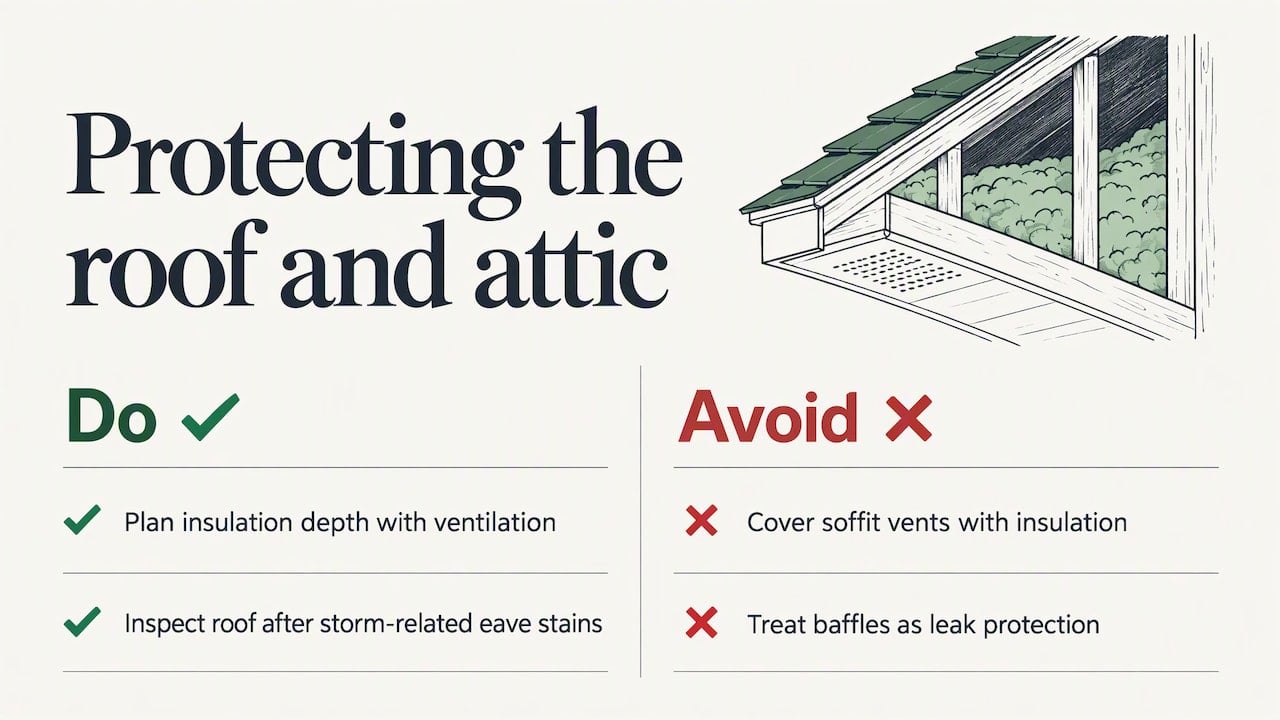
A blocked soffit is not only an energy issue. Trapped heat and moisture in an attic age shingles from underneath and can feed mold on the decking. We see the pattern often: a homeowner adds insulation for comfort, covers the soffit vents and a few years later wonders about curling shingles or a musty smell. Our guide to proper attic insulation for Baton Rouge homeowners explains how insulation depth and ventilation need to be planned together. Our roof and attic care tips cover the seasonal habits that catch these problems early, and our list of common roof maintenance mistakes shows what to avoid.
A note on storms. Louisiana wind can push rain up under shingles and into the attic. Baffles do not stop leaks, and they should never be treated as if they do. If you see water stains near the eaves after a storm, the cause is the roof, and the fix starts with an inspection, not a baffle.
When to call a roofer
Baffles are one of the easier attic jobs, but certain situations are better handled by a professional:
- The attic is too cramped or too hot to work in safely.
- You find stained, soft or rotted decking near the eaves.
- The soffit vents themselves are missing, painted shut or undersized.
- You are planning a roof replacement and want ventilation fixed at the same time, which is often the least disruptive moment.
- You are not sure whether your roof type needs a standard soffit-to-ridge path at all.
Our free residential roof inspection guide shows what a visit looks like, and our roof inspection service is where you can request one.
Our perspective: ventilation starts at the eave
We have spent more than 25 years working on Louisiana roofs, and we keep seeing the same thing: homeowners judge ventilation by the vents they can see from the street. The real problems are usually hiding at the eaves, where a slipped baffle or a handful of compressed insulation has quietly shut off the intake.
That is why our inspections include the attic side of the roof, not just the shingles. A roof can look fine from the driveway and still be cooking itself from below. We would rather show you a fallen baffle with a flashlight today than quote a larger repair later.
Our approach is built on clear communication and honest assessments without pressure. If the fix is a few staples and some foam, we tell you so. If the decking has been damaged by moisture, we explain what we found, why it matters in this climate and what the options are. Our work carries a five-year workmanship warranty, and our goal is for every ventilation fix to hold up through a Gulf Coast summer and the storm season that follows.
Get your attic checked by our team
If you are in the Baton Rouge area and want to know whether your attic is breathing properly, we can look at your baffles, soffit vents, insulation and decking in one visit. Our inspections are free, and we explain what we find in plain language. We also handle repairs, full replacements and storm damage restoration if the inspection turns up more than a slipped baffle.

Start with our roof inspection service, or see our roof repair options if you already know something is wrong.
FAQ
Do I need baffles if I have soffit vents?
If you have air-permeable insulation such as batts or blown fiberglass, yes. The 2015 IECC/IRC calls for baffles next to soffit and eave vents in that case. Without them, insulation can slide over the vent and block it, and wind can move through the material at the edge.
Can I reattach baffles that have fallen?
Usually, yes. The Building America Solution Center says fallen baffles can often be reattached with a heavy-duty staple gun. If a baffle is cracked, crushed or the wrong size, replace it. Pull the insulation back first so you can see the whole channel.
How long should a baffle be?
Most are 2 to 4 feet long and made to fit standard rafter bays. What matters is that the baffle extends past the top of your insulation so the channel stays open. If you plan to add insulation later, size for the deeper layer now.
Do baffles replace ridge or gable vents?
No. Baffles protect the intake side at the soffit. Your attic still needs an exhaust path, such as a ridge or gable vent, so air can flow from the eaves to the top of the roof. If the intake is blocked, the exhaust has nothing to pull.
Sources
- Look For and Install Attic Vent Baffles, Building America Solution Center
- Air Sealing and Insulating Ceilings in Vented Attics, Building America Solution Center
- Wind Washing, Building America Solution Center
- Sealing and Insulating Existing Vented Attics, Code Compliance Brief
- About Attic Ventilation, ENERGY STAR
- Baffles, Building Science Education