A flat roof blister is a raised pocket where the roof layers have separated and trapped air or moisture. Many small, closed blisters can be watched. A blister that is cracked, open, in a walkway or sitting over soft, wet insulation needs a professional repair. Heat is what makes them grow, and in Baton Rouge, where July highs average around 90°F, a roof gets plenty of it.
Below, we explain how to tell a harmless bubble from a leak in waiting, what repair involves, what it may cost, and when patching stops making sense.
TL;DR
- A blister is trapped air or moisture between roof layers. Heat expands it, so it grows through our long Louisiana summers.
- Small, closed, stable blisters in low-traffic areas can often be monitored. Cutting into a sound one can create a leak that did not exist.
- Repair is needed when a blister is open, cracked, has lost surfacing, shows exposed reinforcement, or sits where people walk.
- If moisture has spread through the insulation, patching individual blisters will not work. That calls for a section tear-off or a reroof.
- Blisters are usually treated as wear or installation problems, so insurance rarely pays for them. Wind or hail damage is a different story.
Table of Contents
- What a flat roof blister actually is
- Why blisters form on Louisiana roofs
- Flat roof blisters and shingle blisters are not the same problem
- Repair now, or leave it alone?
- How blisters are repaired
- When patching stops making sense
- Does insurance cover roof blistering?
- Our perspective: inspect first, cut second
- Prevention: how to keep blisters from forming
- Get your roof checked by us
- FAQ
- Sources
What a flat roof blister actually is
A blister forms where the membrane or its plies have lost adhesion to what is underneath. Angi describes it as a pocket of air trapped between roof layers that expands in direct sunlight and can eventually burst through the surface, exposing the material below.
Blisters are not unusual. Roofing Contractor magazine notes that conventional low-slope systems experience blisters in some form, and that membrane systems are most susceptible because blisters form in voids between plies or between the substrate and the membrane.
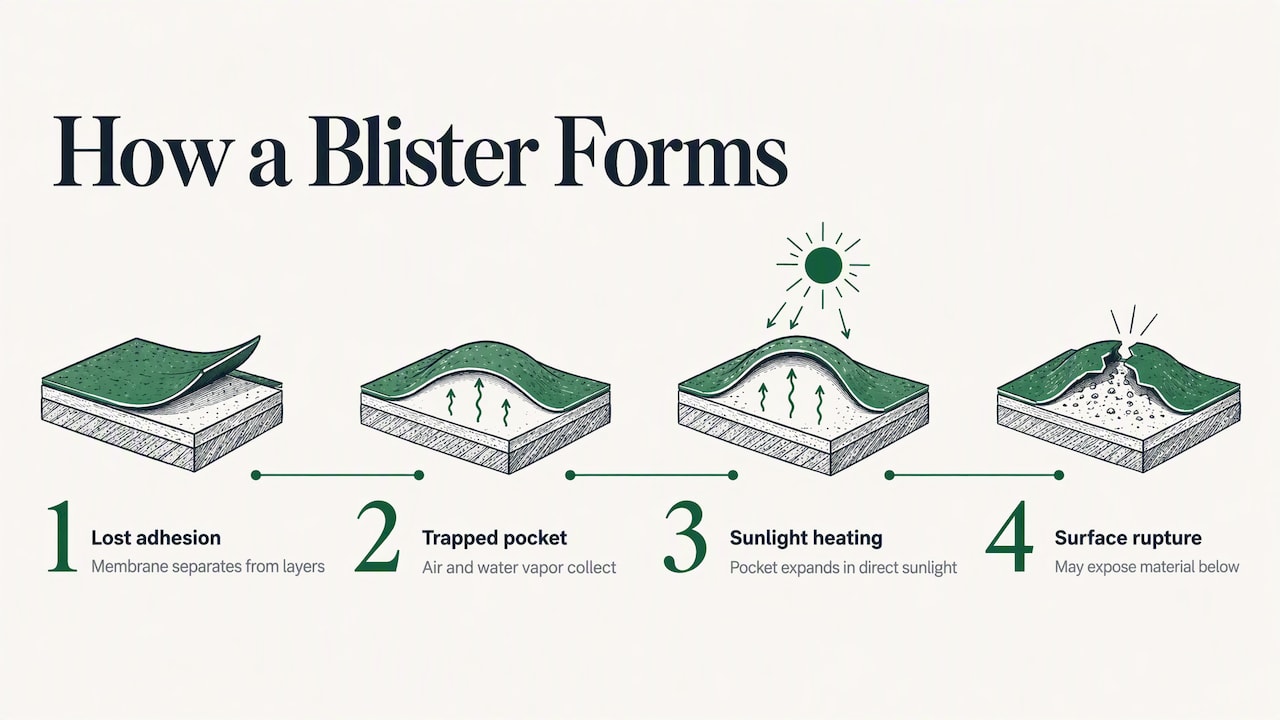
They also behave in a way that surprises homeowners. Dr. Matt Dupuis writes in Professional Roofing that blisters can be highly pressurized by thermal cycling, and that the gas inside is simply atmospheric air and water vapor. The bubble is a physical reaction to a trapped void or moisture meeting daily temperature swings. It is not a chemical problem, and it is not mysterious.
What a blister looks like
- A dome or pancake-shaped bump, from a coin size to a dinner plate or larger, that may feel firm or spongy underfoot.
- A bump that looks bigger on hot afternoons and flatter in the morning.
- On a granulated cap sheet or modified bitumen, a patch where granules are missing, or a split with black material showing.
- On single-ply membranes such as TPO, a raised, loose-feeling area, sometimes near seams, vents or curbs.
The same article notes that there are three types of blisters and that more than one can appear in the same area. That is one reason we do not diagnose a roof from a photo alone.
Why blisters form on Louisiana roofs
Three things show up again and again.
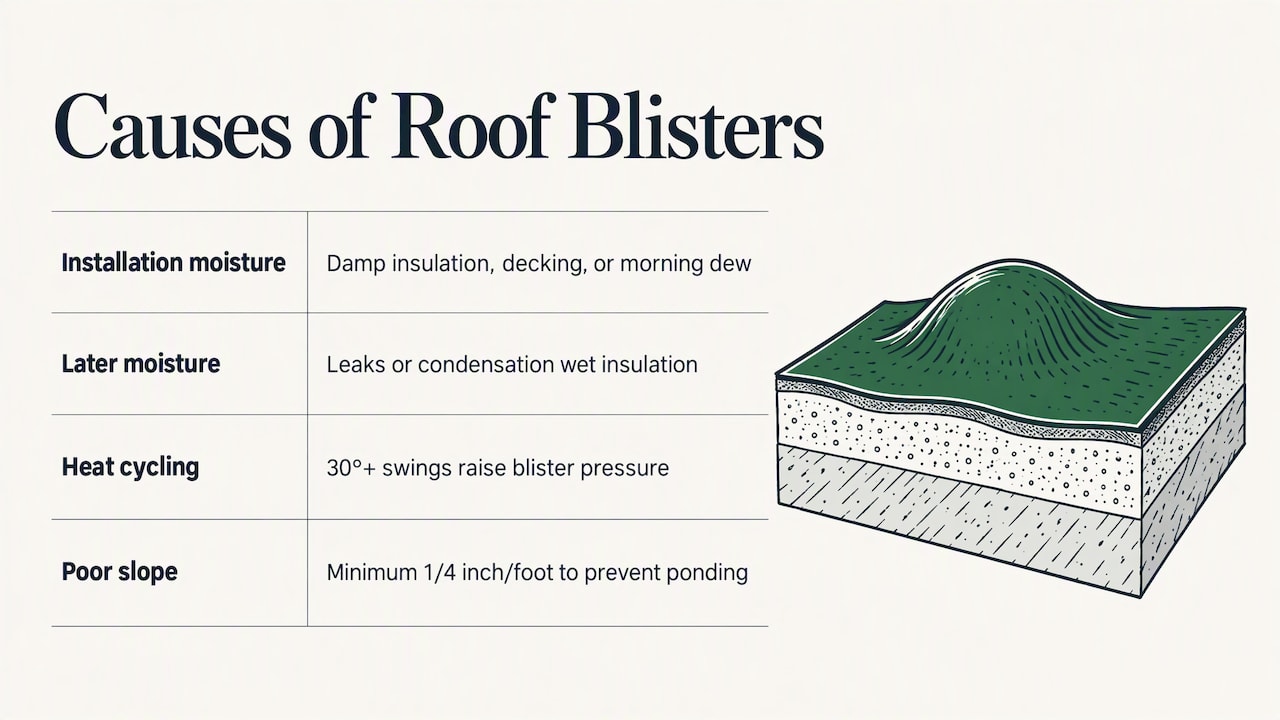
Moisture trapped during installation. If a roof goes down over damp insulation, wet decking or a surface with morning dew, that moisture has nowhere to go. In our humid climate, the window for a truly dry build-up is narrower than many crews admit. Industry guidance cited by a roof condition report for a California community college district stresses a dry build-up and proper design as the foundation of blister prevention.
Moisture that enters later. Water can get in through a failed seam, a bad flashing detail or a puncture, then sit in the insulation. Condensation from poor ventilation or the wrong type of vent can do the same.
Heat cycling. The same report points out that temperature swings of 30 degrees or more make roofing materials cycle repeatedly, which raises pressure in blisters and lets them grow over time. A dark roof surface in a Gulf South August reaches temperatures well above the air temperature, so the pressure builds daily.
Poor slope plays a part too. Standing water speeds up wear on the membrane. Guidance in the same report points to a slope of at least 1/4 inch per foot to avoid ponding. If your roof holds water for days, read our guide to ponding water on commercial roofs in Louisiana, because the lessons apply to many residential flat roofs too.
Flat roof blisters and shingle blisters are not the same problem
Many homeowners searching for shingle blisters or blistered shingles are looking at a pitched roof, not a flat one. The cause is similar: gas or moisture trapped in the material expands with heat and pushes up a bump. On asphalt shingles, that bump can burst and leave a crater where granules have gone, which exposes the asphalt to sun and rain. Angi’s description of blistering bursting through the surface applies to that stage.
The practical difference is the repair. A flat or low-slope roof is a continuous membrane, so one failure can let water travel sideways under it. On a shingle roof, individual shingles can often be replaced. If you see many blistered shingles across a slope, that tends to point to age or an attic ventilation issue, not a single bad spot. Our roof lifespan guide explains how to read those signs.
Repair now, or leave it alone?
This is the question most people have, and the honest answer is that it depends on the blister. Industry triage, as reflected in Professional Roofing and in the guidance Angi summarizes, looks like this:
| What you see | Usual approach |
|---|---|
| Small, closed, firm blister in a low-traffic area | Photograph it, measure it, and monitor it |
| Blister that is growing or multiplying | Have it inspected and tested |
| Open or cracked blister | Repair soon |
| Granules lost or reinforcement exposed | Repair soon |
| Blister in a walkway or near equipment access | Repair, since foot traffic will break it |
| Blister with a ceiling stain below or a soft spot | Inspect for wet insulation right away |
Why we do not cut every blister
Cutting into a sound, intact blister can create a new leak point where there was none. That is why the old habit of cutting out every blister has given way to a diagnostic-first approach. Professionals now check with a moisture scan or a test cut to learn whether a blister is an isolated defect or a symptom of wider saturation in the insulation. Fixing one bubble on a wet roof wastes money and leaves the cause in place.
How to monitor a blister
- Mark the blister’s outline with chalk or a paint pen and photograph it with a tape measure beside it.
- Check it again after the next hot, dry stretch and after the next heavy rain.
- Walk the roof only when needed and avoid stepping on blisters. If you are not comfortable on the roof, view it from a ladder or let us do it.
- Look at the ceiling below after storms for new stains.
- If it grows, cracks or multiplies, call for an inspection.
How blisters are repaired
The method depends on the roof type, but a sound repair follows a sequence.
- Find the extent. Moisture scanning or a test cut shows whether the insulation under and around the blister is wet.
- Remove what is wet. If the insulation is saturated, it has to come out. Drying and recovering it in place rarely works.
- Replace the insulation if needed and bring the substrate back to a dry, clean condition.
- Rebuild the membrane with compatible material, lapped and sealed so water cannot enter at the edges of the patch.
- Address the cause. That may mean a flashing fix, better venting or drainage, or relieving ponding.
On a flat roof with a visible defect, a one-visit repair is common when the damage is local. For a quick stopgap while you wait for a crew, see our guide on how to fix your roof temporarily. A temporary patch is a way to buy time, not a repair.
What blister repair costs
Costs vary with roof type, access and how much insulation is wet. Angi reports that basic blister repairs can start around $100 and may average $550, depending on the extent of damage. Those are national figures. We do not publish set prices for our roof repairs because the scope is what decides the number, so we give a written estimate after we look at the roof.
When patching stops making sense
If moisture has spread through the insulation, the system has failed as a whole. The report cited earlier notes that for systems that have already failed from systemic saturation, the dependable fix is a strip-and-relay or reroof, and that patching individual blisters on a saturated system is essentially ineffective.
Signs that you are in that territory:
- Blisters keep returning in new places after repairs.
- The roof feels spongy or soft over wide areas.
- Moisture readings or test cuts show wet insulation across large sections.
- Interior ceiling stains appear in more than one room.
- The roof is near the end of its service life anyway.
In that situation, replacing it gives you a chance to correct the root problems: add tapered insulation for drainage, choose a membrane suited to our heat, and install over a dry substrate. If you are replacing the roof and thinking about solar, plan the layout before the new membrane goes on. This guide to flat roof solar panels covers what to ask for and get in writing. For our own view on the repair-or-replace call, see our Baton Rouge repair versus replacement guide. Business owners can read our piece on when to fix or replace a commercial roof.
Does insurance cover roof blistering?
Usually not. Standard homeowners policies cover named perils such as fire, hail, lightning and windstorm, and generally exclude wear, maintenance issues and slow water intrusion. Because blisters most often come from age, installation faults or neglected moisture, insurers tend to treat them as maintenance items.
Two cautions. First, if a hailstorm or high winds damaged the membrane and a blister is part of that damage, that may be a different claim. Second, policies differ by carrier and by state. Read yours, and ask your agent or adjuster, not a contractor, what is covered. Our wind damage insurance tips for Louisiana roofs explain how storm claims are usually handled.
Our perspective: inspect first, cut second
We have worked on Louisiana roofs for more than 25 years, and our approach to blisters comes down to one rule: diagnose before you cut. A blister is a symptom. Sometimes it is a single trapped pocket of air that will sit quietly for years. Sometimes it is the first visible sign of a wet roof.
We would rather tell you honestly that a small, closed blister can be monitored than sell you a repair you do not need. We would also rather tell you plainly when patching is throwing money at a failed system. That is what clear communication and honest assessments mean to us in practice: you get the findings, the options and a written estimate, with no pressure.
Two things we see often. First, blisters concentrate around penetrations such as vents, pipes and curbs, where flashing details are complex and water finds its way in. Second, owners wait until a stain shows up on the ceiling. By then, insulation has often been wet for a while, and the repair is bigger. A yearly inspection, ideally before the storm season, catches blisters while they are still small. Our inspection frequency guide for Louisiana explains the timing.
Our repairs carry a five-year workmanship warranty, and we do inspections free of charge to help you spot problems before they escalate.
Prevention: how to keep blisters from forming
- Insist on a dry installation. Ask your contractor how they check substrate and insulation moisture and what they do when weather turns.
- Fix drainage. Clear drains and scuppers, and deal with ponding early. It speeds up membrane wear.
- Ventilate properly. Use vents suited to flat roofs, not those meant for a pitched roof.
- Inspect on schedule. NRC guidance on flat roof inspection recommends checking the ceilings under the roof for signs of leakage, among other routine checks.
- Limit foot traffic. Technicians servicing rooftop units should use walk pads.
- Repair small defects. Cuts, loose seams and failed flashing admit the water that later becomes a blister.
Get your roof checked by us
If you have found a bubble and are not sure what it means, we will come and look. Our roof inspection tells you whether you can monitor it or need a repair. If repair is needed, our roof repair team handles it, including emergency calls, and for commercial buildings we work on flat and low-slope commercial roofs, including TPO and metal. If the roof has failed, we can walk you through replacement and give you a written scope.
FAQ
How do you repair blisters on a flat roof?
First we confirm whether the insulation beneath is wet, using a moisture scan or a test cut. If it is localized, we remove the affected material, dry or replace the insulation, and patch with compatible membrane sealed at the edges. If moisture is widespread, a section replacement or reroof is the realistic fix.
Will bubbles in a roof membrane go away on their own?
Usually they do not. A blister may flatten in cool weather and swell again in heat, because the trapped air or vapor is still there. Small, closed ones can sit stable for years, but they will not heal, so keep an eye on them.
What does a roof blister look like?
It looks like a raised dome or pancake-shaped bump on the surface, sometimes with cracked or missing granules at the top. It often feels firm or spongy underfoot. It tends to look more pronounced on hot afternoons.
Does insurance cover roof blistering?
Usually not, since policies commonly exclude wear and slow water intrusion. Storm damage from wind or hail may be covered, so ask your insurer about your specific policy and document the damage with photos.
Should I pop a blister on my flat roof?
No. Cutting into a sound blister can create a leak where none existed. Have a roofer check for wet insulation before anyone cuts into the membrane.
Sources
- What Is Roof Blistering and How Can I Prevent It? | Angi
- Back to the start, Professional Roofing
- Blisters: To Repair or Not to Repair | Roofing Contractor
- Roof condition report, Ventura County Community College District
- What is Homeowners Insurance? | Lighthouse Insurance
- CBD-179. Inspection and Maintenance of Flat Roofs | NRC-IRC
- Baton Rouge July Weather | Weather Spark