
A leaking roof vent is almost always a failed seal, not a failed roof: a cracked rubber pipe boot, corroded flashing, loose fasteners or damaged shingles around the opening. The lasting fix is to replace the failed part and rebuild the flashing correctly, not to smear more sealant on it. On a wet, steep Louisiana roof, that is work for a roofer. We repair roof vents across Baton Rouge and the surrounding parishes, and we start with a free inspection to find where the water is really getting in.
Key Takeaways
- Most vent leaks come from a worn pipe collar or flashing, and the stain on your ceiling can sit several feet from the actual entry point.
- Condensation from poor attic ventilation can look exactly like a roof leak, so the cause has to be confirmed before anything is replaced.
- Caulk and spray sealants are a short-term patch. A vent that leaks twice usually needs the boot, flashing or whole vent replaced.
- A typical vent leak repair is a few hundred dollars. Waiting until water reaches the deck, insulation and ceiling is what makes it expensive.
- Do not climb onto a wet or steep roof. Protect the interior, document the damage and call a roofer.
Table of Contents
- What causes a roof vent to leak
- Is it the vent, another part of the roof, or condensation?
- Signs of poor roof ventilation
- What to do first when it is raining
- How a roof vent leak is properly repaired
- Will Flex Seal or roofing cement fix a leaking vent?
- What a roof vent repair costs
- Does insurance cover a leaking roof vent?
- Prevent the next leak
- Our perspective
- Get your vent inspected in Baton Rouge
- FAQ
- Sources
What causes a roof vent to leak
Every vent, plumbing stack, exhaust fan or ridge vent is a hole cut in your roof. Water stays out only because of the flashing, the metal or rubber collar that sheds water around that hole. When that collar fails, rain gets in. The most common causes are:
- A cracked or split rubber boot. On a plumbing vent pipe, damage to the collar or the flashing around it from weather exposure or debris strikes is the usual culprit. Sun and heat cycling dry out the rubber until it splits around the pipe.
- Corroded or bent flashing. Metal bases rust, and a branch or hail strike can bend the edge up so water runs underneath.
- Loose or exposed fasteners. Nails that back out or were never sealed give water a path down the shaft of the nail.
- Failed sealant. Caulk shrinks and cracks. Sealant is not a substitute for correctly layered flashing, and older roofs often carry several layers of old patches.
- Installation errors. A boot that is the wrong size, or flashing that was not woven in under the right shingle courses, can leak from the first storm.
- Storm damage. High winds and hail crack plastic vent covers and lift shingles beside the vent. After a named storm, check vents along with everything else.
In south Louisiana, a roof takes intense sun, heavy rain, high humidity and the occasional hurricane-driven wind in the same year. That combination wears out rubber boots and loosens fasteners faster than many homeowners expect, which is why a vent that looked fine last spring can drip this fall.
Is it the vent, another part of the roof, or condensation?
Before anyone repairs anything, the source has to be right. Replacing a boot that was never leaking is the most common reason a “fixed” leak comes back. Use timing and location as your clues.
| What you see | What it usually points to |
|---|---|
| Water at the vent opening during rain | Failed pipe boot, flashing or fasteners |
| Wetting mainly when wind blows from one direction | An open flashing edge or a gap in the collar on the windward side |
| Beads of moisture along a long stretch of pipe in cold, humid weather | Condensation, not a roof leak |
| Dampness at a pipe joint after you run a sink or shower | A plumbing leak, not a roof leak |
| Staining uphill of the vent | Water entering higher on the roof and traveling down |
The stain you see inside is rarely directly under the entry point. Water runs along sheathing, rafters, pipes and insulation before it shows up, so a ceiling spot can be several feet from the vent. Note when it happens (only during rain, only after showers, only on cold mornings) and where the first wet spot appears.
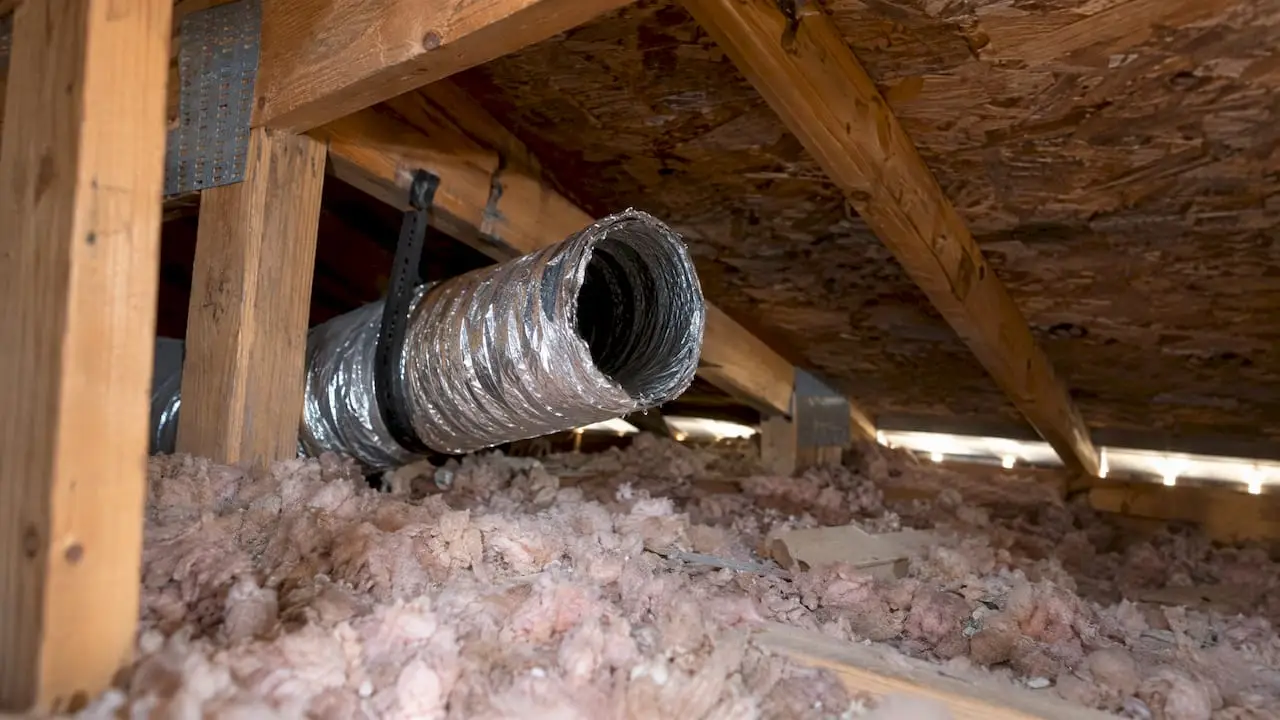
The U.S. Department of Energy’s Guide to Durable Attics lists what to look for in the attic: wet insulation, especially near the eaves, mold or mildew on attic surfaces, and warped or rotting wood. It also notes that moisture gets into attics through roof leaks, poorly flashed penetrations, and water vapor from the house that has no way out.
One more cause to rule out: a bathroom fan, range hood or dryer vented into the attic instead of outdoors. The same guide calls that a major source of attic moisture that can lead to mold and may violate local building codes. If your “leaking vent” drips only after showers, start there.
If the water has already stained a ceiling, act quickly on ceiling water damage so it does not spread, and rule out a plumbing source along with the roof.
Signs of poor roof ventilation
Sometimes there is no failed seal at all. An attic that cannot breathe traps heat and humidity, and the moisture condenses on cool surfaces. Louisiana’s long, humid cooling season makes this common. Warning signs include:
- Moisture, mold or a stale smell in the attic
- Rusty nail tips or damp decking underneath
- Shingles that buckle, curl or blister
- Rooms under the roof that stay hot, and high cooling bills
- Blocked or painted-over vents, or insulation stuffed against the eaves
The Asphalt Roofing Manufacturers Association explains that ventilation has two jobs: moving summer heat out of the attic and exhausting water vapor before it condenses. Its technical bulletin gives the standard code guideline of 1 square foot of net free vent area per 150 square feet of attic floor, which many codes reduce to 1:300, and warns that without proper ventilation roofs face premature failure, shingle buckling, wood rot and trapped moisture. Shingle manufacturers also write ventilation requirements into their warranties, so a poorly vented attic can put your shingle coverage at risk.
Good airflow means cool air coming in at the soffits and hot air leaving at the ridge, with baffles keeping insulation from blocking the intake. We explain how that works in our guide to attic baffles and ventilation. If your vent is a ridge vent, see our page on ridge vent leaks. If you have a metal roof, our metal roof ventilation guide covers the differences.
What to do first when it is raining
The goal in the first hour is to limit damage, not to fix the roof.
- Protect the inside. Move furniture, place a bucket under the drip and lay towels down. If the ceiling bulges with trapped water, a small hole in the lowest point lets it drain into a bucket instead of collapsing.
- Document everything. Take dated photos and video of the stain, the attic and the vent from the ground. You will want them for a roofer and for your insurer.
- Stay off the roof. A wet, steep or storm-exposed roof is dangerous, and walking on it can crack shingles and make the problem worse.
- Check the attic if you can reach it safely. Look for the first wet spot, wet insulation and where daylight or dampness shows around the pipe.
- Call a roofer for any active leak. If water is coming in now, ask for emergency service and temporary protection such as tarping.
If the attic or ceiling has been wet for more than a day or two, mold becomes a concern. Fast cleanup after a roof leak matters, because wet insulation and drywall that stay damp are what turn a small repair into a larger one.
We offer emergency roof repairs and roof tarping for exactly this situation. Our guide on fixing your roof temporarily explains what temporary protection looks like while a permanent repair is scheduled.
How a roof vent leak is properly repaired
The repair depends on what failed. This is the sequence a correct repair follows.
Step 1. Confirm the source
The roofer checks the boot, flashing, fasteners and surrounding shingles, then the attic underside, to match the roof opening to the stain inside. This is where a guess costs money. We start with an inspection, and we offer free inspections, so you know what is actually wrong before you approve work.
Step 2. Choose repair or replacement
A repair may be enough when only a boot, cap, seal, fastener or nearby shingle has failed. Replacement is more likely when the vent is cracked, loose, rusted, poorly installed or storm-damaged, or when it leaks repeatedly. If the same vent leaks again after being patched, the whole boot, flashing or vent assembly should be replaced.
Step 3. Replace the failed part
For a plumbing stack, the standard approach is to slide a new rubber boot over the pipe so it lies flat over the old flashing, with sealant at the edges. On most roofs, a lasting repair also means lifting the surrounding shingles, setting the new flashing so the upper edge sits beneath the shingles above and the lower edge laps over those below, and securing it with sealed fasteners. That layering is what sheds water, and getting it right on a steep, hot, wet roof is the part that takes experience.
Step 4. Check the deck and insulation
If water has been entering for a while, the sheathing around the vent may be soft and need replacement before the new flashing goes on. Wet insulation is removed and replaced.
Step 5. Address ventilation if it contributed
If the inspection finds blocked soffits, missing baffles or an exhaust duct ending in the attic, fixing only the vent leaves the cause in place. We look at the attic airflow along with the penetration.
Our written work is backed by a five-year workmanship warranty.
Will Flex Seal or roofing cement fix a leaking vent?
A tube of roofing cement or a can of spray sealant can slow a drip for a while, which is why so many homeowners try it. But a sealant sits on top of the problem. It does not rebuild the flashing layers, and it cracks again under Louisiana sun and heat cycles. It can also hide the original entry point, making the next diagnosis harder. If you do apply a stopgap in an emergency, treat it as temporary and have the vent looked at the same week.
A vent that has been patched more than once is a signal that the boot or flashing has reached the end of its life. Replacing it costs less than a repeated cycle of patches plus the interior damage in between. For a deeper comparison of the options, see our page on professional repairs versus DIY.
What a roof vent repair costs
Because we price each job after seeing the roof, we do not publish a fixed price for vent repairs. These published national ranges give you a sense of scale:
| Repair type | Typical national range | Source |
|---|---|---|
| Roof vent leak repair | $100 to $600 | Fixr, 2026 |
| Vent leak repair (many homeowners pay about $425) | $150 to $750 | Danbury Renovation, 2026 |
| Vent boot replacement | $150 to $450 | Danbury Renovation, 2026 |
| Vent plus roof deck repair | $450 to $1,500 | Danbury Renovation, 2026 |
What moves the price:
- Vent type. A simple plumbing boot costs less than a ridge vent or a bathroom exhaust vent.
- Roof pitch and height. Steeper and taller roofs take more time and safety equipment.
- Hidden damage. Rotted decking, wet insulation and ceiling repairs add to the bill.
- Urgency. The same Danbury source reports that emergency storm work can add 10% to 30%.
The pattern is consistent: a boot caught early is the cheapest version of this repair. Interior damage is what pushes the total toward the top of the range.
Does insurance cover a leaking roof vent?
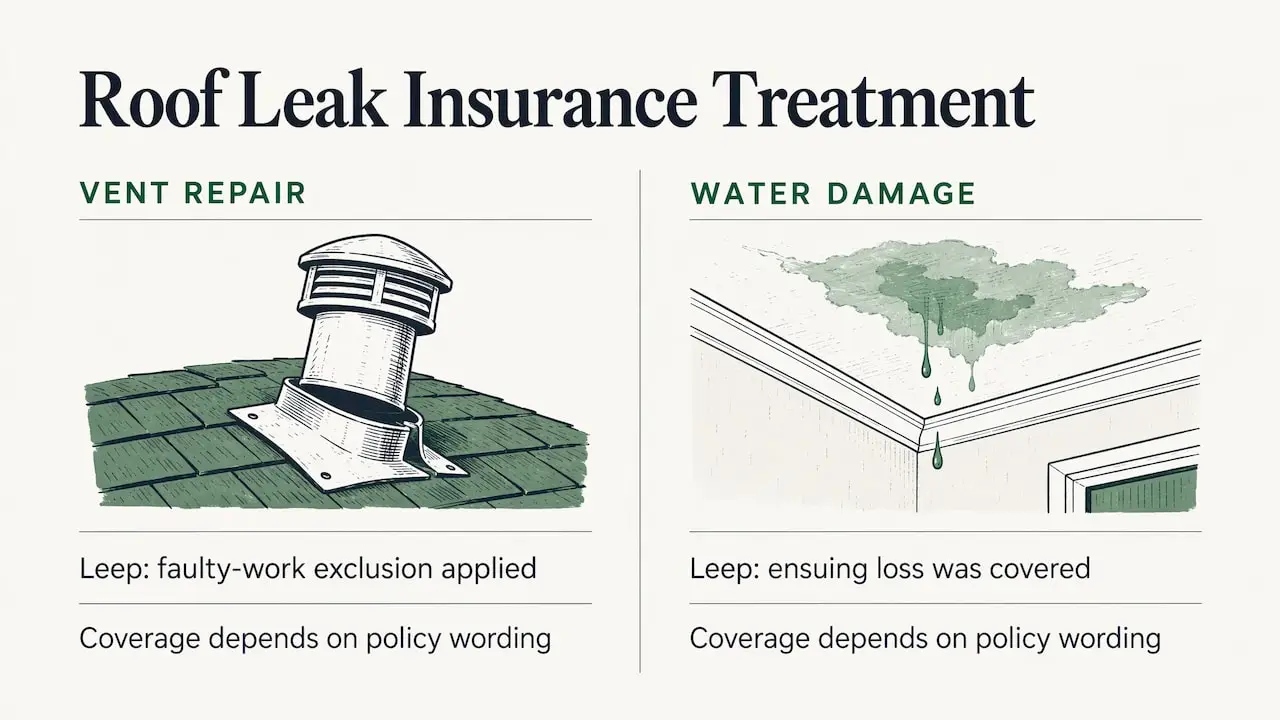
It depends on your policy and on what caused the damage. Policies commonly treat sudden storm damage differently from gradual wear, and the cost of repairing the failed part can be treated differently from the water damage that follows. A court decision, Leep v. Trinity Universal Insurance Co., illustrates the point: the cost of fixing a disconnected vent fell under a faulty-workmanship exclusion, while the resulting water damage was a covered ensuing loss. Your own policy language controls, so call your insurance agent or carrier before you sign a repair contract, and keep your photos and the roofer’s written findings. If the leak followed a storm, our storm damage restoration team documents the damage so your claim has clear records.
Prevent the next leak
- Schedule a roof inspection once a year and after major storms, before the next hurricane season. Our annual roof inspection page explains what it covers.
- Have rubber boots checked when the roof is more than a few years old.
- Keep soffit vents clear and insulation baffled away from them.
- Make sure bathroom fans, range hoods and dryers vent outdoors.
- Trim branches that can strike vents in high wind.
For business owners and property managers, the same logic applies to rooftop units, exhaust vents and drains on flat roofs. Our commercial roofing team handles commercial roof maintenance, so penetrations are inspected on a schedule rather than after a tenant complaint.
Our perspective
We repair roof vents in Baton Rouge and the nearby parishes, and the lesson is the same on almost every job: the drip is the symptom, and the entry point is somewhere else. That is why we begin with an honest assessment instead of a quote for a product. A boot that is cracked gets replaced. A vent whose flashing was never layered correctly gets rebuilt. An attic that traps humidity gets its airflow corrected, because otherwise the new vent is working against the same problem.
Louisiana weather is hard on roofing details. Strong sun, heavy rain and storm winds all concentrate their stress at penetrations. Our approach is built around those conditions: clear communication about what we found, no pressure about what to do next, and careful workmanship backed by a five-year workmanship warranty.
If a vent is leaking, do not wait for the ceiling to tell you how bad it is. A prompt inspection is the least expensive step in the whole process.
John
Get your vent inspected in Baton Rouge
If water is showing up near a roof vent, our team can find the real source and fix it. We handle roof repairs, including emergency repairs and tarping, and we offer free inspections so you get a clear, pressure-free assessment first.

Book through our roof inspections page and tell us when the leak appears and where you see the first stain. That detail helps us trace it faster.
FAQ
Why does my roof vent leak only when it rains hard?
A small gap in the boot or flashing may only let water in when rain is heavy or wind-driven. Wetting on one side during storms often points to an open flashing edge or collar gap. Because the gap is small, the leak seems intermittent, but the water is still reaching the deck.
Can I just caulk around the vent?
Caulk can slow a drip temporarily, but it does not replace correctly layered flashing and it cracks as it ages. If the vent has already been sealed once and leaks again, the boot or flashing needs to be replaced. Have a roofer inspect it rather than adding another layer.
How do I know if it is condensation instead of a leak?
Condensation tends to appear as moisture beads along cold surfaces in humid weather, not only during rain. A leak shows up when it rains. If the moisture appears on cool mornings or after showers, check for blocked attic ventilation or an exhaust fan venting into the attic.
How much does it cost to fix a roof vent leak?
Published national figures put a typical vent leak repair at roughly $100 to $600, with more extensive repairs costing more. The cost rises when decking, insulation or ceilings are damaged. We assess each roof before giving a price.
Is a leaking roof vent an emergency?
If water is coming in during rain, treat it as urgent: protect the interior, take photos and call a roofer for emergency repair or tarping. A slow drip still deserves an inspection within days, because wet decking and insulation worsen quickly in Louisiana humidity.
Sources
- Guide to Durable Attics, U.S. Department of Energy
- Technical Bulletin: Why Ventilation Is Important, Asphalt Roofing Manufacturers Association
- How to Spot and Prevent Roof Vent Pipe Leaks, GAF
- How to Fix a Leaking Roof Vent, Rescreening Masters
- Roof leaking around a vent pipe, ShingleScience
- Roof Vent Repair Cost, HomeRepairCalc
- How to Fix and Maintain a Leaking Rooftop Vent Pipe, This Old House
- How Much Does It Cost to Repair a Roof Leak, Fixr
- Roof Vent Leak Repair Cost, Danbury Renovation
- Leep v. Trinity Universal Insurance Co.
- Water Leak from Ceiling
- Roof Leak Water Damage