A warehouse roof repair is done in four steps: find where the water really enters, dry what got wet, repair the membrane or metal panel the way that system requires, and document the work. Typical U.S. costs run from a few hundred dollars for a single membrane patch to several thousand for a multi-seam zone, and they climb when insulation is wet or the roof is hard to reach. In Louisiana, heavy rain, heat and hurricane winds make that sequence matter even more. We repair commercial and industrial roofs in Baton Rouge and the surrounding parishes, and we offer free inspections so you know what you are dealing with before you commit to anything.
Key Takeaways
- Most low-slope warehouse roofs leak at seams, penetrations and drains, not across the open membrane, so the repair has to start with tracing the leak, not patching the ceiling stain.
- The right repair depends on the roof system: TPO and PVC are heat-welded, EPDM uses splice tape and primer, modified bitumen uses a torch-applied patch, and metal panels need fasteners and washers addressed.
- Published U.S. repair ranges run from roughly $3 to $14 per square foot, with emergency work adding 25% to 50%. Your own number depends on penetrations, access and wet insulation.
- Repair makes sense when damage is localized and the roof is under roughly 75% to 80% of its expected life. Past that, coating or replacement usually pays back better.
- After a storm, document storm damage separately from old wear before anyone touches the roof.
Table of Contents
- Why warehouse roofs fail in Louisiana
- Where the leak really is
- How the repair depends on your roof system
- What warehouse roof repair costs
- Repair, coat or replace
- What to do first after a storm
- Maintenance that keeps repairs small
- A free look at your warehouse roof
- Our perspective
- FAQ
- Sources
Why warehouse roofs fail in Louisiana
Warehouses are big, flat or nearly flat, and covered in things that pierce the roof: HVAC curbs, vents, conduit, skylights and drains. Every one of those is a place where water can get in. Add Louisiana’s long wet season, summer heat that works membranes and sealants hard, and wind from tropical systems, and small defects open up fast.
Facilities-maintenance guidance notes that most commercial low-slope roofs, whether EPDM, TPO, PVC or built-up asphalt, fail at seams, penetrations and drains rather than across the main field of the membrane. That is useful because it tells you where to look first.
Warning signs to look for
A roof inspection guide from the Institute for Catastrophic Loss Reduction (a Canadian research body) lists what to check. On low-slope roofs, long-term standing water can make membranes brittle, and mold or vegetation growing on the surface is a sign that water is sitting. On single-ply membranes, look for blisters, cracks, tears, punctures and fasteners backing out. On metal roofs, look for loose screws, worn rubber washers and rust on panels.
Inside the building, watch for:
- Ceiling stains or drips after rain, especially near rooftop units or walls
- Damp insulation or sagging ceiling tiles
- Rust on racking or equipment below a suspected leak
- Water that appears only during wind-driven rain, which usually points to flashing or a seam
Where the leak really is
The stain on your warehouse floor or ceiling is rarely under the hole. On a low-slope roof, water often tracks along a deck seam feet away from where it finally drips through. Patching where the stain appears is the most common reason a repair fails.
A proper service call, as described in that same guidance, includes interior leak tracing, a moisture-meter inspection, cleaning and drying the surface, a repair matched to the membrane, re-securing pipe boots and curb flashing, clearing the affected drain, and photos with a written report. When we inspect a warehouse roof, that is the standard we hold the job to. Our inspections are free, and they are where we find out whether you have a ten-minute flashing problem or wet insulation that needs to come out.
If you want to know how the roof looks before we arrive, our roof inspection service covers exactly that, and our guide to the most common commercial and multi-family roofing problems shows what we usually find.
How the repair depends on your roof system
There is no single warehouse roof repair. Each system has its own method, and using the wrong one is how patches peel off in the first summer.
| Roof system | Typical repair method | Published U.S. cost range |
|---|---|---|
| TPO or PVC | Hot-air welded cover patch | $400 to $1,200 per single patch; $1,500 to $4,000 for a multi-seam zone |
| EPDM | Splice tape, primer and cement (primer is mandatory) | $300 to $900 per zone |
| Modified bitumen | Torch-down cap-sheet patch with a 6-inch overlap | $600 to $1,800, plus a fire watch and hot-work permit |
| Aging membrane | Recover-board overlay, or fluid-applied silicone or acrylic coating | $4 to $7 per sq ft for an overlay; $1.50 to $3.50 per sq ft for a coating |
Those figures come from a 2026 U.S. repair-method table and are national ranges, not Baton Rouge quotes. Two details in them are worth understanding.
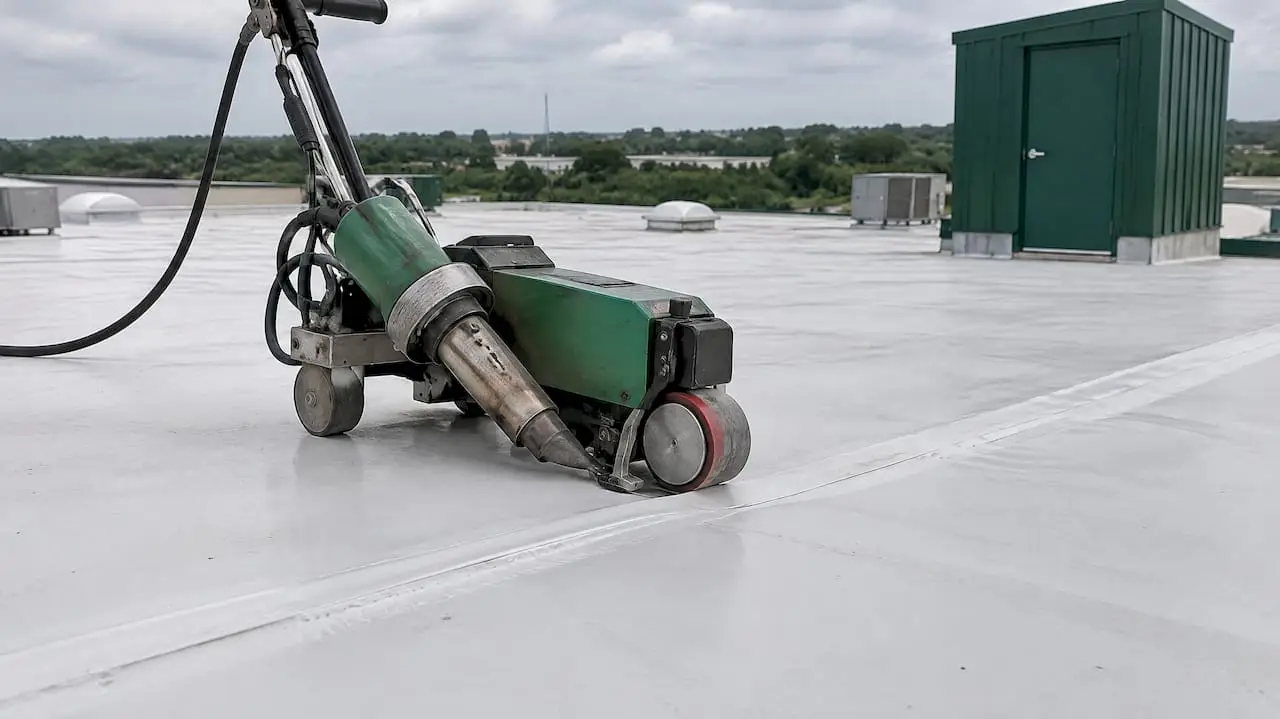
First, torch-down work on modified bitumen is hot work. It calls for a fire watch under NFPA 241 (the fire-safety standard for construction and repair operations) and often a permit, which adds cost. Second, a welded repair on a TPO roof only holds if the old membrane is clean enough to weld to. Roofs that have sat for years under Louisiana humidity and mildew need proper cleaning first.
If you are not sure what your roof is, or you are weighing a new membrane, our TPO vs EPDM guide for Louisiana commercial flat roofs explains how the two behave in this climate. For metal buildings, our commercial roofing page covers metal and TPO systems, and our guide to the best materials for commercial roofing goes further.
What warehouse roof repair costs
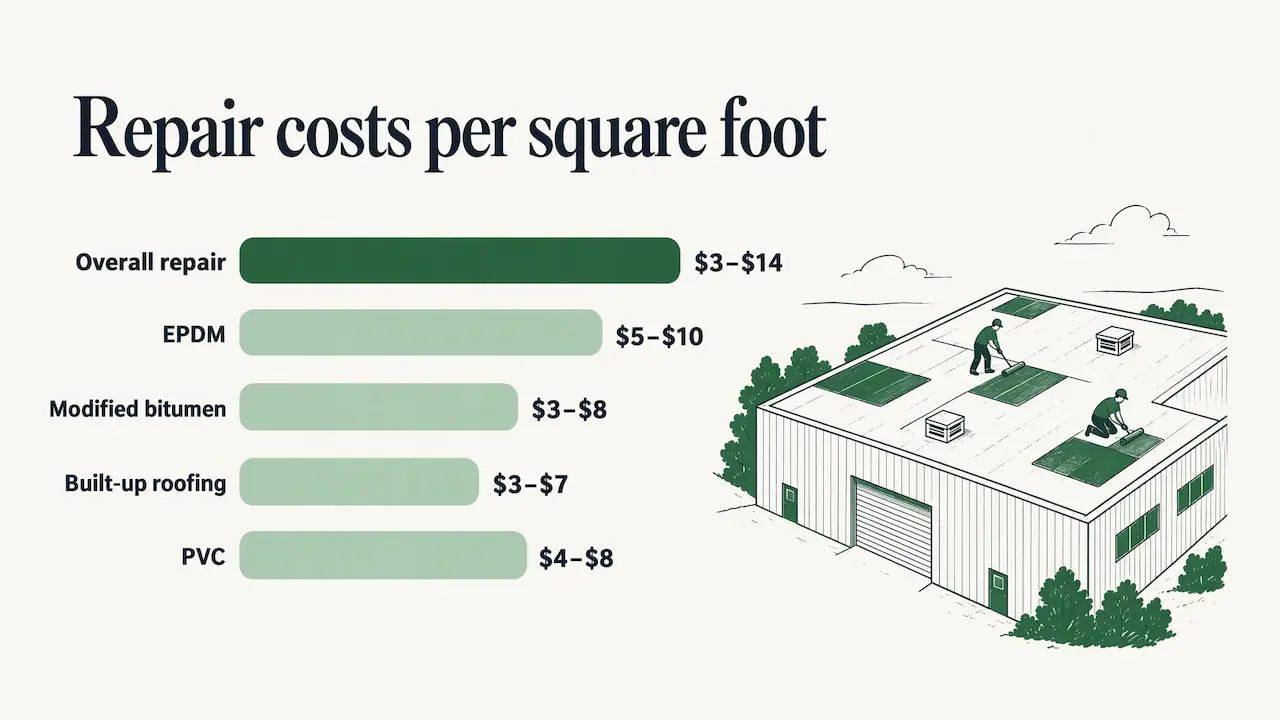
Here is the honest range. One 2026 U.S. cost guide puts commercial roof repair at $3 to $14 per square foot, depending on system and extent of damage, with emergency repairs adding 25% to 50% to standard rates. By system, it lists EPDM at $5 to $10 per square foot, modified bitumen at $3 to $8, built-up roofing at $3 to $7 and PVC at $4 to $8. TPO repairs are listed as $600 to $3,000 per project.
We do not publish prices, because a warehouse roof is not a standard product. We give a written assessment and quote after the inspection. What moves the number most:
- Penetrations. HVAC curbs, conduit, skylights and drains each need their own flashing work.
- Access. A roof that needs a lift or has limited walkways costs more to work on.
- Wet insulation. If water has gotten into the insulation, it has to be removed and replaced, not just covered.
- Urgency. After-hours and storm-surge calls cost more.
- Roof age and system. An older membrane may not accept a patch, which changes the whole decision.
An inspection by itself, according to the same guide, typically runs about $75 to $600 depending on size and complexity, and a basic maintenance plan averages $0.03 to $0.04 per square foot, usually including an inspection, drain cleaning and a written report. Our own inspections are free, and that is where a repair budget should start.
A worked example
Say a 20,000 sq ft TPO warehouse roof leaks near a rooftop unit. A tracing visit finds an open seam around the curb. A welded multi-seam zone repair in the published $1,500 to $4,000 range is a reasonable expectation. Now say the same leak went unnoticed through a wet season and the insulation under the unit is saturated. The job now includes cutting out and replacing that insulation, and the bill is no longer a seam repair. That gap is why early repair is cheaper, and why we want to see a leak the week it starts.
Repair, coat or replace
Most owners want the cheapest option that works. The question is how long it will last.
A 2026 cost guide says repair makes sense when damage is localized and the roof is under about 75% to 80% of its expected lifespan. Beyond that, coating restoration or replacement usually delivers a better return. The same repair-method table puts a full overlay at $4 to $7 per square foot versus $9 to $14 for tear-off, and a restoration coating at $1.50 to $3.50 per square foot, extending service life by 10 to 15 years.
Coating is not a cure for wet insulation. Our article on roof coating vs. replacement explains why moisture has to be checked first. If you are weighing localized repair, overlay, coating or replacement, restoration versus replacement decisions follow the same logic on masonry, where a fix only lasts when it addresses the cause. For roofs specifically, read our guide on when to fix vs. replace a commercial roof in Baton Rouge and our commercial roof replacement cost guide.
A quick test:
- Repair if the problem is one or two seams, a flashing or a drain, and the roof has plenty of life left.
- Coat if the membrane is sound but worn, and moisture readings show dry insulation.
- Replace if leaks keep returning in different places, insulation is widely wet, or the roof is near the end of its life.
What to do first after a storm
Louisiana warehouse owners deal with wind and rain damage regularly. The order of operations affects both the repair and any insurance claim.
- Make the building safe. Keep people away from areas with ceiling damage or standing water, and shut off power where water is near electrical equipment.
- Stop more water getting in. Temporary tarping limits interior damage. We offer roof tarping and emergency roof repairs as part of our storm damage restoration work.
- Document everything. Take time-stamped photos and video of the roof exterior, the roof surface and the interior, showing the path from the point of entry to the affected areas. Keep a written log of when you found the damage, the weather, and everyone you contacted.
- Separate storm damage from old wear. One 2026 roofing-repair guide advises documenting each independently, because a blended report gives the insurer room to deny the whole claim. Worn-out seams and dried sealant are a maintenance item, not a storm claim.
- Call your insurance carrier and read your policy, including any named-storm or wind deductible. Your insurance agent is the right person for coverage questions.
For more on how coverage works here, see our wind damage insurance coverage tips for Louisiana roofs and our guide to commercial storm damage restoration.
Maintenance that keeps repairs small
A warehouse roof that is inspected twice a year, once before hurricane season and once after, rarely surprises its owner. Drains get cleared before they back up. Loose fasteners get tightened before panels move. Sealant gets refreshed before it cracks.
Cost guidance frames maintenance as part of the roof’s financial structure, which is why many owners fold inspections into a service contract instead of buying them ad hoc. Property managers with several buildings benefit most, because a written report per building makes budgeting predictable. We provide commercial roof maintenance and annual inspections for exactly this reason.
A free look at your warehouse roof
If your warehouse roof is leaking, has taken storm damage, or is simply getting old, we can inspect it for free and tell you plainly what it needs. We have more than 25 years of roofing experience, we serve Baton Rouge and the surrounding parishes including Ascension, Livingston and Iberville, and our repairs carry a five-year workmanship warranty.
Start with our commercial roofing services, or book an inspection through our roof repair page.
Our perspective
Most warehouse roof problems we are called to are not mysteries. The leak is at a seam, a curb, a drain or a fastener, and the owner has already paid once for a patch somewhere else.
We think the honest way to run a repair is to find the source first, tell you what we found, and show you the options without pressure: repair, coating or replacement. Louisiana weather punishes shortcuts, so we match the repair to the roof system and stand behind the work with a five-year workmanship warranty.
That is also why we offer free inspections. A roof you understand is a roof you can budget for, and a small repair done early is almost always the cheapest one.
John
FAQ
How much does warehouse roof repair cost?
Published U.S. ranges run from about $3 to $14 per square foot, and single-patch repairs on TPO or PVC can start in the hundreds of dollars. Penetrations, access and wet insulation drive the final number. We quote after a free inspection.
Can a warehouse roof be repaired while the building is in use?
Often yes, because most repairs are done from the roof. Work that involves torches or roof openings needs more planning, and torch-applied repairs call for a fire watch. We schedule around your operations where we can.
How often should a warehouse roof be inspected?
Twice a year is a sound routine, before hurricane season and after it, plus after any major storm. Annual inspections are the minimum for most commercial roofs. We offer both one-time and recurring inspections.
Should I repair or replace my warehouse roof?
Repair when damage is localized and the roof is under about 75% to 80% of its expected life. If leaks recur or insulation is widely wet, replacement or coating is usually the better value. An inspection will show which applies.
Sources
- How to inspect and maintain your commercial roof (ICLR, June 2022)
- Commercial Roof Repair (Facilities Maintenance)
- Commercial Roof Repair: Costs by System Type (First Roof Guide, 2026)
- Warehouse Roof Repair: Patch, Weld and Cold Methods (2026)