
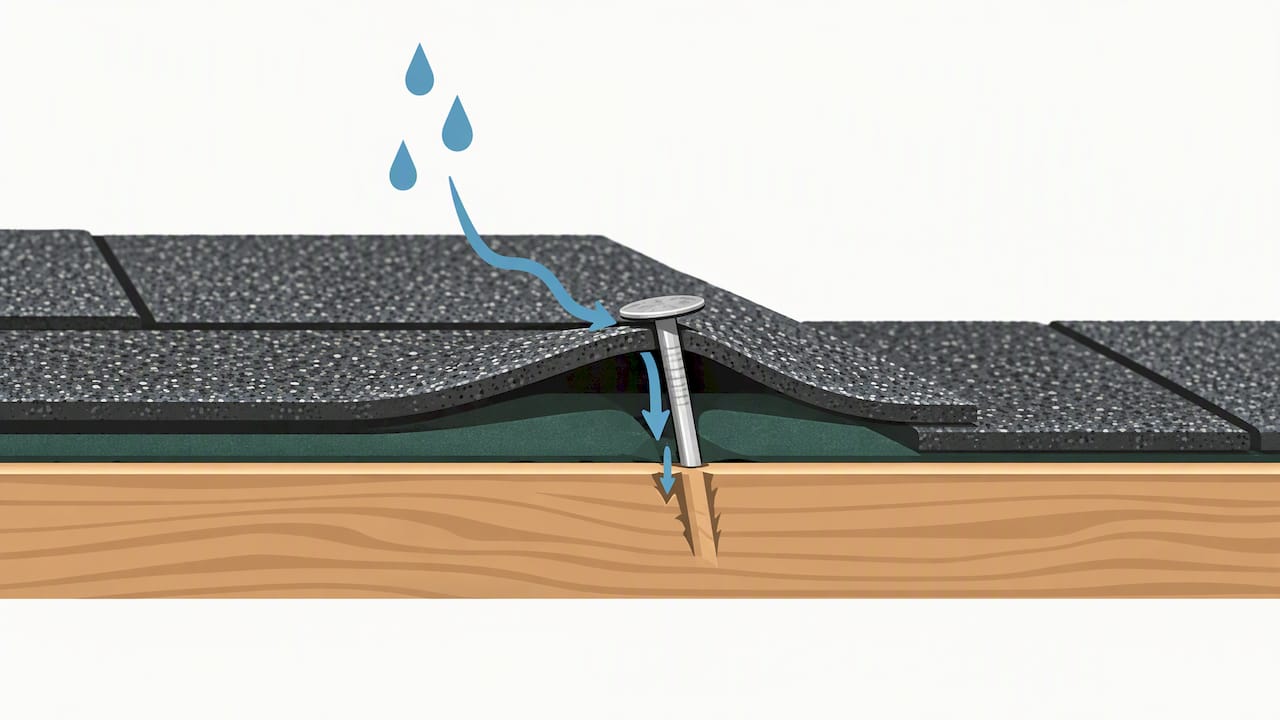
A roof nail pop is a shingle nail that has backed out of the decking and now pushes up against, or through, the shingle above it. It is not normal, and it is not just cosmetic. One or two isolated pops can come from temperature swings, but a cluster usually points to poor attic ventilation, decking movement or a flawed installation. The proper fix is to pull the nail, seal the old hole and drive a new ring-shank nail into fresh wood. Hammering the old nail back down does not last.
We are Stalwart Roofing in Baton Rouge, and we have spent more than 25 years looking at roofs in Louisiana’s heat, humidity and storm seasons. This guide explains what we look for, what the work costs, and when a pop is a small repair or a warning.
TL;DR
- A nail pop is a fastener that has worked its way up out of the roof deck. It creates a bump in the shingle and an opening for wind-driven rain.
- Isolated pops can happen with thermal cycling. Clusters often indicate systemic trouble such as weak ventilation or deck movement.
- Do not just hammer them down. The correct repair removes the nail, seals the hole and uses a new ring-shank nail placed in sound decking.
- Minor repairs commonly run $150 to $500. Standard homeowners policies usually treat nail pops as maintenance, not a covered loss.
- Nail pops showing up on a ceiling inside the house deserve a prompt professional inspection.
Table of Contents
- What a roof nail pop actually is
- Why roofs in Louisiana develop nail pops
- Are roof nail pops normal?
- Isolated pops or a pattern: how to read what you see
- How to check your roof safely
- How nail pops are repaired properly
- How much does it cost to fix roof nail pops?
- Are roof nail pops covered by insurance?
- When nail pops mean repair, and when they mean replacement
- Preventing nail pops
- Our perspective on nail pops
- Get a free roof inspection in Baton Rouge
- FAQ
- Sources
What a roof nail pop actually is
Asphalt shingles are held down by nails driven through the nail zone, a defined band on each shingle. When a nail loses its grip, it can lift slowly until the head presses a small hump into the shingle above. Sometimes the head breaks through the surface granules and sits exposed to sun and rain.
You may see it from the ground as a faint ridge or a row of tiny bumps. Up close, you may find a shiny nail head, a cracked shingle over the head, or a dark spot where moisture has started to stain the shingle. Some homeowners first find the problem as nail heads or granules in the gutters.
The nail is only the visible part. The real issue is that the fastener’s hold in the deck has failed, and the hole it leaves behind is now a path for water.
Why roofs in Louisiana develop nail pops
No single cause explains every pop. In our experience around Baton Rouge, these are the usual ones.
Thermal cycling
Decking and shingles expand when hot and contract when cool. Across thousands of cycles, that movement can slowly push a nail out. Louisiana summers put roof surfaces under intense heat, and the daily swing from a hot afternoon to a cooler night repeats it over and over.
Attic heat and moisture
A poorly ventilated attic gets hotter and holds more humidity. That makes the deck swell and shrink more than it should. Ventilation problems are among the commonly cited causes of nail pops, and in a humid climate like ours they deserve a hard look any time pops appear in groups. Our guide to roof and attic care covers what to check.
Installation errors
Most nail pops we see trace back to how the roof was installed. Common faults include:
- Nails not seated. A nail left standing proud of the shingle, or one that missed the wood, can lift later. GAF’s technical bulletin on improperly driven nails describes nails that are over-driven, under-driven or crooked.
- Nails in the wrong place. High nailing puts fasteners outside the nail zone and weakens the hold.
- Smooth-shank nails. Many older roofs used them. Ring-shank or threaded nails give better withdrawal resistance in wood decks.
- Nails that are too short. They barely bite the deck and loosen first.
Decking quality and moisture
Deck panels that swell and shrink a lot, such as some OSB, can work fasteners loose. The APA, the engineered wood trade association, also notes that nail pops occur when wet lumber dries and shrinks, which is mostly a framing concern but shows how wood movement alone can lift a nail.
Age
As a shingle roof ages, materials get brittle and the deck has more seasons of movement behind it. A roof in its later years may show pops along with curling, granule loss and cracked shingles. At that point the question changes from repairing a nail to repairing or replacing the roof.
Are roof nail pops normal?
They are common, but they are not normal in the sense of harmless. Isolated pops can result from thermal cycling and may be a modest repair. Unaddressed, they can lead to water intrusion, premature granule loss and more vulnerability to wind damage.
There is one more detail that surprises homeowners. Water that enters through a nail pop can travel along the deck before it drips. The stain on your ceiling may be far from the actual pop, which is why tracing a leak without an inspection is often guesswork.
Isolated pops or a pattern: how to read what you see
| What you see | What it often means | What to do |
|---|---|---|
| One or two pops on an otherwise sound roof | Minor thermal movement or a few missed nails | Schedule a repair and a quick inspection |
| Pops in a line or in one slope | Installation error in that area, or deck movement | Have a roofer check the slope and the attic underside |
| Pops scattered across the whole roof | Ventilation, deck or fastener problems affecting the roof as a system | Get a full inspection before paying for spot repairs |
| Pops plus curling, cracking or granule loss | An aging roof | Compare repair with replacement |
| Nail pops or stains on interior ceilings | Possible deck separation or moisture damage | Call a professional promptly |
The last row matters most. If nail pops are appearing in your ceiling, that can mean the roof deck is separating from the trusses or extreme thermal movement is at work. Do not wait for the next storm.
How to check your roof safely
We do not want anyone on a steep, wet or hot roof. A safer routine:
- Look from the ground with binoculars after a dry day. Check for bumps, lines of shiny heads and shingles that sit unevenly.
- Check the gutters for stray granules or nail heads.
- Go into the attic on a bright day. Look for daylight at nail tips, rusted nail points, damp or dark decking and any staining around them.
- Check ceilings for small round bumps, cracks or spots.
- Photograph everything with dates. Photos help in any later conversation with a roofer or an insurer.
If you spot anything in steps 3 or 4, treat it as more urgent than a few bumps seen from the yard.
How nail pops are repaired properly
Online you will often read advice to loosen the shingle, tap the nail down and dab sealant on it. That is the shortcut that fails. The hole in the deck is already enlarged, so the nail will usually pop again. Here is how a careful repair goes.
- Lift the shingle gently. In cool weather shingles crack easily, so handling matters. In Louisiana we have the opposite risk in summer: hot shingles scuff and tear if pried carelessly.
- Remove the original nail. Pull it completely rather than leaving it in the hole.
- Seal the old hole with roof cement so it does not become a leak path.
- Drive a new ring-shank nail about an inch or two from the old hole, into fresh decking, inside the manufacturer’s nail zone, and flush with the shingle without over-driving.
- Seal the shingle back down and cover the nail head as the manufacturer’s instructions call for.
- Look at the cause. If a repair is made but the attic is still too hot and wet, the next set of pops is already on its way.
It looks simple. Yet putting a nail in the wrong place or skipping the seal on the new penetration can create a new leak while the old problem remains. That is why we recommend professional repair rather than a weekend project. If you are weighing it, see our comparison of Baton Rouge roofing DIY repairs versus pros and why a roof repair company often saves more than DIY.
How much does it cost to fix roof nail pops?
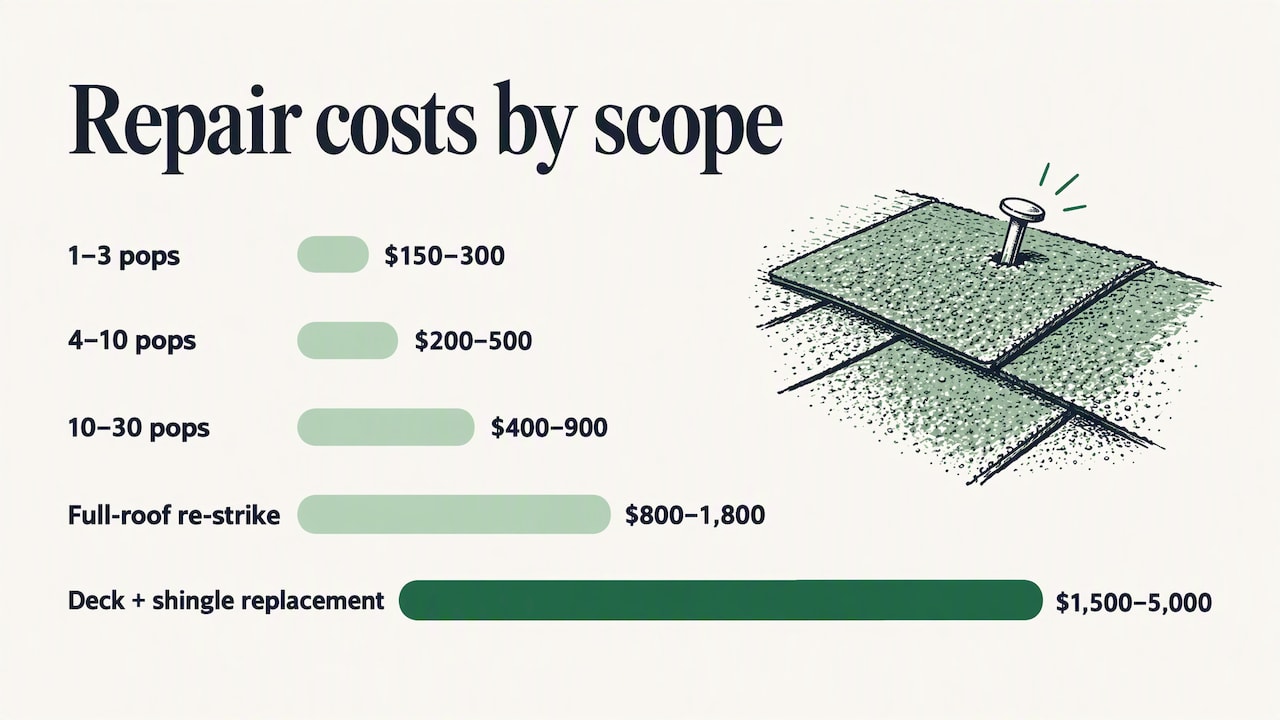
Exact prices depend on the number of pops, roof access, pitch and the contractor’s minimum service charge. One published breakdown puts typical ranges like this (2026 figures, national, not Baton Rouge quotes):
| Scope of work | Typical range |
|---|---|
| 1 to 3 pops | $150 to $300 |
| 4 to 10 pops | $200 to $500 |
| 10 to 30 pops | $400 to $900 |
| Full-roof re-strike | $800 to $1,800 |
| Decking and shingle replacement | $1,500 to $5,000 |
These figures come from The Roofing Brief’s nail pop cost breakdown. Treat them as a guide for judging a quote, not as a promise. We do not publish prices for our work because every roof is different. We assess first and give you a written number you can review without pressure.
If water has already reached the ceiling below, the interior repair is a separate cost. For a sense of how repair versus replacement thinking works on ceiling trim, this guide to water-damaged cornices is written for UK homes, so materials and prices will differ from what you will see in the US, but the logic of when to patch and when to replace carries over.
Are roof nail pops covered by insurance?
Usually not. Homeowners policies generally cover sudden and accidental damage from named perils, not gradual problems. The Insurance Information Institute explains that maintenance damage is your responsibility, and insurers do not pay for wear and tear or poor upkeep. Nail pops from age or from a faulty original installation tend to fall in that category.
The picture changes when a storm lifts shingles, drives rain under them or damages the roof in other ways. Then the nail pops may be one of several findings in a storm claim. Policies differ, so read yours and ask your insurer or agent about your deductible and wind or hail terms. If you are unsure whether damage is storm-related, a free inspection with photos gives you facts to work from. Our storm damage restoration team can document what we find.
When nail pops mean repair, and when they mean replacement
Spot repair makes sense when the roof is otherwise sound, the pops are few, and the cause is clear. Think again when:
- Pops are spread across most slopes.
- The deck feels soft, shows staining or has moved in the attic.
- Shingles are curling, cracking or losing granules.
- You have had repeated repairs in the same area.
- The roof is near the end of its expected lifespan.
The cost of repeated small repairs can approach the cost of a proper solution. Our guides on signs it is time to replace your roof, asphalt shingle replacement signs and repair versus replacement in Baton Rouge walk through that decision.
Preventing nail pops
- Insist on the right fasteners. Ring-shank nails of the proper length, driven flush and placed in the nail zone.
- Fix ventilation. Balanced intake and exhaust keep attic temperature and humidity in check.
- Choose decking and installers carefully when you replace a roof, and ask how fasteners will be set and checked.
- Inspect on a schedule. There is no such thing as a maintenance-free roof, and Louisiana’s weather makes routine checks more valuable. See our advice on how often to inspect a roof in the Louisiana climate and on shingle roof maintenance.
- Check after storms. Wind and heavy rain can loosen fasteners that were already marginal.
Our perspective on nail pops
When homeowners call us about nail pops, they usually expect to hear about a small fix. Sometimes that is exactly what it is. A few pops on a decent roof are a short repair, and we will tell you so plainly.
But we treat every pop as a clue. The first question we ask is why this nail moved. If we find a hot, damp attic, a run of poorly placed nails or soft decking, a quick patch would just take your money and leave the cause in place. That is not how we want to work.
Three habits shape our approach:
- We pull the nail, we do not tap it. The old hole is compromised. Fresh wood and a ring-shank nail hold better.
- We look inside as well as outside. The attic often explains what the shingles only hint at.
- We say what we find, and what we do not. If your roof needs only a small repair, that is what you get, with a clear explanation and no pressure. Our work carries a five-year workmanship warranty.
Louisiana roofs work harder than most: strong sun, humidity, sudden storms and long wet stretches. We build our recommendations around that, not around a generic checklist.
Get a free roof inspection in Baton Rouge
If you have seen bumps, shiny nail heads or ceiling spots, the easiest next step is to have someone look. We offer free roof inspections, and if repairs are needed, our roof repair team can handle them, including emergency situations. We will tell you what we find, show you the photos and give you honest options.
Managing a commercial building or multi-family property? See our commercial roofing services.
FAQ
Are roof nail pops normal?
They are common, but they should not be ignored. An isolated pop can come from temperature cycling. Several pops together often signal a ventilation, decking or installation problem that can lead to leaks, granule loss and wind damage.
Can I just hammer a nail pop back down?
It is a temporary fix at best. The hole in the deck is already enlarged, so the nail tends to work loose again. A proper repair removes the nail, seals the hole and uses a new ring-shank nail in fresh wood. Because shingles crack and nails must land in the nail zone, we suggest a roofer do it.
How much does it cost to fix roof nail pops?
One published 2026 breakdown lists $150 to $300 for one to three pops and $200 to $500 for four to ten. Larger jobs involving a re-strike or decking can cost much more. Your quote will depend on roof access, the count and the contractor’s minimum charge.
Are roof nail pops covered by insurance?
Standard homeowners insurance generally does not cover them, because insurers treat maintenance and wear as the owner’s responsibility. If a covered storm caused the damage, a claim may be possible. Check your policy and talk with your insurer.
When should I worry about nail pops in the ceiling?
As soon as you see them. Pops or bumps on an interior ceiling can indicate deck separation or serious moisture and movement in the roof structure. Call a roofing professional for an inspection promptly, and photograph the area.
Sources
- Nail Pops on Shingles: Causes, Fix & Bigger Trouble Signs (The Roofing Brief)
- Shingle Nail Pops in Asphalt Shingle Roofs (InspectApedia)
- Which disasters are covered by homeowners insurance? (Triple-I)
- GAF Technical Bulletin R-117: Improperly Driven Nails
- GAF Technical Bulletin R-144: Fastening Methods for Open Eaves
- Builder Tips: 4 Ways to Minimize Nail Pops (APA)