A good roofing contractor checklist comes down to seven checks: a valid Louisiana license or registration, proof of insurance, a written itemized estimate based on a real roof inspection, a clear permit plan, a written workmanship warranty, a named person in charge of your job, and a payment schedule that never runs ahead of the work. If a roofer can’t answer all seven in writing, keep looking. Below is each check, the question that tests it and where it goes wrong in Louisiana, from Baton Rouge subdivisions to commercial flat roofs.
Key Takeaways
- Louisiana sets its own license rules: since January 1, 2026, residential roofing work of $7,500 or more requires a Residential Roofing or Residential Construction license, and you can verify it online before you talk price.
- Get at least three written, itemized estimates for the same scope, after each contractor has actually been on your roof.
- After a storm, be most careful with out-of-state crews and anyone asking for full payment up front.
- A workmanship warranty is only worth what it says in writing: length, what it covers, what it excludes and how to claim.
- Ask who supervises the crew, who pulls permits and how your home is protected if rain rolls in mid-tear-off.
Table of Contents
- Check the license and registration first
- Confirm insurance, and get proof from the insurer
- Demand a real inspection before any estimate
- Read the estimate line by line
- Ask about permits and who handles them
- Know who is in charge of your job
- Questions to ask a roofer before you sign
- Warranties: read what is actually covered
- Payment terms and contract red flags
- Extra checks after a storm
- Extra checks for commercial roofs and property managers
- Our perspective: what the checklist is really testing
- Get a clear, no-pressure estimate
- FAQ
- Sources
Check the license and registration first
Start here because it takes five minutes and filters out the most risk. Since January 1, 2026, Louisiana requires anyone who bids on or performs residential roofing work of $7,500 or more to hold the Residential Roofing or Residential Construction classification from the State Licensing Board for Contractors. A home improvement registration alone no longer covers roof work. Commercial work has its own commercial licensing track. The board’s rules say licenses can be verified in real time on its website, so don’t accept a photo of a card as proof.
What to do:
- Ask for the contractor’s license or registration number before the estimate visit.
- Look it up on the state board’s site and confirm the name matches the company on the estimate and the contract.
- Confirm the classification fits the job. For residential roof work, look for Residential Roofing or Residential Construction, not just a home improvement registration.
Where it goes wrong: a salesperson gives you a number that belongs to a different company, or a business that just “works under” someone else’s license. If the name on the license is not the name on your contract, stop. Our Louisiana roofing contractor licensing guide walks through the classifications in more detail.
Confirm insurance, and get proof from the insurer
The Georgia Attorney General’s consumer office says a legitimate roofer should be able to show a business license, workers’ compensation insurance, general liability insurance and a permanent address and phone number. That list applies as well in Louisiana as in Georgia.
The Louisiana Department of Insurance goes a step further in its post-disaster guide: ask the contractor’s insurance carrier to mail a certificate of coverage directly to you. A certificate handed to you by the contractor can be out of date. One that comes from the carrier cannot be.
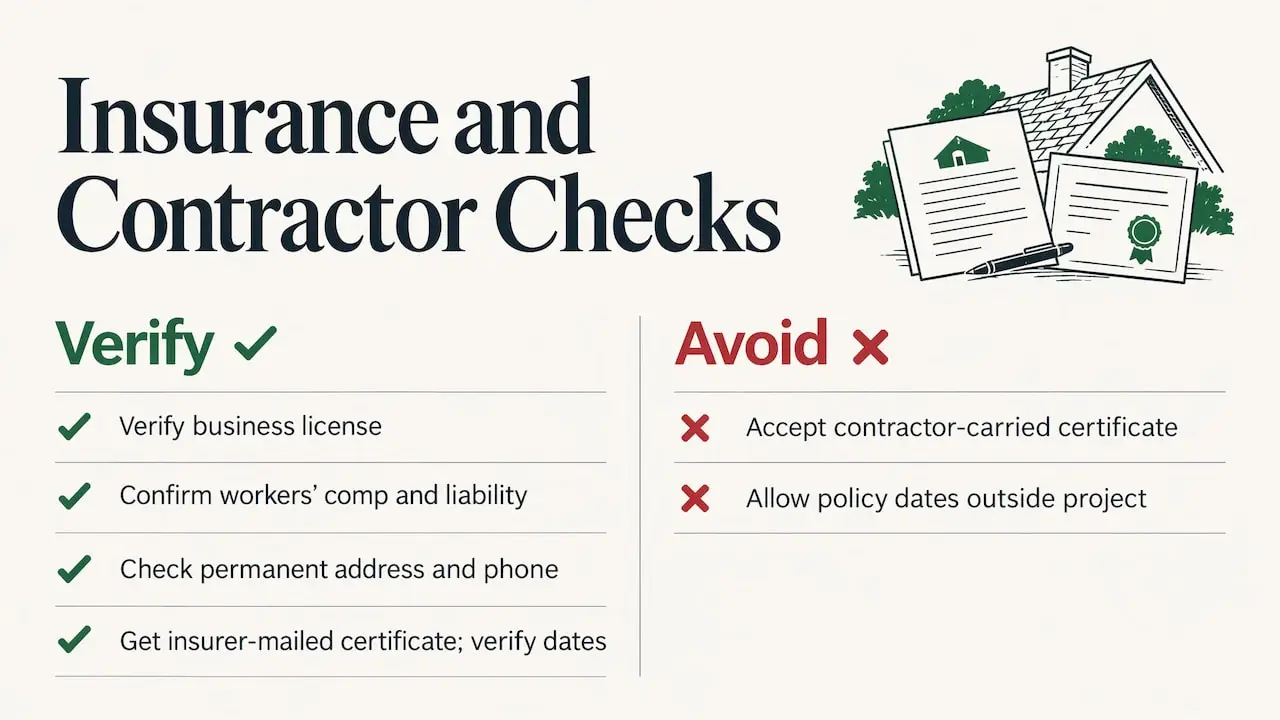
Why it matters on a roof: if a worker falls or a tear-off damages your neighbor’s car, an uninsured contractor leaves you holding the claim. Ask for both workers’ compensation and general liability, and check the policy dates cover your project.
Demand a real inspection before any estimate
An estimate given from the driveway or over the phone is a guess. Owens Corning’s contractor guide says to ask whether the contractor inspects the deck, attic, flashing, chimney, soil stacks, valleys and other penetrations, and checks attic ventilation. That’s where leaks and hidden rot are found, and it’s also where Louisiana roofs take a beating from heat, humidity and wind-driven rain.
The Kansas Attorney General makes a related point: estimates are only comparable when each contractor inspects the property and prices the same defined work. If one bid includes replacing damaged decking and another doesn’t, the cheaper number isn’t cheaper.
We offer free inspections, and our crew will tell you what we find, including when a repair is enough and a replacement isn’t needed. You can read what an inspection covers on our roof inspection page or in our annual roof inspection guide.
Read the estimate line by line
GAF’s homeowner checklist advises meeting with at least three contractors and getting itemized written estimates that cover labor, materials, permit fees, prep, cleanup and disposal. Use that as your template.
A solid estimate names:
- The shingle or metal product, by manufacturer and line, plus underlayment, flashing, vents and drip edge
- Whether decking repair is included, and what happens to the price if rotted decking turns up
- Tear-off and disposal of the old roof
- Permit fees and who pays them
- Whether any work is subcontracted
- Start and completion estimates
- Total price and payment schedule
A simple way to compare: put the three bids in a table with the same rows.
| Line item | Bid A | Bid B | Bid C |
|---|---|---|---|
| Roofing product and underlayment named | |||
| Decking repair terms | |||
| Permits and cleanup included | |||
| Workmanship warranty in years | |||
| Payment schedule |
A blank cell is a question to ask, not a detail to assume. Transparent pricing is something we take seriously. We put the scope and price in writing so you can lay our estimate next to any other.
Ask about permits and who handles them
Permit rules vary by parish and city, so ask the local building department what applies to your address. The principle is universal: a contractor should pull permits and expect the job to be inspected. The City of Arlington, Texas, tells homeowners to ask whether the contractor is pulling the proper permits and whether the work will be inspected, and treats a “no” answer as a red flag. That’s a Texas city’s guidance, but the logic holds anywhere.
The California contractors’ board adds that the contractor should obtain the necessary permits and the building department inspects the work. The question for you: who applies, who pays and who is on site when the inspector arrives? Get the answer in the contract.
Know who is in charge of your job
The Arlington guidance recommends asking the contractor to explain supervision and quality control, and to name the person in charge at your home, how many workers are needed and the estimated completion time. A professional association guide from Southern California suggests adding a few more questions: who is your day-to-day contact, what is the start date and work schedule, and how the home is protected if rain or delays hit, including overnight.
That last one matters more in south Louisiana than almost anywhere. Afternoon thunderstorms can build fast in summer, and a roof stripped to the deck needs to be dried in the same day. Ask what the crew does when the forecast turns: tarps, underlayment, a stop-work call. Our roof replacement timeline explains how long a typical job takes and why hidden repairs can add time.
Questions to ask a roofer before you sign
Keep this list on your phone during each estimate visit:
- What is your Louisiana license or registration number?
- Can your insurer send me a certificate of coverage?
- Will you inspect the attic and decking, not only the shingles?
- Is the estimate itemized, and what happens if you find rotted wood?
- Who pulls the permits, and will the job be inspected?
- Who runs my job day to day, and how do I reach them?
- How will you protect my landscaping, AC unit, driveway and pool area?
- What does cleanup include each day and at the end?
- What are the workmanship and manufacturer warranties, in writing?
- What is the payment schedule?
The Colorado Roofing Association also advises requiring written material and workmanship warranties, following manufacturer installation instructions, and making the contractor responsible for protecting landscaping and cleanup. If a roofer gets defensive about any of these, that tells you how the job will go.
Warranties: read what is actually covered
There are two warranties on most roofs. The manufacturer covers the product. The contractor covers the installation, which is where most leaks begin. A workmanship warranty should state its length, the defects it covers, any exclusions, how to file a claim and whether it transfers to a new owner.
We back our work with a five-year workmanship warranty. We explain what a good one should spell out in our workmanship warranty guide. Whichever contractor you choose, ask to see the actual warranty text before you sign, not a brochure line.
Payment terms and contract red flags
The California contractors’ board advises putting every agreed term in writing, keeping payments from getting ahead of the work, avoiding cash and paying the final amount only when you are satisfied. California also caps down payments by law, and Louisiana’s rules differ, so don’t assume a California limit applies here. The principle is the one to carry: your money should trail the work.
The Louisiana Department of Insurance warns homeowners to be wary of contractors who demand payment in full before work is completed. Other warning signs:
- Pressure to sign today because the price “expires”
- No physical address or only a cell number
- A bid far below the others, with a vague scope
- A verbal promise that isn’t in the contract
- Cash-only requests
A contractor who is confident in the work doesn’t need pressure. Pressure-free, honest assessments are how we run every estimate.
Extra checks after a storm
After a hurricane or hail event, crews arrive from everywhere. The Louisiana Department of Insurance tells homeowners to be careful with contractors who say the insurance company sent them, since an insurer usually does not recommend a contractor, and to get written proof. It also says not to make permanent repairs until your adjuster has authorized them.
In practice:
- Document damage with photos before anything is moved.
- Call your insurer and get the claim started.
- Get emergency tarping done to prevent more water damage, and keep the receipt.
- Then run the full checklist above on whoever does the permanent repair.
We handle emergency repairs and tarping as part of our storm damage restoration service, and our Baton Rouge area crews know the local conditions.
Extra checks for commercial roofs and property managers
For a business owner or property manager, the same license, insurance and written-scope checks apply, with a few additions:
- Louisiana has a separate commercial licensing track, so confirm the classification fits the project value.
- Ask for experience with your roof type: TPO flat roofs, metal, built-up systems.
- Ask how work will be phased so tenants and operations keep running.
- Ask whether a maintenance plan is available so small leaks are caught before they become claims.
- Get the warranty terms in writing, for both the system and the installation.
Our commercial roofing services cover repair, maintenance, metal roofing and flat roof TPO. If you’re weighing a fix against a full replacement, see our guide on when to repair or replace a commercial roof.
Our perspective: what the checklist is really testing
Every item on this checklist tests one thing: will the contractor tell you the truth in writing? After more than 25 years of roofing in Louisiana, we’ve learned that the humidity, heat and storm season here punish shortcuts. A roof that is badly flashed or poorly ventilated will show it within a few seasons.
That’s why we start with an inspection, explain what we find in plain language and put the scope and price on paper. You shouldn’t have to decode an estimate or feel rushed. We stand behind our installations with a five-year workmanship warranty, and we think a contractor should welcome every question on this list.
Compare us against any bid you receive. We expect to hold up.
John
Get a clear, no-pressure estimate
If you’re ready to put this checklist to work, we’ll inspect your roof, explain what we find and give you a written estimate you can compare line by line. Whether it’s a repair, a full replacement or storm damage, we’ll walk you through the scope. Start with our residential roofing and replacement services, or reach us through our site.
FAQ
How many roofing estimates should I get?
Get at least three. GAF’s homeowner checklist recommends meeting with three contractors and asking for itemized written estimates. Make sure each one inspects the roof and prices the same scope, or the numbers can’t be compared.
How do I check a roofer’s license in Louisiana?
Use the State Licensing Board for Contractors’ online lookup and match the license number to the company name on your contract. Since January 1, 2026, Louisiana requires the Residential Roofing or Residential Construction classification for residential roofing work of $7,500 or more, so a contractor without one should not be doing your job.
What is a reasonable down payment for a roof?
It depends on the contract, but payments should never run ahead of the work, and the final payment should wait until you are satisfied. Louisiana’s insurance department warns against contractors demanding full payment before the job is finished. Put the schedule in writing.
What should a roofing warranty cover?
A workmanship warranty should state its length, the installation defects it covers, such as leaks and flashing problems, what it excludes and how to make a claim. Ours runs five years. The manufacturer warranty is separate and covers the product.
Can I sign a roofing contract right after a storm?
Take time to do it right. Document the damage, call your insurer and have the roof tarped to stop further water damage. Then compare written bids from licensed, insured local contractors before you sign for permanent work.
Sources
- Louisiana State Licensing Board for Contractors, Licensing Law and Rules and Regulations
- Louisiana State Licensing Board for Contractors, Residential Roof Work memo (December 8, 2025)
- Louisiana Department of Insurance, Post-Disaster Insurance Guide
- Georgia Attorney General, How do I know if a roofer is reputable
- Owens Corning, Questions to Ask Before Hiring a Roofing Contractor
- Kansas Attorney General, Roofing Information for Consumers
- GAF, Checklist for Choosing the Right Roofer
- City of Arlington, Tips for Choosing a Contractor
- California Contractors State License Board, A Roofing Contractor guide
- Roofing Contractors Association of Southern California, Questions to Ask Before Hiring
- Colorado Roofing Association, Selecting a Professional Contractor