If shingles blew off your roof, you don’t need to panic, but you shouldn’t wait either. Photograph the damage from the ground, cover any exposed area if rain is coming, and have a licensed roofer inspect it. A few missing shingles can usually be repaired. Missing shingles in several places, or on an older roof, often point to a bigger problem. In Baton Rouge, where heavy rain follows most wind events, a bare spot on the roof can become a leak inside the house within days.
TL;DR
- Missing shingles are rarely an emergency in themselves, but GAF advises acting quickly in wet weather, and Louisiana has plenty of it.
- Isolated blow-offs on a healthy roof are a simple repair. Widespread loss, or loss on a roof near the end of its life, usually means replacement is on the table.
- Find the cause: poor sealing, high nailing, poor attic ventilation or age. Replacing the shingle without fixing the cause invites a repeat.
- Check your wind and hail deductible before you file. A small repair may cost less than the deductible.
- Stay off the roof. Take photos from the ground and call a professional.
Table of Contents
- What to do in the first 24 hours
- Why shingles blow off in the first place
- Repair or replace? A practical way to decide
- How a proper repair works
- Will insurance cover blown-off shingles?
- Perspective: what we see on Baton Rouge roofs
- Prevent the next blow-off
- Get your roof checked by Stalwart Roofing
- FAQ
- Sources
What to do in the first 24 hours
The order matters, because what you do first protects both the house and any insurance claim.
- Stay on the ground. A wet or windblown roof is dangerous, and loose granules and debris make footing worse. Walk the property and look up, ideally with binoculars.
- Photograph everything. Take wide shots of each slope and close-ups of bare spots, along with any shingles, flashing or debris in the yard. Note the date and the storm.
- Check inside. Look at attic decking, ceilings and the corners of upstairs rooms for stains, drips or damp insulation.
- Protect the opening. If rain is forecast, a temporary tarp keeps water out until the repair. We install roof tarping as part of storm damage restoration. A badly secured tarp can tear off in the next gust, so this is a job for a crew rather than a ladder and a hardware-store sheet.
- Call a roofer before you call your insurer. You want a professional assessment first, for reasons covered below.
If water is already coming in, that is an emergency, and our emergency roof repair team can respond.
Why shingles blow off in the first place
Wind alone is only part of the story. Shingles stay on a roof because of a factory adhesive strip that bonds to the shingle below once the sun warms it, plus nails. When that system fails, the tab lifts, flexes, and eventually tears away. InterNACHI describes blow-off as often caused by poor bonding of the adhesive strips, where uplift forces break the bonds completely.
In our experience across Louisiana roofs, these are the usual culprits:
Seal strips that never bonded
Shingles installed in cold weather may not seal until warm sun reaches them. Until then they are vulnerable to wind. Dust, debris and a lack of direct sunlight can also keep the strip from bonding properly, a point InterNACHI’s inspection guidance covers. Louisiana winters are mild, but a roof installed in a cool, shaded stretch can still have unsealed tabs.
High nailing
Nails placed too high above the sealant strip weaken a shingle’s wind resistance. This is one of the most common reasons a roof loses shingles again and again, even in ordinary gusts. We check nail placement on every inspection, because it turns a simple repair into a recurring one.
Age and weathering
Asphalt shingles wear out. Cracking, curling and heavy granule loss all reduce their grip. Liberty Mutual’s guide to shingle damage notes that missing shingles are often a symptom of age, poor ventilation or installation problems, not just weather. If you see gritty granules in your gutters, read our piece on the impact of granule loss.
Attic ventilation
A hot, humid attic cooks the underside of the roof deck and shingles. In Baton Rouge summers that heat adds up year after year, and it can shorten shingle life and loosen the bond.
Storm-force wind
Hurricanes and tornadoes can strip well-installed roofs, and that is a real wind event rather than a defect. GAF’s technical bulletin on wind-damaged shingles describes the types of damage that extraordinary wind can cause.
Repair or replace? A practical way to decide
The count of missing shingles matters less than where they are, how old the roof is and what the exposed area looks like.
| Situation | Likely answer |
|---|---|
| A few shingles missing in one area, roof under about 10 years old, rest of roof sound | Repair |
| Creased or lifted tabs but still attached | Hand-seal or replace the tabs |
| Missing shingles on multiple slopes | Full inspection, often replacement |
| Ridge cap shingles gone | Repair promptly, since the ridge can open into the attic |
| Roof near the end of its 15 to 30 year lifespan | Compare repair cost against replacement |
| Same area blows off repeatedly | Look for high nailing, ventilation or installation faults |
The 15 to 30 year range is the general lifespan for asphalt roofs, as Liberty Mutual’s shingle guide discusses. Where your roof falls in that range depends on the product, the installation and the climate.
We lay out the trade-offs in more detail in roof repair vs. replacement in Baton Rouge, and our guide to signs it’s time to replace your roof helps if you suspect your roof is aging out.
How a proper repair works
Replacing a blown-off shingle looks simple from the ground. Done right, it is not.
- The roofer lifts the tabs of the row above and breaks the seal gently, without tearing it.
- Damaged nails are removed from the old shingle and the surrounding course is checked for loose fasteners.
- The new shingle slides into place and is nailed in the manufacturer’s specified pattern. Angi notes that each shingle typically takes 4 to 6 nails along the sealant strip.
- The tabs above are resealed with roofing cement, on clean, dry surfaces.
- Surrounding shingles are checked for hidden lifting, creasing or unsealed tabs.
For minor wind damage, hand-sealing lifted tabs with quality roofing cement is often enough. GAF’s technical guidance is the manufacturer’s own reference for wind damage. Dust is the enemy: if the surface isn’t clean, the bond fails early and the repair fails with it.
What it costs
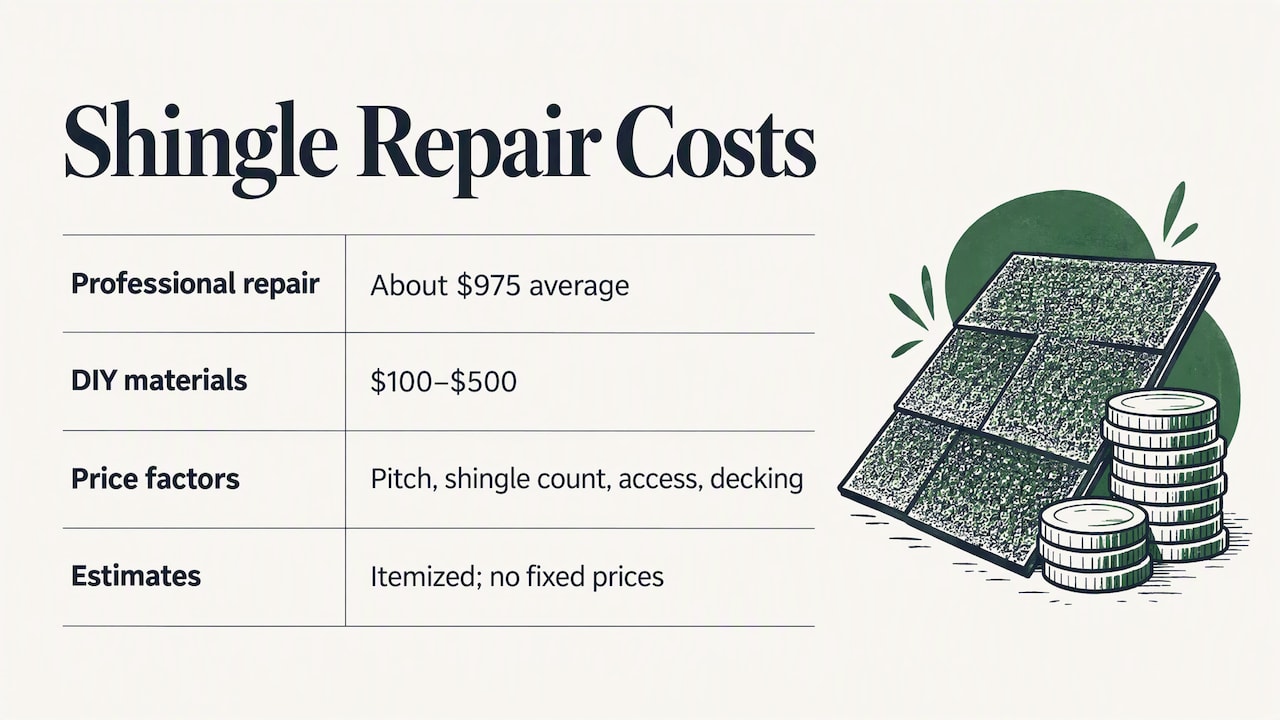
Professional repair of wind-damaged shingles averages about $975 according to Angi, with DIY materials running $100 to $500. That is a national figure, and your price depends on roof pitch, the number of shingles, access, and whether decking is damaged. We don’t publish fixed prices because every roof is different, but our estimates are itemized so you can see what you are paying for. For a broader look, read how much it costs to fix a roof.
Why we don’t recommend DIY
The savings are real but small, and the risks are not. A fall from a roof can be serious, and a patch that isn’t sealed or nailed properly can leave you with a leak and a bigger bill. Our comparison of roof repair company vs. DIY goes through where the money really goes.
Will insurance cover blown-off shingles?
Often, yes, but the details decide whether a claim is worth filing.
- Covered peril. Standard homeowners policies generally treat wind damage as a sudden, accidental loss. In coastal or high-risk parts of Louisiana, though, some insurers exclude wind or hail, leaving homeowners to buy separate coverage, sometimes through the state insurer of last resort. Read your own policy.
- Repair, not necessarily replacement. Insurers are generally required to cover the damaged area. The North Carolina Department of Insurance explains that a homeowner policy only has to replace the damaged area, even if the new shingles don’t match. That is one state’s guidance, but the principle is common. Check your policy and Louisiana rules for your situation.
- Deductibles. Wind and hail deductibles are often a percentage of the home’s value. The same agency guide says 2% to 5% is common for hurricane, named-storm or wind and hail triggers. On a $250,000 home, 2% is $5,000, which is more than many shingle repairs cost.
That is why we say to get an assessment first. The Oregon Division of Financial Regulation advises weighing the benefits of a claim against the costs, including your deductible, before you file. Insurance guidance from the state regulators you can trust will tell you the same.
We walk through what to document in four ground checks before an insurance claim and in our Louisiana wind damage insurance coverage tips. If your roof is damaged and you are weighing a sale instead of a repair, the options for selling a house with roof damage are a different path worth understanding, though it is a separate market from the one we serve.
If you have questions about your policy, your insurance agent or the Louisiana Department of Insurance is the right person to ask. We can’t interpret your coverage, but we can document the damage so your claim is clear.
Perspective: what we see on Baton Rouge roofs
After more than 25 years of working on roofs in this area, we’ve learned that the missing shingle is rarely the whole story. Louisiana roofs face heat, humidity, heavy rain, and sudden storms with gusty winds, and each of those leaves a different mark. When we get a call about blown-off shingles, we don’t just look at the bare patch. We look at the rows around it, the nail line, the ridge, the flashing, the attic decking and the ventilation.
Two patterns come up again and again. First, a homeowner patches a roof that is simply old, and the next storm takes more shingles. Second, a roof that is fairly young loses the same section repeatedly because of how it was installed. Telling those apart is the point of an honest assessment. Sometimes the answer is a modest repair, and we say so. Sometimes it is replacement, and we show you the evidence rather than pushing you into a decision.
Our approach is simple: clear communication, no pressure, and a workmanship warranty of five years on what we install. If a repair isn’t the right call, we’d rather tell you now than see you again after the next storm.
Prevent the next blow-off
- Inspect twice a year. The National Roofing Contractors Association is cited by GAF as recommending professional inspections in spring and fall. With hurricane season running through November, a fall check after storm season is worth the visit. See our roof inspection frequency guide for Louisiana’s climate.
- Watch for aging signs. Cracked or curled shingles, visible fiberglass matting and granules in gutters tell you the shingles are losing their grip.
- Fix ventilation. Balanced intake and exhaust reduce attic heat and moisture. Our roof and attic care tips cover what to look for.
- Trim overhanging limbs. Branches abrade shingles and become projectiles in storms.
- Hire carefully. Use licensed, insured roofers who carry workers’ compensation. Cornell’s Legal Information Institute explains how responsibility differs between employees and independent contractors, which is why an uninsured handyman on your roof is a risk for you.
If you want a closer look at what an inspection includes, see our step-by-step free residential roof inspection guide.
Get your roof checked by Stalwart Roofing
We handle roof repairs, storm damage restoration and full roof replacement for homes in Baton Rouge and the surrounding area, and commercial roofing for businesses and property managers. Start with a roof inspection: we’ll find out why your shingles came off, tell you plainly whether you need a repair or more, and back our work with a five-year workmanship warranty.
FAQ
Can I leave missing shingles unrepaired for a while?
Sometimes you can for a short time, but not through wet weather. GAF says missing shingles aren’t an emergency but you should act quickly in wet seasons. In Louisiana, cover the spot and schedule a repair as soon as you safely can.
Will insurance pay for a whole new roof if shingles blew off?
Usually not, unless the damage is widespread. Policies typically pay to repair the damaged area, and regulators note that matching shingles isn’t guaranteed. Your policy language and your adjuster decide the outcome.
Should I file a claim for just a few shingles?
Not until you know the repair cost and your deductible. If the repair is below a percentage-based wind deductible, a claim won’t pay anything and may affect your coverage later. Get a professional assessment first and talk to your agent.
Why do the same shingles keep blowing off?
Repeated loss in one spot often means high nailing, poorly bonded sealant strips, or an attic ventilation problem. InterNACHI’s inspection guidance lists poor bonding as a common cause. A roofer should find the cause rather than just replace the shingles.
Is a missing ridge shingle more serious than others?
Yes, in most cases. When ridge shingles are gone, there can be a direct opening into the attic, so water gets in more easily. Get it repaired quickly.
Sources
- GAF: Missing shingles on your roof, here’s what to do
- InterNACHI: Mastering Roof Inspections, Asphalt Composition Shingles, Part 51
- Liberty Mutual: How to identify asphalt shingle damage
- GAF technical bulletin: Damage to shingles caused by wind events
- Angi: How to repair wind-damaged shingles
- Mohr Agency: A guide to wind and hail insurance for Louisiana homeowners
- North Carolina Department of Insurance: Homeowners insurance FAQs
- Oregon Division of Financial Regulation: Storm damage
- Cornell Legal Information Institute: Respondeat superior