A roof insurance claim starts with a call or online report to your insurer, not a call to a contractor. Document the damage, make temporary repairs to stop further loss, report the claim, meet the adjuster, then compare the estimate to what the repair really costs. Your payout depends on the cause of damage, your deductible and whether your policy pays replacement cost or actual cash value. Below is how we walk Baton Rouge homeowners through each step, and where claims most often go wrong.
TL;DR
- Report the claim to your insurer first, photograph everything, and tarp the roof to prevent more damage. Keep every receipt.
- Check whether your policy pays replacement cost value (RCV) or actual cash value (ACV) and what your wind or hurricane deductible is before the adjuster visits.
- In Louisiana, a roofer may inspect and repair, but may not act as your public adjuster or negotiate the claim for you.
- For minor damage, compare the repair cost with your deductible before you file.
- Hidden damage found during repairs, such as rotted decking, can be reported to the insurer as a supplement.
Table of Contents
- What a roof claim actually covers
- The roof insurance claim process, step by step
- ACV vs. RCV: why two identical roofs get different checks
- Should you file at all? Small damage and your deductible
- Public adjuster vs. contractor: who does what in Louisiana
- What happens when the adjuster visits
- Louisiana conditions that shape a roof claim
- Our perspective: what we see on Baton Rouge roofs
- Need a roof inspected or tarped after a storm?
- FAQ
- Sources
What a roof claim actually covers
Homeowners policies generally pay for sudden, accidental damage from a covered cause such as wind, hail, fire or a fallen tree. They generally do not pay for wear, neglect or age. In practice, that gap is where most disputes begin: a roof that is 20 years old and leaking looks the same in a photo as a roof a storm just damaged.
The insurer’s question is always “what caused this?” Yours should be the same. Missing shingles, creased tabs, a torn ridge cap or a limb through the decking point to a storm. Curling, granule loss across the whole slope and brittle shingles point to age.
Age still matters even when the cause is covered. Industry data presented to insurance regulators and summarized in a 2026 NAIC working-group packet puts a 10-year-old asphalt shingle roof at roughly a 1 in 12 chance of damage in 60 mph winds, and that risk climbs as shingles age. Older roofs fail more easily, and carriers know it.
Wind, rain and flood are different claims
Louisiana homeowners deal with this distinction more than most. Wind and hail damage fall under your homeowners policy. Rising water does not: that needs a separate flood policy. The Louisiana Department of Insurance (LDI) tells homeowners to separate wind-driven rain from flood damage, and FEMA explains that flood policy claims often run alongside homeowners claims, with separate adjusters for each. If you can’t tell how water got in after a hurricane, report to both carriers and let each decide.
The roof insurance claim process, step by step
- Make the property safe. Stay off a damaged roof. Look from the ground and the attic.
- Photograph and film everything. Take wide shots of each slope, close-ups of damage, interior ceiling stains and debris. Date-stamped video helps.
- Stop further damage. Your policy expects reasonable temporary repairs. LDI lists placing plastic tarps over holes in the roof among them. Keep receipts for materials and labor.
- Read your declarations page. Find your deductible, your roof coverage basis (RCV or ACV) and any separate wind or named-storm deductible.
- Report the claim. Call your insurer or agent, or use the carrier’s online or app reporting. Ask for the claim number and the adjuster’s contact details.
- Meet the adjuster on the roof. Be there if you can. A roofer you trust can be present to point out damage, but cannot negotiate for you (more on that below).
- Review the estimate line by line. Compare it with a written repair or replacement estimate from a licensed local roofer.
- Repair, then report anything new. If the crew finds rotted decking or other damage the adjuster could not see, photograph it before covering it and tell your insurer.
How long do you have to file?
Louisiana law gives property owners at least 180 days after a hurricane or declared emergency to file a damage claim, according to a Louisiana insurance-claims law firm’s summary of La. R.S. 22:1264. Your own policy may set shorter notice terms for other events, such as a spring hailstorm, so do not wait. Late reporting makes it harder to prove the storm caused the damage rather than the months that followed.
ACV vs. RCV: why two identical roofs get different checks
This is the single biggest factor in what lands in your bank account.
| Replacement cost value (RCV) | Actual cash value (ACV) | |
|---|---|---|
| What it pays | The cost to repair or replace with similar materials at today’s prices | The same cost minus depreciation for age and condition |
| Effect on an older roof | Smaller reduction | Often a much lower settlement |
| What you pay out of pocket | Deductible | Deductible plus the depreciation gap |
The Texas Department of Insurance explains the difference in its roof guidance. It is a Texas agency, but the RCV and ACV mechanics are standard across the industry. Also check whether your carrier has moved your roof to ACV at renewal as it aged. Many homeowners learn this only after a storm.
Ask your agent three questions: Is my roof paid at RCV or ACV? Is there a roof surfacing schedule that reduces payment by age? Is my wind or hurricane deductible a flat amount or a percentage of my insured home value? Percentage deductibles can be far larger than the all-peril deductible you remember.
Should you file at all? Small damage and your deductible
Not every leak or lost shingle justifies a claim. If a repair costs less than or close to your deductible, filing gets you nothing and the claim may still be on your record. Experienced agents also point out that claims on older roofs can affect renewal terms.
A simple test:
- Get a written repair estimate first.
- Subtract your deductible. If the difference is small, pay for the repair yourself.
- If the damage is widespread, such as multiple slopes, a torn-off section or water intrusion into the attic, file.
If you are weighing the bigger picture on a badly damaged property, for example whether to repair or sell, this guide to selling a house with storm damage compares a cash sale with repairing first. That is a different decision from claiming, but the numbers overlap.
We offer free roof inspections so you can find out whether the damage is a claim, a repair or neither before spending anything. For minor jobs, our roof repair service is often the sensible route.
Public adjuster vs. contractor: who does what in Louisiana
These two roles are not interchangeable, and in Louisiana the line is enforced.
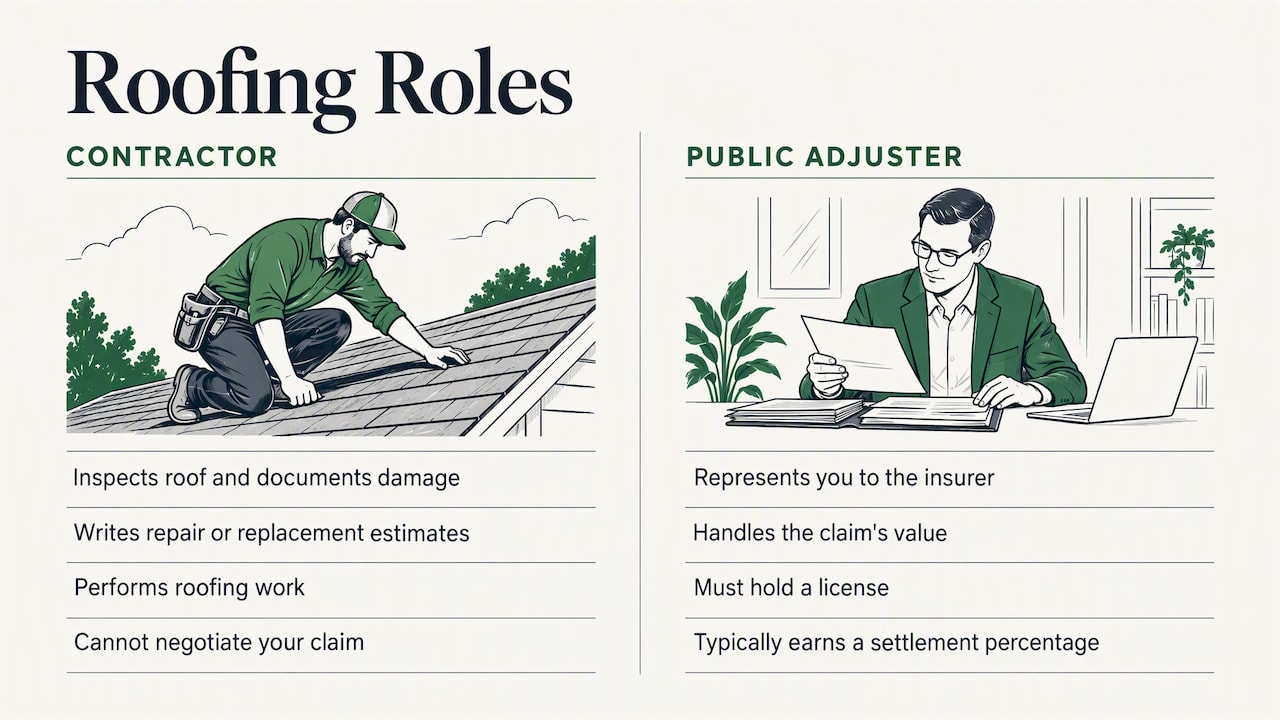
A roofing contractor inspects the roof, identifies damage, writes a repair or replacement estimate and does the work. We can walk the roof with you, document what we find and explain the repair scope.
A public adjuster is a licensed professional who represents you, the policyholder, in dealing with the insurer on the claim’s value. They typically work for a percentage of the settlement.
The LDI made the boundary explicit in Advisory Letter 2024-01. It says a person may not act as a public adjuster without a license, and that contractors and roofers who present themselves as insurance professionals and act as de facto public adjusters are violating the insurance code. Treat any roofer who promises to “handle your claim” or negotiate with your carrier on your behalf as a red flag.
If you feel the insurer undervalued your claim, the right next steps are to ask the carrier to review the estimate with your contractor’s written documentation, hire a licensed public adjuster, or contact the LDI. The LDI lists its consumer line, 800-259-5300, in its storm guidance.
When to bring a roofer in
LDI guidance advises homeowners to talk with their insurer before signing with a contractor. A contract signed too early can cause trouble if the carrier does not agree the work is needed, or if the price exceeds what the policy allows. Our approach:
- Emergency: tarp first and keep receipts. That is mitigation, not a repair contract.
- Before the adjuster visit: a free inspection gives you your own photos and an independent view of the damage.
- After the estimate: we compare the carrier’s scope with the work the roof needs and give you an honest written assessment.
If you are unsure whether an offer from a door-knocker is legitimate, our guide to roof insurance claims after storm damage covers more of the warning signs.
What happens when the adjuster visits
The adjuster measures slopes, counts damaged shingles per test square, checks decking, flashing, vents and gutters, and notes the roof’s age and condition. A few things help.
- Have your photos ready and a list of interior damage.
- Point out every area of concern, including those you can only see from the attic.
- Ask when you will receive the written estimate and whether depreciation is being withheld.
- Do not sign a release or accept a final payment until you have compared the estimate with a real repair quote.
It is common for the first estimate to miss items: drip edge, code-required upgrades, ridge vents, extra layers of underlayment or steep-slope charges. Ask your roofer to itemize what the roof needs so you can ask the carrier to reconsider.
Hidden damage and supplements
Once old shingles come off, crews sometimes find soft or rotted decking that nobody could see from above. Photograph it before it is covered, tell your insurer promptly, and ask what its supplement process requires. Insurers generally will not pay for work they had no chance to see.
Louisiana conditions that shape a roof claim
Baton Rouge roofs take hurricane-driven wind, heavy summer thunderstorms, high humidity and a long season of heat. That affects claims in several ways.
- Wind-driven rain can enter through lifted shingles or damaged flashing long before you see a leak inside. Check attic insulation and decking after any named storm.
- Moisture and heat shorten shingle life, so an adjuster may call a roof “aged” earlier than you expect. Keeping inspection records helps show the roof was maintained.
- Surge of claims after a storm means adjusters and roofing crews are booked for weeks. Tarping and early reporting protect you in the meantime.
- Storm deductibles can be higher than the standard deductible, so know yours before the season, not during it.
Our guides on wind damage insurance coverage in Louisiana and how often to inspect a roof in the Louisiana climate go deeper on these.
Our perspective: what we see on Baton Rouge roofs
We have worked on Louisiana roofs for over 25 years, and the same pattern repeats after every big storm. The homeowners who have the smoothest claims did three things before anything went wrong: they knew whether their roof was paid at RCV or ACV, they had a recent inspection on file, and they called their insurer before signing anything.
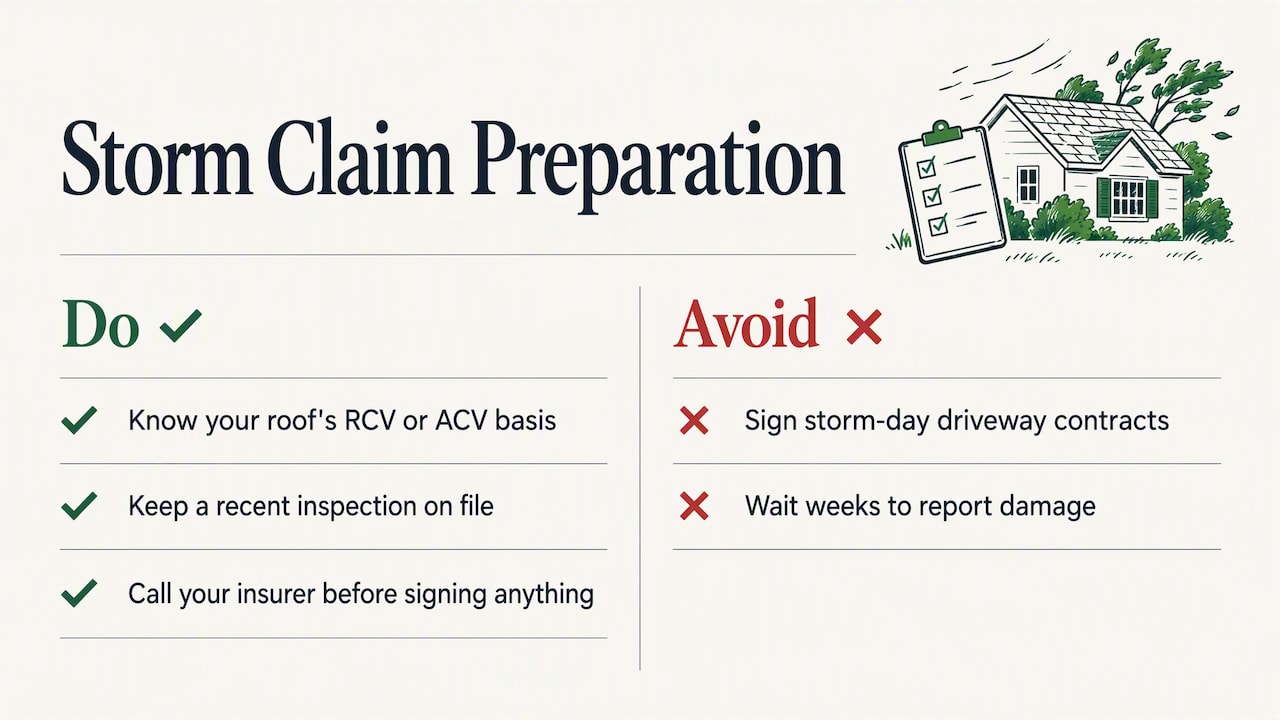
The ones who struggle usually signed a contract on the driveway the day after a storm, or waited weeks to report because the damage “didn’t look that bad.” Neither is a failure of character. Storms are stressful, and some people knock on doors fast.
Our job is narrower than some roofers claim. We inspect honestly, tell you if the damage is repairable or if the roof is at the end of its life, tarp quickly, and do the work well under our five-year workmanship warranty. We will tell you when a claim is not worth filing. We will not tell you what your policy covers, because only your insurer and your policy can, and we will not negotiate your claim for you, because Louisiana law says that is not our role.
— Emma
Need a roof inspected or tarped after a storm?
If you have storm damage in the Baton Rouge area, we can inspect the roof and tell you plainly what we see. For leaks, we can arrange emergency tarping and storm damage restoration so you can meet your duty to prevent further damage. If the roof is at the end of its life, we also handle full roof replacement. Commercial owners and property managers can see our commercial roofing services.
FAQ
How do roof insurance claims work?
You report covered damage to your insurer, who sends an adjuster to inspect and issues an estimate. The payment is that estimate, minus your deductible and any depreciation if your policy pays ACV. You then hire a contractor to repair or replace the roof.
Will insurance cover an older roof?
It can, if a covered event such as wind or a fallen tree damaged it. Age affects the amount, though: under ACV coverage depreciation reduces the check, and some carriers limit or decline coverage on very old roofs. Normal wear is not covered.
Should I hire a contractor before filing a claim?
Talk to your insurer first. LDI guidance advises against signing a contract before consulting the insurer. An inspection to document damage is fine, but a signed replacement contract before the claim is settled can create disputes.
Can my roofer file the claim for me?
Your roofer can supply photos, an inspection report and an estimate. In Louisiana, though, only a licensed public adjuster may represent you in negotiating the claim’s value. You, as the policyholder, report the claim.
What if the repair cost is lower than my deductible?
Then filing will not result in a payment, and the claim may affect renewal. Get a written estimate, compare it with your deductible and decide with your agent whether filing makes sense.
Sources
- Louisiana Department of Insurance: Information About Storm Damage
- Louisiana Department of Insurance: Advisory Letter 2024-01
- Louisiana Department of Insurance: Storm Arthur insurance FAQ
- Texas Department of Insurance: Insurance and your roof
- NAIC: Pre-Disaster Mitigation & Risk Modeling working group materials
- FEMA: NFIP and homeowners insurance claims
- Trey Morris Law: Hurricane claim filing deadline in Louisiana
- Sell a House With Storm Damage: U.S. Cash Sale or Repairs?