
The most common roof leak signs are brown or yellow stains on a ceiling, peeling paint, bubbling drywall, a musty smell, damp insulation in the attic, and missing or curled shingles outside. Some leaks give no warning at all, so the attic is often where you catch them first. If you see any of these signs, protect the room, document the damage and have a roofer trace the source before the next heavy rain. In Baton Rouge’s humid climate, a small leak can turn into mold quickly.
TL;DR
- Look for ceiling stains, peeling paint, bubbling drywall, musty odors, and damp or matted insulation. The GAF homeowner guide lists these as the reliable indicators.
- The stain is rarely right under the hole. Water travels along rafters and decking, so the entry point is usually uphill.
- Attic dampness is not always a leak. Poor ventilation and condensation can look nearly identical, especially in Louisiana humidity.
- Dry wet materials within 24 to 48 hours, and never climb onto a wet roof to tarp it.
- Skip tar and caulk. A proper repair fixes the flashing, vent boot or decking that failed.
Table of Contents
- Signs of a Roof Leak Inside Your Home
- Signs You Can Spot on the Roof Itself
- Why the Stain Is Rarely Under the Leak
- Roof Leak or Condensation?
- Common Roof Leak Causes
- What to Do the Moment You Spot a Leak
- What a Roof Leak Repair Costs
- Our Perspective: Honest Diagnosis Beats a Fast Patch
- Let Us Find the Source
- How Often Should You Check?
- FAQ
- Sources
Signs of a Roof Leak Inside Your Home
Your ceilings and attic are the early-warning system. Water usually shows up inside well before you can see a hole outside, so walk every room, look up, and then go to the attic with a flashlight.
Ceiling and wall stains
The first interior sign is typically a water stain on the ceiling, as This Old House describes it. Stains are brown or yellow, often with a darker ring at the edge where the water dried and then got wet again. A ring that has grown in layers tells you the leak has been active through several rains.
Related signs include:
- Peeling or bubbling paint
- Blistering or soft drywall
- Sagging ceiling sections
- Stains running down an exterior wall, often near a chimney or a roofline change
Attic clues
The attic tells you more than the ceiling does. Look for:
- Dark spots or trails of moisture on rafters and roof sheathing
- Insulation that is matted down, clumped or wet
- Water dripping along a pipe or vent
- Daylight where there should be none
- Rusty or “frosted” nails poking through the sheathing
Attic moisture, dark spots on rafters and trails of moisture along the sheathing are early red flags, according to GAF. Check after every major storm, not once a year.
Smells and sounds
A persistent musty odor means moisture is trapped somewhere. A faint dripping sound during rain, or after rain stops, means water is moving through a cavity. Neither is a normal part of an older house. Treat both as a reason to look.
Mold
Visible mold in the attic, in a closet corner or on an exterior wall is a late sign. By the time you see it, moisture has been there for days at least. We cover timing and next steps in our guide to roof leak mold and the 24 to 48 hour window.
Signs You Can Spot on the Roof Itself
You do not need to climb up. Stand in the yard, or use binoculars, after a storm.
- Missing, cracked or curled shingles. Wind lifts shingles and breaks the seal. Exposed underlayment is a direct path for water.
- Granules in the gutters. Heavy granule loss means shingles are aging or storm-worn and losing UV protection.
- Damaged flashing. Bent, cracked or lifting metal around chimneys, vents, skylights and wall joints is among the most common leak points. Roofing contractors report that leaks usually start where the roof is interrupted, not in the open field of shingles, according to The Roofing Brief.
- Cracked vent boots. The rubber collar around a plumbing vent pipe dries out under Louisiana sun and splits. It is a cheap part that causes expensive damage.
- Sagging or low spots. A dip in the roofline can mean saturated decking.
- Debris and moss in valleys. Valleys carry the most water. Blocked ones push water under shingles.
For a clearer picture of what age and wear look like, see our page on signs it is time to replace your roof.
Why the Stain Is Rarely Under the Leak
This is the mistake we see most often. Water enters at one point, runs along the top of a rafter or the underside of the decking, and drips off somewhere else, sometimes several feet away. A University of Wisconsin Extension publication on leaky roofs points out that you need to trace the moisture uphill to find the actual entry point.
That is why a patch applied directly above the stain so often fails. A practical way to trace it:
- In the attic, find the wet spot on the sheathing or insulation.
- Follow the dark trail up the slope toward the ridge.
- Look for a penetration: chimney, vent pipe, skylight, valley or wall joint.
- Compare that spot with the exterior. Is flashing loose, or a boot cracked, or a nail head exposed?
If the attic is not accessible or the ceiling is finished with no access, a roofer has to do this with moisture meters and a careful look at the roof. It is the core of any honest roof leak diagnosis.
Roof Leak or Condensation?
Not every damp attic has a leaking roof. Poor ventilation lets warm, humid indoor air hit cool surfaces and condense. The results mimic a leak: musty odors, damp walls, warped ceiling material, even dripping from nails. This Old House cautions that distinguishing the two often needs a professional inspection. In a humid place like Louisiana, humidity control matters even more.
Quick ways to tell them apart:
| Clue | Likely roof leak | Likely condensation |
|---|---|---|
| When it appears | During or right after rain | Cool or humid periods, rain or not |
| Where | One spot, often near a penetration | Wide areas, especially the north side or near vents |
| Stain pattern | Ringed, localized | Frost-like or uniform dampness, dark sheathing across the surface |
| Nails | Wet near a specific spot | Many nails damp or rusty |
| Fix | Flashing, boot, shingle or deck repair | Ventilation, air sealing, insulation |
If you suspect the second column, this explanation of condensation and air sealing shows how homeowners reduce moisture at a framing joint. The same logic applies to metal roofs, which we cover in metal roof condensation causes and prevention in Louisiana.
Common Roof Leak Causes
Knowing causes helps you know where to look.
- Failed flashing. Sealant dries out, metal bends in wind, and the joint opens.
- Cracked vent boots and exposed fasteners. Small parts, constant sun.
- Storm damage. Wind-lifted or torn shingles, impact from branches, and hail.
- Aging shingles. Brittle, curling, shedding granules.
- Clogged gutters and valleys. Water backs up under the shingle edge.
- Worn underlayment or deteriorated decking. The hidden layers fail after years of moisture.
- Poor past repairs. Layers of tar and caulk that crack and hide the real problem.
On that last point, professionals warn against quick fixes. Tar and caulk expand and contract with temperature, fail, and can mask the true cause, per the Extension guide. Our own look at common roof maintenance mistakes goes into more of these.
What to Do the Moment You Spot a Leak
Focus on the interior first, then the roof, in that order.
- Protect people and wiring. Leave the room if a ceiling is sagging or water is near electrical fixtures. Home repair guidance says to leave and call 911 or the utility when water is near wiring, a ceiling is sagging, or part of the roof is collapsing. Switch off power to the affected area if you can do so safely.
- Contain the water. Move furniture, set buckets, and lay plastic sheeting. A small hole in a bulging ceiling stain, with a bucket under it, can relieve pressure. Only do this if the ceiling is not sagging heavily.
- Document everything. Take photos and video, note the date of the storm, and keep receipts. HomeMatchup notes that insurers often reimburse reasonable temporary repairs, and that failing to document before tarping can complicate a claim. Check your own policy and talk to your insurer about deductibles and deadlines.
- Start drying. The EPA and CDC advise drying wet materials within 24 to 48 hours to prevent mold, as summarized by Palm Build. Fans and dehumidifiers help.
- Wait for safe weather before any roof work. Never go up during an active storm, high wind or rain. The same source stresses that the fall risk from a wet, slick surface far outweighs the benefit of a temporary patch.
- Call a roofer. A temporary tarp buys time, but it does not diagnose the problem or restore structural integrity.
If you need a stopgap, read how to fix your roof temporarily and what a safe temporary repair looks like. Then schedule the permanent repair.
What a Roof Leak Repair Costs
Cost depends on what failed and how hard it is to reach. One 2026 industry breakdown from Ridgeline Roofing puts most leak repairs between $350 and $1,550. Minor fixes such as a vent boot start around $150. Extensive rot or decking replacement can run from $3,000 to $8,000. Angi cites a range of $700 to $3,000, with an average around $900, so figures vary by source and region.
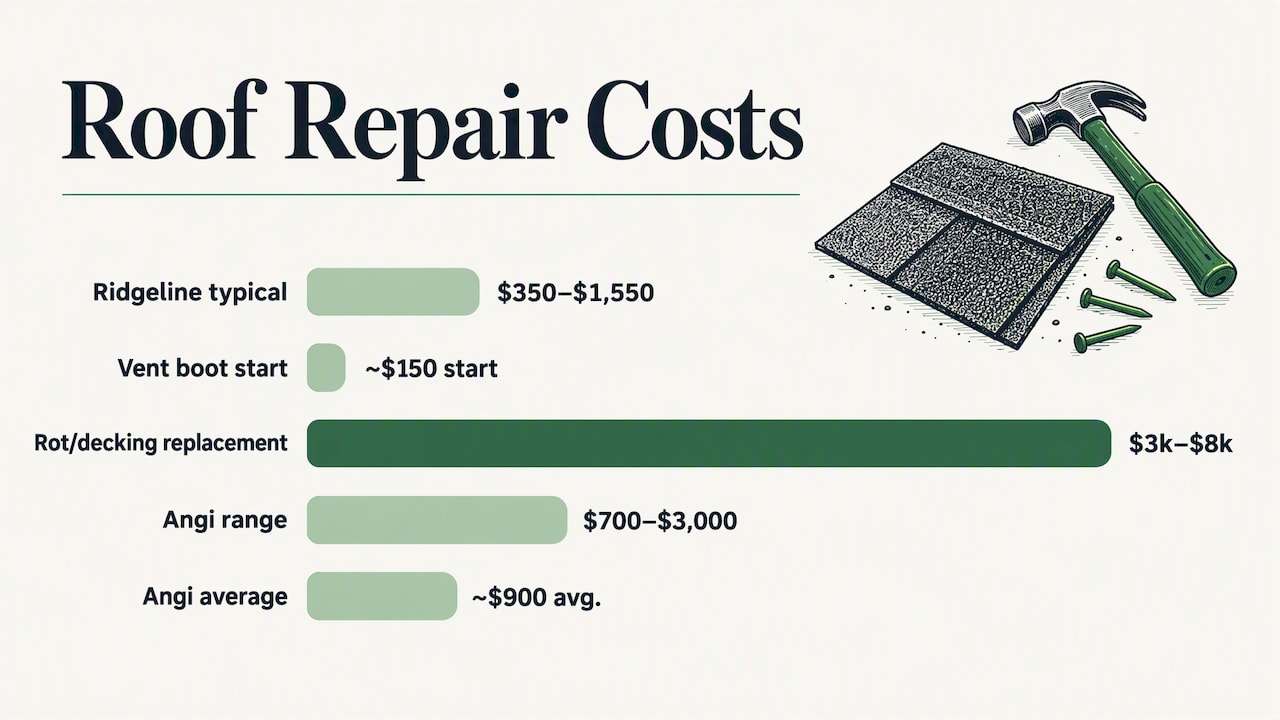
Labor accounts for around 60% of a typical repair invoice, per the Ridgeline data. That means a steep roof, a two-story house or complex rooflines often influence cost more than materials. These are national figures, not a quote. Our own pricing is set after an inspection, because we do not publish a fixed price for repairs.
The cheapest path is almost always to act early. A $150 boot replaced this week costs far less than wet decking and mold remediation next season.
Our Perspective: Honest Diagnosis Beats a Fast Patch
We have worked on Louisiana roofs for over 25 years, and the pattern is consistent. Homeowners call after they see a stain, and the stain is the end of a story that started with a lifted shingle or a dried-out boot months earlier. Heat, heavy rain, humidity and storm winds are all hard on a roof here, so small defects open quickly.
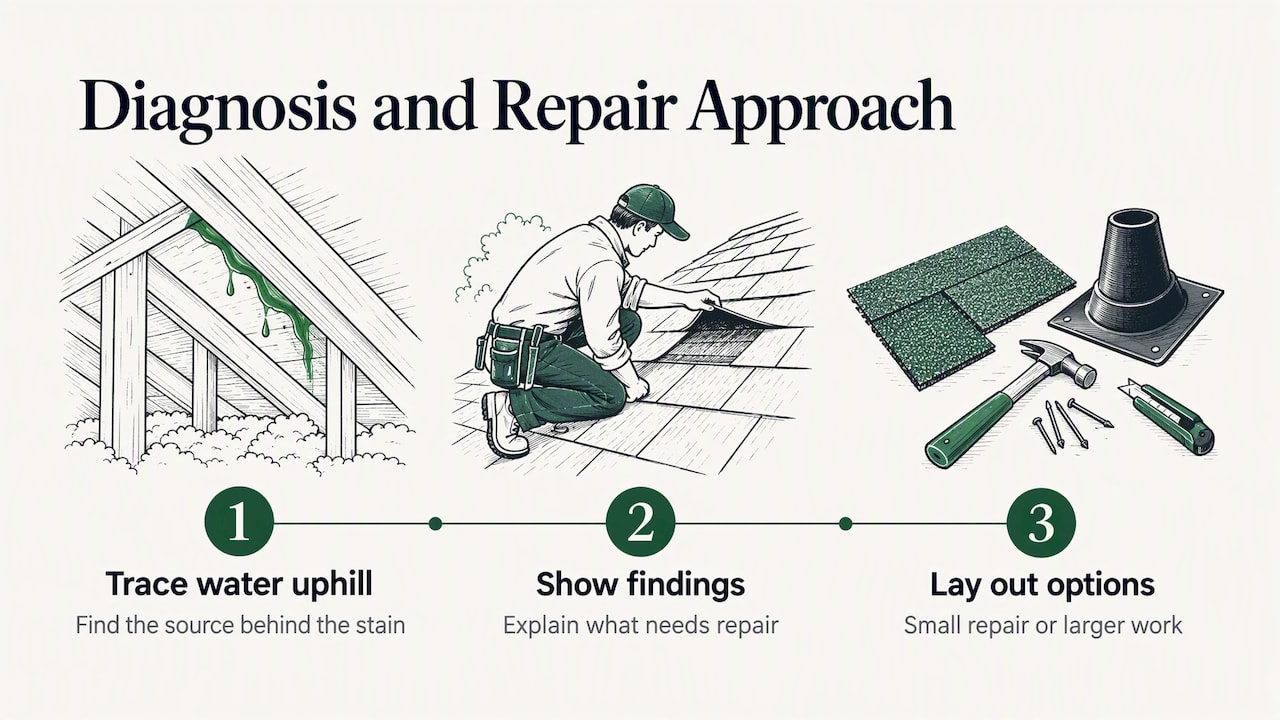
Our approach is simple. We trace the water uphill, show you what we find, and explain whether you need a small repair or a larger one. We would rather tell you a boot replacement solves the problem than sell you a roof you do not need. If the roof is near the end of its life, we say that plainly and lay out your options without pressure.
Two habits save homeowners the most money. First, look in the attic after every significant storm. Second, never let a leak sit while you wait for a “good time.” Water does not wait. And if the cause turns out to be ventilation, not the roof, we tell you that too, because a new patch will not fix condensation.
Let Us Find the Source
If you are seeing any of these signs, we offer roof inspections that locate the actual entry point, and roof repairs, including emergency repairs, once we know what failed. After a storm, our storm damage restoration team can also tarp the roof and help you document the damage. Our work carries a five-year workmanship warranty. Business owners can find the same support under commercial roofing.
How Often Should You Check?
A simple routine catches most leaks early:
- Monthly: a quick attic look with a flashlight, and a glance at ceilings.
- After every big storm: attic, ceilings, gutters, and a ground-level look at the roof with binoculars.
- Once a year: a professional inspection. See our guide on roof inspection frequency in Louisiana’s climate.
- Know your normal. If you know how your attic usually looks and smells, you spot changes faster.
If you are weighing repair against replacement, our page on roof repair vs. replacement in Baton Rouge lays out the signs that point each way.
FAQ
How do I know if my ceiling stain is an active leak?
Touch it. A damp, cool or soft spot, or one that grows after rain, is active. A dry, ringed stain may be old, but it still marks a past leak that needs tracing. Check the attic above it with a flashlight during or just after rain.
Can a roof leak without a visible stain?
Yes. Water can soak insulation and sheathing for a long time before it reaches the ceiling. Musty odors, matted insulation, dark rafters and rusty nails in the attic can show a leak that has not reached the living space yet.
Is a small roof leak an emergency?
Treat it as urgent. Even a small leak can let materials stay wet beyond the 24 to 48 hour mold window. If water is near wiring or a ceiling is sagging, treat it as an emergency and leave the area.
Can I fix a roof leak myself with caulk or tar?
It is tempting, but it usually fails and can hide the real cause. Safe interior containment is fine. Roof work should wait for dry weather and a professional, because falls from wet roofs are a serious risk.
How much does it cost to fix a roof leak?
National estimates run from about $350 to $1,550 for most repairs, with minor fixes starting near $150 and major structural work above $3,000. The final figure depends on the cause, roof access and labor. An inspection gives you a number based on your actual roof.
Sources
- Roof leak signs and repair, GAF
- How To Find and Fix a Roof Leak, This Old House
- Leaky Roofs, University of Wisconsin Extension
- Leaky Roof Repair: Causes, Fixes and 2026 Costs, The Roofing Brief
- Emergency Roof Tarping: Cost & Timeline, Palm Build
- Roof Storm Damage: What to Do First, HomeMatchup
- Roof Repair and Replacement Assistance for Homeowners
- How Much Does It Cost to Repair a Roof Leak?, Ridgeline Roofing
- 8 Signs of a Roof Leak and What to Do About It, Angi