A reflective metal roof bounces a large share of sunlight away from your home and releases the heat it does absorb, so less warmth reaches your attic and your air conditioner runs less. What it delivers depends on three things: the finish and color you choose, how clean the surface stays, and how your roof is installed and ventilated. Here in Baton Rouge, where summer cooling bills are a real line item, those details are worth getting right before you sign anything.
TL;DR
- A cool metal roof pairs high solar reflectance with high thermal emittance. You need both numbers, not just one.
- Federal research simulated total HVAC savings of about 6% to 12% for homes in warmer climate zones. Your results depend on your home’s insulation, ducts and attic.
- Dark “cool colors” can reflect near-infrared sunlight, so you do not have to choose white to get a reflective roof.
- A Class 4 hail rating means a product stayed functional after two 2-inch steel ball impacts in one spot. It does not promise a dent-free roof.
- Reflectivity fades with dirt and oxidation, so cleaning and yearly inspections protect your investment.
Table of Contents
- What makes a metal roof “reflective”
- How a cool metal roof reduces heat gain and cooling demand
- Color, finish and coatings: what actually moves the needle
- Hail resistance: what Class 4 means for a metal roof
- Keeping reflectivity high: maintenance that matters
- Residential or commercial: what changes
- Is reflective metal roofing right for your roof?
- Perspective
- Talk to us about a cool metal roof
- FAQ
- Sources
What makes a metal roof “reflective”
Two properties decide how a roof handles the sun. The Department of Energy describes a reflective metal roof as one that limits heat absorption through high solar reflectance (how much sunlight it bounces back) and high thermal emittance (how well it re-emits the heat it absorbed).
Both matter. Lawrence Berkeley National Laboratory’s Heat Island Group explains that a cool roof has high solar reflectance and high thermal emittance, so it reflects sunlight and also sheds heat as thermal radiation.
Solar reflectance and thermal emittance in numbers
Solar reflectance is a decimal between 0 and 1. The Metal Building Manufacturers Association notes that white painted metal typically has a reflectance around 0.70. The same guide says low-emittance products such as bare, unpainted Galvalume sit near 0.10 emittance.
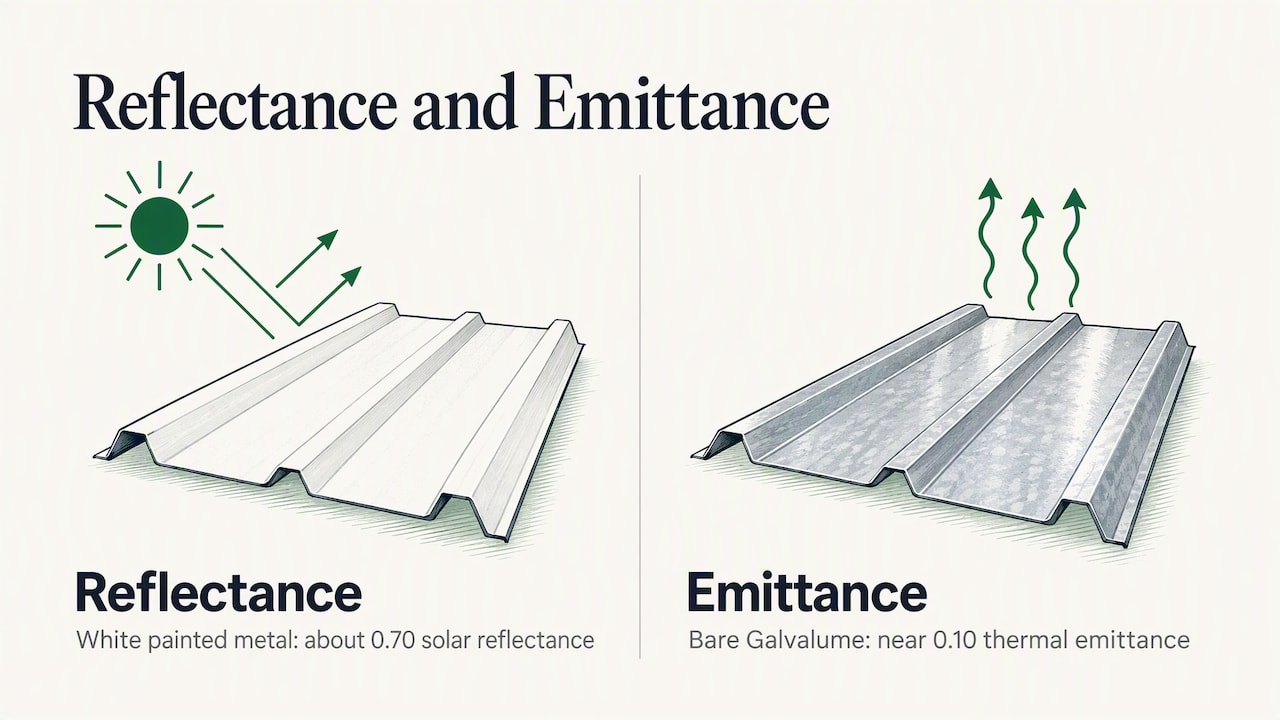
That last point surprises many homeowners. Shiny bare metal looks reflective, but it holds onto heat because it releases it poorly. A painted finish with good emittance often outperforms a mirror-bright bare panel at keeping the roof surface cool.
The Solar Reflectance Index
The Solar Reflectance Index (SRI) rolls both properties into one number. According to LBNL, standard black is assigned 0 and standard white is assigned 100, and a higher value means a cooler surface. When you compare two finishes, SRI gives you a quick apples-to-apples ranking, and the individual reflectance and emittance values tell you why.
| Property | What it tells you | Higher is… |
|---|---|---|
| Solar reflectance | Share of sunlight bounced back | Better |
| Thermal emittance | How well the roof releases absorbed heat | Better |
| SRI | Combined coolness score (black = 0, white = 100) | Better |
How a cool metal roof reduces heat gain and cooling demand
When less heat enters through the roof, your attic stays cooler, less heat reaches the ceiling below, and your air conditioning does less work. The Building America program at Pacific Northwest National Laboratory reports that simulated total HVAC savings were about 6% to 12% for homes in warmer climate zones.
Read that as a range from modeling, not a guarantee. A house with leaky ducts, thin attic insulation or poor ventilation will not capture the full benefit. If your attic bakes even under a decent roof, look at what is happening beneath it. A guide on fixing a hot attic without reroofing covers insulation and air sealing, and this explainer on ventilation and energy efficiency shows how airflow ties into cooling costs. We often see the best results when the roof and the attic are treated as one system.
Is there a winter penalty?
Honest answer: a cool roof can raise heating use in winter. The Department of Energy guide says that winter penalty can be smaller than the summer savings even in mixed climates. In a cooling-dominated region like south Louisiana, where air conditioning runs for a large part of the year, the balance leans toward reflectivity. Our own write-up on cool roof technology and Louisiana energy savings goes deeper on local conditions.
Beyond your own bill
LBNL also notes that cool roofs can help mitigate the urban heat island effect by sending sunlight back toward space. For a neighborhood full of dark roofs and pavement, that matters at the margin. The MBMA adds that the extent of these benefits varies by construction and climate, which is why we assess each building rather than quote a blanket savings figure.
Color, finish and coatings: what actually moves the needle
Light colors reflect the most sunlight, but they are no longer your only option. LBNL describes “cool colors” as dark and medium-toned surfaces that strongly reflect near-infrared sunlight. Much of the sun’s heat arrives as invisible near-infrared light, so a pigment engineered to reflect it can keep a charcoal or deep bronze panel far cooler than an ordinary dark paint.
How to choose a finish
- Ask for rated numbers, not marketing words. “Reflective” and “energy efficient” are not measurements. Ask for initial and aged solar reflectance, emittance and SRI.
- Look for third-party listings. The Cool Roof Rating Council keeps an independent directory of over 3,000 roofing products, including over 1,400 metal products, each with tested and labeled radiative properties.
- Weigh the aged value. LBNL explains that aged properties are typically measured after three years of natural outdoor exposure, because soil, oxidation and particle deposition reduce performance. The aged number is closer to what you will live with.
- Match the color to your home and neighborhood. Our Louisiana metal roofing color guide walks through how common colors behave in heat and how they look against brick, siding and HOA rules.
- Be cautious with bare metal. Because of its low emittance, unpainted Galvalume is not the cool-roof choice, however bright it looks on day one.
What about reflective coatings over an old roof?
Coatings can restore reflectance on an existing metal roof, and some commercial buildings use them to extend service life. They work best on a sound, clean substrate with sealed seams and fasteners. If your panels are rusted through or leaking, a coating hides a problem rather than solving it. That is a question for an inspection, which we offer free of charge for homeowners through our roof inspection service.
Hail resistance: what Class 4 means for a metal roof
Reflectivity gets people looking at metal, and hail is the next question in Louisiana, where severe storms come with wind and sometimes ice. Here is what the ratings do and do not tell you.
How the tests work
Under UL 2218, a Class 4 rating means a roof covering remained functional after being struck twice in the same location by 2-inch steel balls. The test is meant to replicate hailstone impact energy on flexible materials such as metal panels. FM 4473 is a related test for rigid materials that uses frozen ice balls; its Class 4 requires the product to remain functional after two impacts in the same spot with 2-inch ice balls.
The limits you should know
Metal roofs are generally highly resistant to functional hail damage, meaning leaks and punctures. They can still show cosmetic dents. The Insurance Institute for Business & Home Safety points out that these ratings test function and may not capture visible, non-functional damage in real storms.
There is another wrinkle. IBHS reports that U.S. model building codes have no specific hail-resistance requirements for roofing products. So a Class 4 label is a voluntary, product-level signal, and it is worth asking for the actual test report. Our guide to metal roofing hail resistance in Louisiana covers panel gauge, profile and what to expect, and if you are weighing shingles instead, see our Class 4 shingle guide.
One practical tip: check with your insurance agent about whether a Class 4 or metal roof affects your premium or how cosmetic damage is handled in your policy. Policies differ, and the answer is in your contract.
Keeping reflectivity high: maintenance that matters
A reflective roof only reflects when it is clean and sound. Dirt and oxidation lower reflectance over time, according to LBNL’s cool roof guidance. In humid Baton Rouge, mildew, pollen and tree debris build up quickly, especially under oaks and pines.
IBHS guidance for metal roofs recommends you limit foot traffic, keep corrosive agents and debris off the roof, follow manufacturer maintenance advice, and inspect and reseal penetrations every year using compatible products. It adds that valleys are mostly self-cleaning in rain, and that occasional cleaning with a mild household cleaner may be effective.
Our routine for a metal roof looks like this:
- Walk the perimeter first. We look at flashing, ridge caps, fasteners and sealant at chimneys, vents and skylights, because penetrations are where leaks start.
- Clear debris from valleys and gutters so water drains rather than pools.
- Wash gently. Pressure washers can strip finishes and drive water under laps, so we stick to low-pressure methods. Read why in our piece on regular metal roof washing.
- Check after every major storm. Wind and hail can loosen fasteners or damage coatings before any leak appears.
For a complete checklist, see our metal roof maintenance guide and our top 10 maintenance tips.
Residential or commercial: what changes
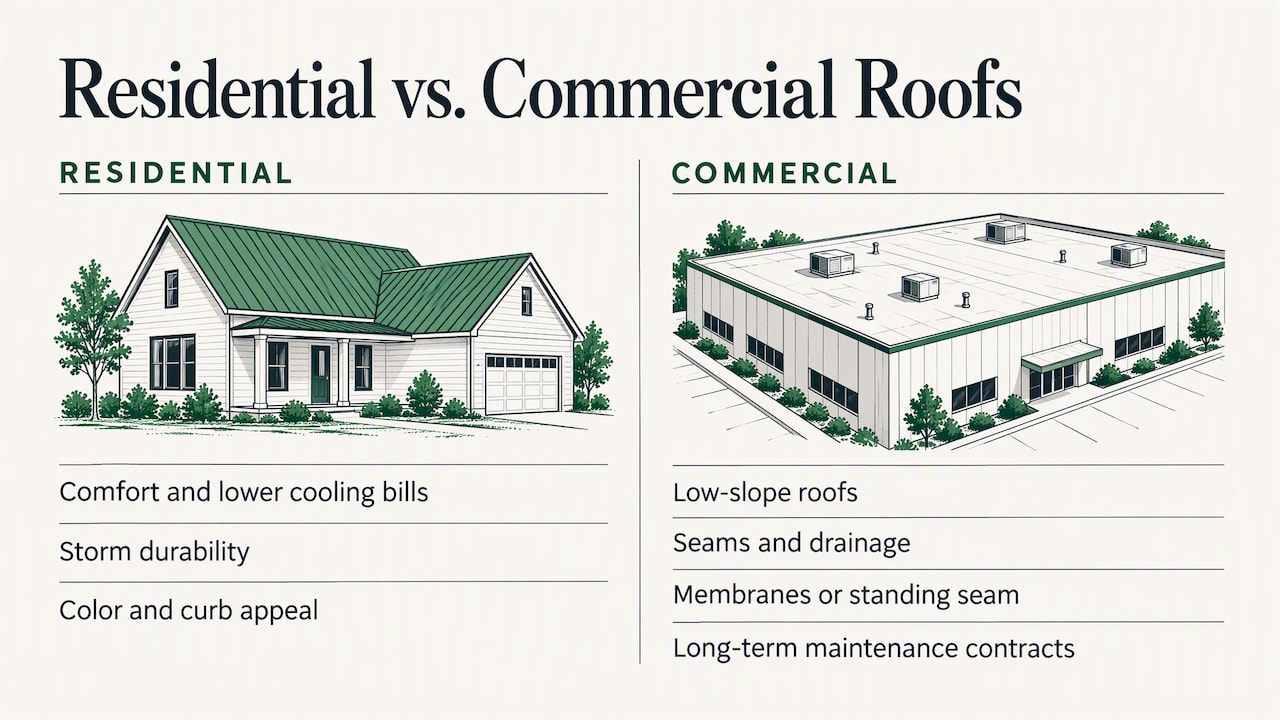
On a home, the main goals are comfort, lower cooling bills and storm durability, and color and curb appeal weigh heavily. On a commercial building, the roof is often low-slope, so the conversation shifts to seams, drainage, membranes or standing seam systems, and long-term maintenance contracts. Large flat roofs absorb a lot of sun, which makes reflective surfaces especially useful there. We install commercial metal roofing and flat roof TPO systems, and you can read about energy efficient commercial roofing in Louisiana or the best materials for commercial roofing.
Is reflective metal roofing right for your roof?
Use these questions as a quick filter:
- Is your roof near the end of its life? If shingles are curling, granule loss is heavy or leaks keep returning, replacement is more sensible than patching. Our guide to signs you need a metal roof replacement in Baton Rouge helps you decide.
- Does your home run hot upstairs or in the attic? Roof reflectivity can help, and insulation and ventilation should be reviewed at the same time.
- Do you want one roof to handle sun, wind and storms? Metal with a rated finish and proper fastening is built for that.
- Are you staying long enough to benefit? Energy savings and durability pay off over years, not months.
We also cover how metal handles intense sun in our article on metal roof heat resistance.
Perspective
We have been working on roofs for over 25 years, and the most common mistake we see is choosing a roof on a single word. “Reflective” on a brochure tells you very little. We would rather show you the rated numbers, the aged values and the test reports, then talk through what your attic, ducts and shade trees will do to the result.
Our view is that a well-chosen metal roof is one of the strongest answers to Louisiana weather: it handles sun, wind-driven rain and storm debris, and a cool finish takes some load off your air conditioner. But the finish is only as good as the installation underneath it. Flashing details, fastener placement and ventilation decide whether a roof performs in year 15 the way it did on installation day, which is why we stand behind our work with a five-year workmanship warranty.
We also believe in straight talk. If your roof can be repaired, we will say so. If it needs replacement, we will show you why before you decide anything, with no pressure.
Talk to us about a cool metal roof
If you are comparing finishes, wondering whether your current roof is worth saving, or checking storm damage on a metal roof, we can look at it with you. We handle roof inspections, repairs, full replacements, storm damage restoration and commercial metal roofing across the Baton Rouge area, and we explain what we find in plain language.
Start with a roof inspection, or if you are ready to plan a new roof, see our roof replacement services. Business owners can review our commercial roofing services.
FAQ
Is a reflective metal roof worth it in Louisiana?
For many homes, yes. Cooling dominates energy use here, and federal simulations showed total HVAC savings of roughly 6% to 12% in warmer climate zones. Actual savings depend on your insulation, ducts and attic ventilation, so an inspection of the whole system gives a better answer than the roof alone.
Do I have to choose white to get a cool metal roof?
No. Cool-color pigments reflect near-infrared sunlight even in dark and medium tones. Ask for the rated solar reflectance, emittance and SRI of the exact color, and check the aged values, since dirt and oxidation lower performance over time.
Will a Class 4 metal roof still get dented by hail?
It can. Class 4 under UL 2218 means the product stayed functional after two 2-inch steel ball impacts in the same spot, so leaks are unlikely. Cosmetic dents are still possible in a severe storm, so ask about panel gauge and check how your insurance policy treats cosmetic damage.
How often should a reflective metal roof be inspected?
At least once a year, and after any major storm. Professional guidance calls for annual checks and resealing of penetrations with compatible products. Regular gentle cleaning also keeps the surface reflective.
Sources
- Cool roof Q & A, Lawrence Berkeley National Laboratory Heat Island Group
- Guide to Cool Roofs, U.S. Department of Energy
- Energy Guide for Metal Building Systems, Metal Building Manufacturers Association
- Cool Roofs and Walls to Reduce Heat Gain, Building America
- Commercial Roofs Best Practices, Insurance Institute for Business & Home Safety
- Roof Guide: Codes & Standards, Insurance Institute for Business & Home Safety
- Low-Slope Metal Roof Guide, Insurance Institute for Business & Home Safety