Most commercial roof replacements in the U.S. cost roughly $5 to $17 per square foot, installed. A 15,000-square-foot flat roof therefore lands somewhere between about $75,000 and $255,000, and the system you choose, the insulation you need and the condition of the deck underneath decide where in that range you end up. Below we break down the price by roofing system, show worked examples, and explain what changes a bid for a building in Baton Rouge and the surrounding parishes.
TL;DR
- Expect about $5 to $17 per square foot for a full commercial replacement, with single-ply membranes at the lower end and metal and multi-ply systems at the higher end.
- A 60-mil TPO roof with R-25 or R-30 insulation is commonly priced between about $9.35 and $13.60 per square foot, depending on how the membrane is attached.
- Tear-off, insulation, wet decking, drainage changes and permits are the line items that move a quote the most.
- For any project above $50,000, get several written bids and have the scope verified on the roof itself.
- Free inspections from us give you a scope you can compare bids against before you commit.
Table of Contents
- What a commercial roof replacement costs per square foot
- Cost by roofing system
- Flat roof and TPO costs in detail
- What drives a commercial roof quote up or down
- Baton Rouge: what changes the number locally
- Repair or replace: where the line falls
- Perspective: how we read a commercial roof bid
- How to compare bids
- Get a scope you can price against
- FAQ
- Sources
What a commercial roof replacement costs per square foot
Per-square-foot pricing is the fastest way to size a budget, but it is a range, not a quote. A national 2026 guide puts the overall spread at about $5 to $17 per square foot. The bottom of that range is a ballasted EPDM overlay with no new insulation. The top is a two-ply modified bitumen system with enough insulation to meet an R-30 energy-code requirement.
Square footage is the roof’s area, not the building’s footprint. Parapets, curbs, equipment pads and flashing details all add surface and labor, so a roof with many rooftop units costs more per square foot than an open, simple deck.
You will see other published ranges, and they will not match exactly. Different guides count different things: some price only the membrane, some include tear-off, some include insulation. When you compare any two numbers, ask what is in each one.
Cost by roofing system
The membrane or panel you pick sets the baseline. These are national installed figures, so treat them as a starting point and expect Gulf South labor and material pricing to move them.
| System | Typical installed range (per sq ft) | Where it fits |
|---|---|---|
| EPDM | $5.50 to $8.50 | Lowest upfront cost, simple roofs |
| TPO, 60-mil, with insulation | $9.35 to $13.60 | Reflective single-ply for flat and low-slope roofs |
| PVC | $7.50 to $11.00 | Restaurants, food processing, chemical exposure |
| Single-ply, 25,000 sq ft example | $125,000 to $375,000 total | Equivalent to roughly $5 to $15 per sq ft |
| Standing-seam metal, 25,000 sq ft example | $250,000 to $500,000 total | Roughly $10 to $20 per sq ft, long service life |
The spread inside a single row is often bigger than the gap between rows. That is why the details below matter more than the headline number.
Flat roof and TPO costs in detail
Flat and low-slope roofs are the most searched commercial replacement type, and TPO is the most common single-ply choice for them. One 2026 TPO guide lists full-system examples for a 60-mil membrane. With R-25 insulation they run $9.35 ballasted, $11.85 mechanically attached and $12.10 fully adhered per square foot. With R-30 they run $10.35, $13.35 and $13.60.
Its wider TPO range runs from about $4 per square foot for a recover with no added insulation to about $14 for a fully adhered 80-mil system with R-30. Another 2026 estimate puts installed TPO broadly between $4.50 and $16, with membrane material alone commonly $1.50 to $3.50 of that.
What do the three attachment methods mean for you?
- Ballasted: the membrane is held down by stone or pavers. It is the cheapest, but it adds heavy weight, and the structure must carry it.
- Mechanically attached: fasteners and plates secure the membrane through the insulation into the deck. It is the middle option on price, and fastener spacing is set by the wind load.
- Fully adhered: the membrane is bonded to the substrate. It costs the most and gives a smooth, tight surface, which many owners prefer where wind uplift is a concern.
Worked example: a 15,000 sq ft building
Take a one-story retail or office building with a 15,000-square-foot flat roof and apply the 60-mil TPO figures above:
- Ballasted, R-25: 15,000 x $9.35 = about $140,250
- Mechanically attached, R-25: 15,000 x $11.85 = about $177,750
- Fully adhered, R-30: 15,000 x $13.60 = about $204,000
That is a $64,000 swing on one roof with one membrane, from the attachment method and the insulation alone. These are illustrations built from published national figures, not our prices, and a real bid also reflects tear-off, drainage and access.
What drives a commercial roof quote up or down
National guides list the same drivers: roof size and complexity, material type and thickness, attachment method, insulation, tear-off, labor, access, permits and disposal fees. Here is how each one behaves in practice.
Tear-off versus recover
Removing an existing roof can add $1 to $2 per square foot. On our 15,000-square-foot example that is $15,000 to $30,000. A recover, which installs a new membrane over the old assembly where code allows, avoids it. It only makes sense when the insulation underneath is dry. If it is saturated, covering it just hides the problem and shortens the new roof’s life.
Insulation and energy code
Above-deck insulation typically adds about $0.75 to $1.50 per square foot for each inch, and most U.S. climate zones call for roughly R-25 or R-30 on a replacement. Insulation values are not just a line item, they also change how the roof performs over time. For a plain-language look at how insulation types differ, see this explanation of closed cell versus open cell insulation. If your roof is metal, our guide on metal roof insulation for climate and efficiency covers the Louisiana side of it.
Wet insulation and deck repairs
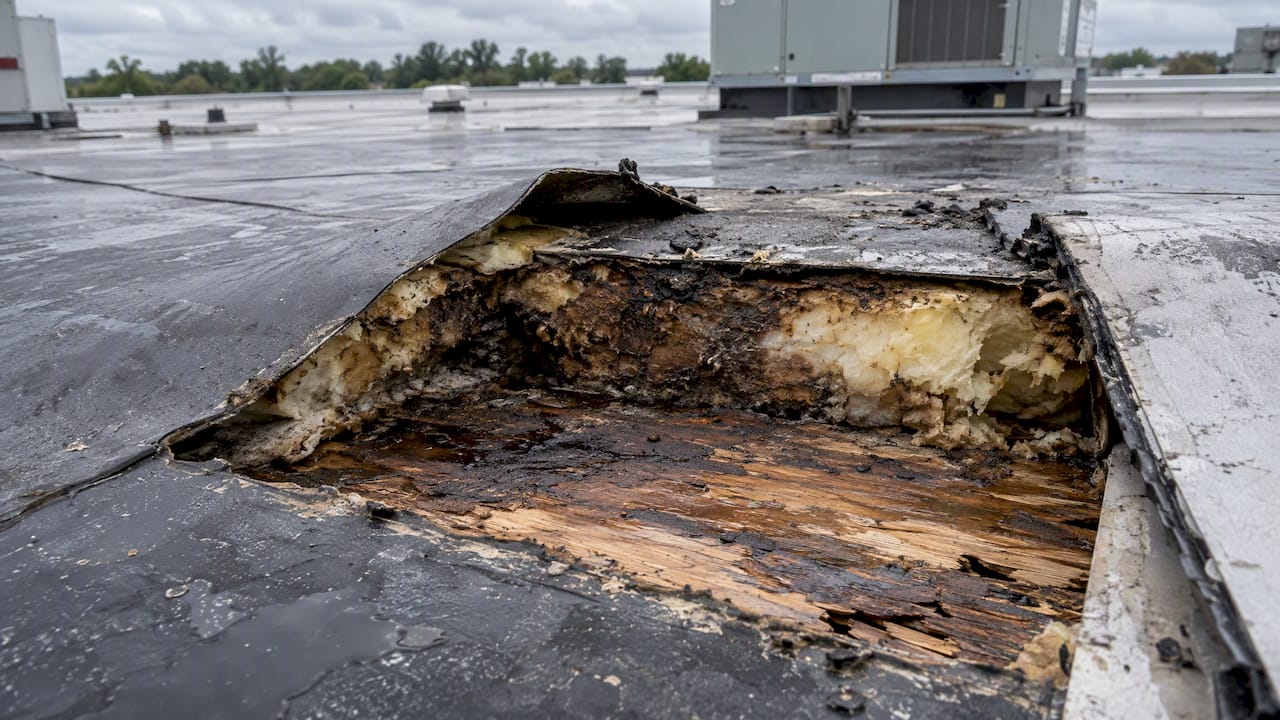
This is where budgets break. Water-damaged insulation or deck sections can add substantially to the total beyond the base membrane price. You cannot see it from the ground, and a good estimate states how repairs will be priced, for example per square foot of deck or per sheet of replaced decking, before the crew opens the roof.
Drainage
Flat roofs in a region with heavy, frequent rain live or die by drainage. Adding or re-sloping drains and tapered insulation costs money, but ponding water shortens the life of nearly any membrane. We cover the details in our flat roof drainage guide for Louisiana commercial buildings.
Access, logistics and permits
A roof with no crane access, a busy loading dock or an occupied tenant space takes more labor and more planning. Permits are also part of the job. Baton Rouge’s code of ordinances makes it unlawful to repair, alter or replace regulated systems without first applying to the building official for a permit, so confirm that your bid either includes permitting or states who pulls it. Neighboring parishes have their own rules, and our parish roofing regulations overview is a good place to start.
Baton Rouge: what changes the number locally
Published local figures are thin. One construction estimate for a Baton Rouge warehouse lists roofing budgets of $9,000, $20,000 and $50,500, but it does not state the roof area or the scope, so it cannot tell you a per-square-foot price. Be wary of any site that offers a precise Baton Rouge number without a scope behind it.
What we can say from working on roofs here is how the climate shapes the job:
- Rain and standing water: low-slope roofs here see intense downpours, so drainage capacity, seam quality and flashing details deserve as much attention as the membrane brand.
- Heat and humidity: reflective membranes such as TPO and cool-coated metal help with cooling loads, and moisture trapped in an old assembly spreads quickly in humid air.
- Storm season: wind uplift ratings and fastening patterns matter more on the Gulf Coast. After a hurricane or hail event, a storm damage claim can change whether the work is a repair, a partial replacement or a full replacement. See our guide to commercial storm damage restoration.
- Insurance pressure: commercial property insurance has been rising. One industry source reports a 35% increase in reconstruction costs since 2020 nationally, which is one reason carriers look closely at roof age and condition.
For a wider look at the options here, read our overview of commercial roofing solutions in Baton Rouge and our notes on the best materials for commercial roofing.
Repair or replace: where the line falls
Repair costs are not a clean per-square-foot figure, because a repair is priced by the problem: a failed seam, a flashing detail around a rooftop unit, a clogged drain. A small, isolated leak on a roof in good overall shape is usually a repair. Repeated leaks in different places, wet insulation found in a moisture survey, blistering, or a membrane that is near the end of its service life point to replacement.
A useful test is the trend. If you are paying for repairs every season and the repaired areas keep growing, the repair budget is quietly turning into a replacement budget, only without the warranty. A written inspection with moisture readings shows which side of that line you are on. Our commercial roof repair and maintenance work covers both, and for the residential side see our comparison of roof repair versus replacement in Baton Rouge.
Perspective: how we read a commercial roof bid
We have been roofing in Baton Rouge for over 25 years, and the same thing happens again and again: two bids for the same building differ by tens of thousands of dollars, and the owner assumes one contractor is overcharging. Usually, the bids are not for the same roof. One includes tear-off and tapered insulation, the other assumes a recover. One states how wet decking is handled, the other leaves it as a surprise change order.
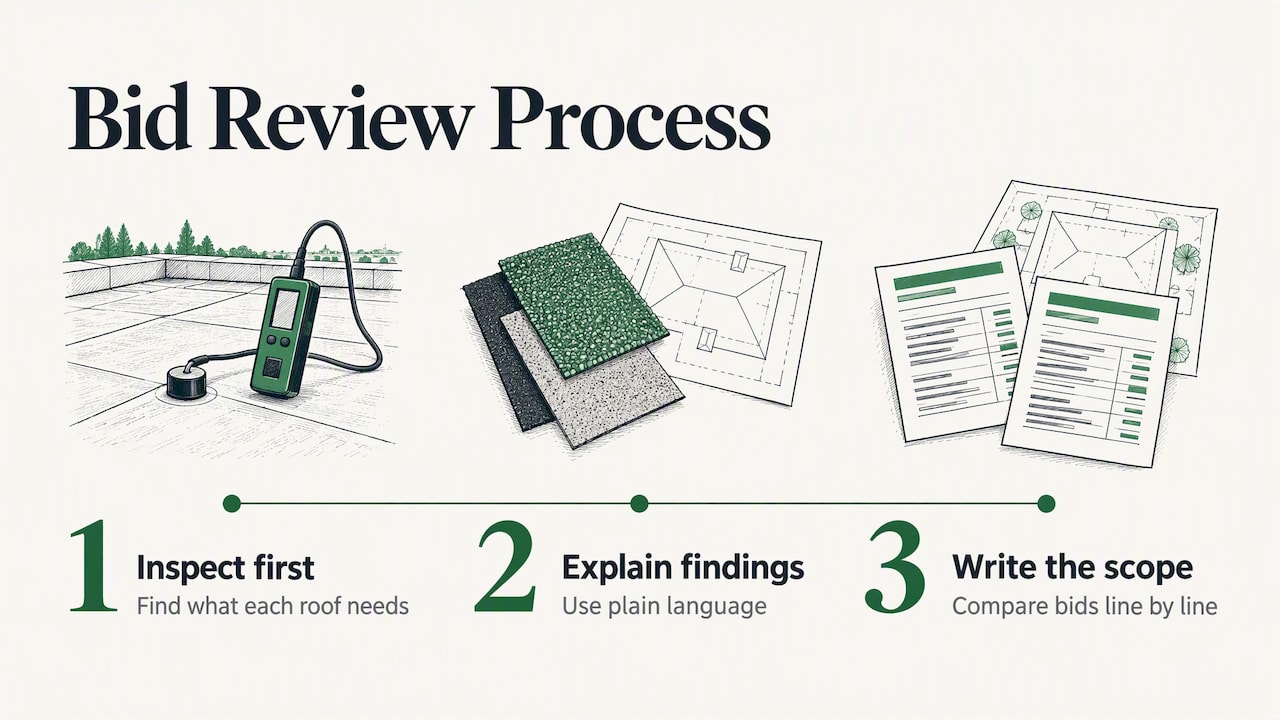
Our approach is simple. We inspect first, we explain what we find in plain language, and we write the scope so you can set it beside any other bid line by line. We do not pressure anyone into a signature, and our work carries a five-year workmanship warranty. If your number comes out higher than a competing bid, we would rather show you why than hide it.
One more point from the field: do not pick on price per square foot alone. Pick on scope, on how the contractor handles the unknowns, and on who answers the phone when it rains.
How to compare bids
It helps to ask every contractor for the same things in writing:
- System and thickness: for example, 60-mil or 80-mil TPO, and the attachment method.
- Tear-off or recover: and the reason, based on a moisture survey.
- Insulation: the R-value, the type and the code requirement it meets.
- Deck repair pricing: a unit price for replacing wet or damaged decking, so surprises have a known cost.
- Drainage and flashing: what is added or changed at drains, curbs, parapets and penetrations.
- Permits and disposal: who pulls the permit and whether disposal is included.
- Warranty: what the workmanship coverage and manufacturer coverage each include and for how long.
For projects above $50,000, one 2026 guide suggests treating the job as a candidate for an independent roof consultant and several competing bids, because the existing insulation and deck can change the scope substantially. That is sound advice on a six-figure roof.
If you are thinking about solar on the new roof, settle that before the membrane goes down. These questions to ask about flat roof solar are worth reading, since penetrations, ballast loads and warranty terms all interact with the roofing contract.
Get a scope you can price against
We offer free inspections and written assessments for commercial buildings in Baton Rouge: replacement, repair, maintenance, metal roofing and flat roof TPO systems. We do not publish a flat price for commercial work, because an honest number depends on what is under your membrane. If you want a clear scope and a straightforward quote, start with our commercial roofing services page or book a roof inspection.
FAQ
How much does it cost to replace a roof on a commercial building?
Most projects fall between about $5 and $17 per square foot installed, according to a 2026 national cost guide. Multiply that by your roof’s actual area, then add allowance for tear-off, wet decking and drainage work. A roof inspection narrows the range far better than any national average.
How much does a TPO roof cost per square foot?
Full 60-mil TPO systems with R-25 or R-30 insulation are listed at about $9.35 to $13.60 per square foot, depending on whether the membrane is ballasted, mechanically attached or fully adhered. A recover with no new insulation can cost much less, and an 80-mil fully adhered system with R-30 sits at the top.
Is the flat roof replacement cost different from the commercial roof cost?
Not much, because most commercial roofs are flat or low-slope. The same single-ply, modified bitumen and built-up systems are used, so the per-square-foot ranges above apply to both. What changes is scale and complexity: larger roofs usually cost less per square foot, and roofs with many penetrations cost more.
Does a commercial roof need a permit in Baton Rouge?
Generally yes. The city-parish code requires an application to the building official before work that is regulated by the technical codes, and it accepts certified third-party plan reviewers. Confirm the requirements with the building official for your specific address and scope.
Sources
- Roof Replacement Cost Guide: 2026 Average Prices
- TPO Membrane Roof Cost Guide (2026 Update)
- TPO Roof Cost: Installation Variables and Project Prices
- TPO Roofing Installation Financing Options and Costs
- Commercial Roof Cost Guide (2026)
- Commercial Flat Roof Replacement FAQs
- Commercial Property Insurance Rate Increases 2025
- Baton Rouge Code of Ordinances, Chapter 1, Building Codes
- Closed cell versus open cell insulation
- Questions to ask about flat roof solar