Louisiana’s FORTIFIED roof program is really two things that work together. FORTIFIED is a voluntary roof standard from the Insurance Institute for Business & Home Safety (IBHS). The Louisiana Fortify Homes Program (LFHP) is a state grant that pays up to $10,000 toward a roof upgrade built to that standard. You can build a FORTIFIED roof without the grant. You cannot get the grant without building one.
Below, we walk through who qualifies, what the roof must include, what it costs, how certification works and what to expect from your insurer. We are a Baton Rouge roofing contractor, and these are the questions we hear most from homeowners after a hurricane season.
TL;DR
- FORTIFIED is the IBHS roof standard. The LFHP is the state grant, up to $10,000, for roofs that meet it.
- Grants are awarded by lottery to owner-occupied primary residences in eligible parishes. Registering on the last day of a window gives the same odds as the first day.
- A FORTIFIED re-roof on a 2,000-square-foot home typically adds $1,000 to $3,000 over a standard re-roof, according to IBHS.
- Louisiana insurers must offer an actuarially justified discount for FORTIFIED structures. The size varies by insurer, so ask yours before you start.
- Certification is issued by IBHS after an evaluator documents the work, and it must be renewed every five years.
Table of Contents
- What the FORTIFIED roof program is, and how Louisiana’s grant fits in
- Who qualifies for a Louisiana Fortify Homes grant
- How the application and lottery work
- FORTIFIED Roof requirements in Louisiana
- What a FORTIFIED roof costs in Louisiana
- Certification: what it confirms and how you get it
- Benefits: protection and insurance discounts
- Our perspective: what we see on Louisiana roofs
- Choosing a contractor for a FORTIFIED or LFHP project
- Planning a FORTIFIED roof with us
- FAQ
- Sources
What the FORTIFIED roof program is, and how Louisiana’s grant fits in
FORTIFIED Roof is a set of installation requirements that go beyond the building code. The idea is simple: most wind damage starts when the roof covering or deck lets go, and then rain gets inside. The standard closes the common weak points.
The state’s grant program exists because of cost. Louisiana homeowners spend a higher share of household income on homeowners and flood insurance than residents of other hurricane-exposed states, and the Louisiana Department of Insurance (LDI) describes the LFHP as part of its effort to make coverage more affordable. The grant lowers the upfront cost, and the roof itself can lower what you pay and lose later.
Two points trip people up:
- Grant and standard are separate. Paying for a FORTIFIED roof yourself is perfectly allowed. The grant only covers projects that follow the LFHP process.
- Funding comes in rounds. Money has been added and eligibility has widened more than once, so the open window and the parish list change. Always check the LDI Fortify Homes page for the current round.
Who qualifies for a Louisiana Fortify Homes grant
According to LDI, an eligible homeowner must:
- Own the home as a primary residence with a homestead exemption.
- Live in a parish the program has approved.
- Carry active wind insurance, plus flood insurance if the home sits in a designated Special Flood Hazard Area.
The home also has to be in good repair. Condominiums, mobile homes and new construction are excluded, and so are rental properties that are not owner-occupied.
Parish eligibility has expanded. The program began in coastal parishes and has since reached further inland, so do not assume you are in or out. Look up your parish on the LDI site. If your roof is already failing or leaking, a repair may be needed first, because the home must be in good repair to be accepted. Our roof repair team can sort out that stage.
How the application and lottery work
Grants are not first come, first served. Homeowners create a profile in the LDI Fortify Homes system and register when a registration period is open. Registering on the last day gives the same chance of selection as the first day, so there is no reason to rush a sloppy application.
If you are selected, the process runs roughly like this:
- Submit the online grant application. The LFHP rules and requirements summary says awards are made by lottery, followed by an online application.
- Hire a certified Home Evaluator. You select and pay for the evaluator, who performs the IBHS home review.
- Collect bids. You need bids from at least three LFHP-approved contractors.
- Complete the work on the clock. FORTIFIED work must be finished within 90 days of your eligibility notice, unless an extension is granted.
- Evaluation and certification. The evaluator documents the work and IBHS reviews it.
The 90-day window is the part that catches people. Roofers’ calendars fill after storms, so line up your evaluator and your bids early. A contractor who can start quickly and communicate clearly matters more here than in an ordinary re-roof.
FORTIFIED Roof requirements in Louisiana
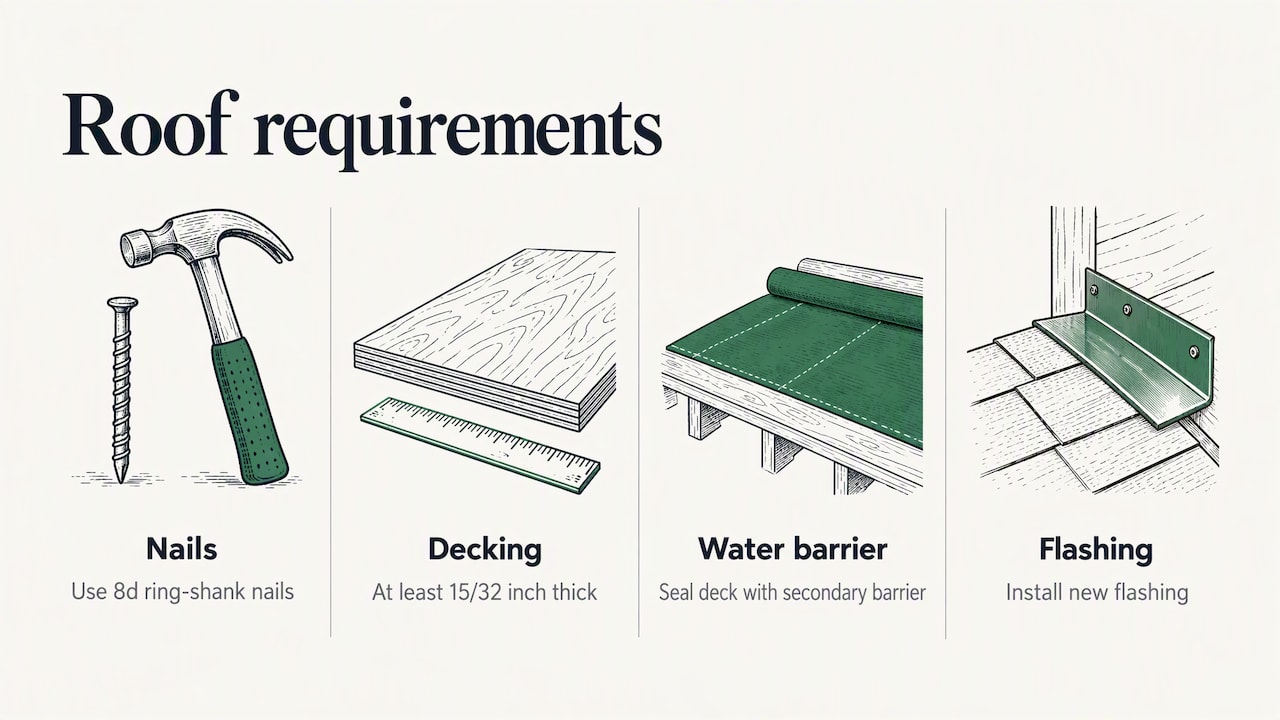
LDI’s service provider guidance lists the core technical items: 8d ring-shank nails, roof decking at least 15/32 inch thick, a sealed roof deck with a secondary water barrier, and new flashing. Here is what each means on a real job.
Ring-shank nails and deck attachment
Smooth nails can pull out of decking under suction from high wind. Ring-shank nails have ridges that grip the wood. The deck is re-nailed to the rafters in a tighter pattern, so the whole roof acts as a stronger diaphragm.
Deck thickness
The deck must be at least 15/32 inch thick. Thinner or deteriorated sheathing gets replaced, and this is where hidden costs show up once the old shingles come off.
Sealed roof deck
A secondary water barrier means that if shingles blow off, the deck underneath still sheds water. That matters in Louisiana, where the rain that follows a wind event often does more damage than the wind. Our Louisiana wind-resistant roofing materials guide covers the underlayment and shingle options in more detail.
New flashing
Old flashing is reused on many standard re-roofs. A FORTIFIED roof calls for new flashing, which removes one of the most frequent leak paths, especially around chimneys and walls.
FORTIFIED standards are revised from time to time, so the evaluator and your contractor should work from the version in force for your project. Ask for the specification in writing.
What a FORTIFIED roof costs in Louisiana
The honest answer is a range. IBHS says that when re-roofing a 2,000-square-foot home, the cost increase is typically between $1,000 and $3,000. The same page notes that FORTIFIED involves extra materials and labor, and that cost varies with the home’s design and the building code in its area.
That figure is the premium over a standard re-roof, not the whole job. Your total depends on roof size, pitch, how much decking needs replacing and the shingle or metal product you choose. We do not publish flat prices because every roof has surprises under the old layer. We give written, itemized estimates after an inspection, and we flag deck repairs before work starts rather than adding them later.
The grant of up to $10,000 can cover a large share of a FORTIFIED re-roof on a typical house, but it is a maximum, not a guarantee. Grants are paid toward qualifying construction costs, so ask the program how and when funds are released before you sign, and plan for your share of the bill. If wind has already damaged the structure around your roof, storm damaged building repair may need to happen alongside the roof work.
Certification: what it confirms and how you get it
A FORTIFIED Roof certification confirms that a home was built, renovated or re-roofed to FORTIFIED standards. IBHS issues it after reviewing documentation from a FORTIFIED Evaluator. That documentation is why photos at each stage matter: the decking, the nailing, the sealed deck and the flashing all need to be recorded before they are covered up.
Certification has an expiry. A designation must be renewed every five years. Under the 2025 standard, renewals carry evaluation fees, and a certificate that has been expired for more than five years requires a full new evaluation. Put the renewal date in your calendar when you receive the certificate, because your insurance discount may depend on it being current.
If you are buying a home with a FORTIFIED roof, ask for the certificate and its date. Our home buying roof inspection guide explains what else to look at.
Benefits: protection and insurance discounts
FORTIFIED roofs are more wind-resistant and can reduce windstorm damage and uninsured losses. LDI also points to less disruption after storms. Fewer displaced families and fewer emergency tarps are real benefits when a whole neighborhood is waiting on contractors.
On insurance, Louisiana law is specific. Admitted insurers that file rates must provide an actuarially justified discount or credit to insureds whose structures meet IBHS FORTIFIED standards. The same LDI report says most insurers apply it to the wind and hail portion of the premium, not the whole bill.
What that means for you:
- The discount is real but not uniform. It varies by insurer, location and FORTIFIED level.
- Call your agent before you begin and ask what documentation the insurer wants, and how much the discount is for your policy.
- IBHS notes that some carriers across the U.S. provide FORTIFIED endorsements at no additional cost, so it is worth asking whether yours does.
- A FORTIFIED roof does not guarantee a claim will be paid or that the roof will survive every storm. It improves the odds. Our wind damage insurance tips cover how to document a claim.
Our perspective: what we see on Louisiana roofs
We have spent more than 25 years on roofs in and around Baton Rouge, and the pattern after a storm is consistent. Roofs fail at the edges, the flashing and the deck, rarely in the middle of a well-installed field of shingles. That is why the FORTIFIED checklist makes sense to us: it targets the places we see leaks start.
Our advice is plain. If your roof is near the end of its life, do not replace it with a standard roof and then wish you had upgraded. The FORTIFIED premium is smallest when you are already tearing off. If your roof still has years left, a professional inspection will tell you whether to wait, repair or plan the upgrade. We give honest assessments, with no pressure to replace a roof that does not need it.
On the grant, be realistic. It is a lottery, the 90-day clock is tight, and the paperwork rewards homeowners who prepare. Have your homestead exemption, insurance declarations and a shortlist of contractors ready before your registration is selected.
Choosing a contractor for a FORTIFIED or LFHP project
Grant projects require approved contractors, so confirm approval with the program rather than taking anyone’s word. Beyond that, look for:
- A written scope that names the FORTIFIED items: nails, deck thickness, sealed deck, flashing.
- A clear plan for photographing each stage for the evaluator.
- A valid Louisiana license. Our contractor licensing guide explains what to verify.
- A workmanship warranty in writing. Ours is five years.
- Local knowledge of your parish’s permitting rules, which we cover in our Baton Rouge area parish regulations guide.
If your home is in a flood zone, there are extra insurance considerations covered in our flood zone roofing guide.
Planning a FORTIFIED roof with us
If you are weighing an upgrade, start with a free inspection so you know the condition of your decking and flashing before anyone quotes a number. See our FORTIFIED roofing page for how we approach these projects, or go straight to roof replacement if you are ready for an estimate. We explain what we find, put it in writing and leave the decision to you.
FAQ
Is the FORTIFIED roof program mandatory in Louisiana?
No. FORTIFIED is a voluntary standard, and the LFHP grant is optional. It does not replace the building code your parish enforces. You choose it for the storm protection and the possible insurance savings.
How much does a FORTIFIED roof cost in Louisiana?
IBHS says the added cost on a 2,000-square-foot re-roof is typically $1,000 to $3,000 over a standard roof. Your full price depends on roof size, pitch, decking repairs and materials. A written estimate after an inspection is the only reliable number.
Can I get the grant for a new home or a rental?
No. Eligible homes must be owner-occupied primary residences with a homestead exemption. New construction, condominiums and mobile homes are not eligible, and neither are non-owner-occupied rentals.
How long does FORTIFIED certification last?
Five years. After that you renew, with an evaluation fee. If the certificate has been expired for more than five years, a full new evaluation is required.
Will a FORTIFIED roof lower my insurance premium?
Louisiana requires insurers to offer an actuarially justified discount, most often applied to the wind and hail portion of the premium. The amount varies by insurer, so ask your agent for the figure before you commit.
Sources
- Louisiana Fortify Homes Program, LDI
- LDI Fortify Homes informational report
- LFHP summary of requirements
- LDI lottery press release
- Fortify Homes service providers, LDI
- Fortify Homes FAQ, LDI
- FORTIFIED frequently asked questions, IBHS
- 2025 FORTIFIED Home Standard
- LDI FORTIFIED discount report