
A ridge vent leak almost always comes from one of four things: installation mistakes, worn or rusted parts, wind-driven rain pushed through the vent, or an unbalanced attic ventilation system that pulls rain in. Most fixes are small, such as resealing, replacing fasteners or end caps, or swapping a damaged section. Replacing a vent typically runs $300 to $1,200. Left alone, though, even a slow leak can soak insulation and rot decking.
We repair roofs across the Baton Rouge area, and a leak at the peak is one of the trickier calls. The stain on the ceiling rarely sits under the spot where water gets in. Below, we explain how to confirm the ridge vent is the culprit, what to do tonight, and what a lasting fix looks like.
TL;DR
- Ridge vent leaks come mainly from poor installation, rusted or loose fasteners, cracked or missing end caps, aged foam or filter material, and imbalanced intake and exhaust airflow.
- Check the attic during or right after rain: damp ridge-board wood, stained sheathing near the peak, or wet insulation under the ridge point to the vent.
- Small repairs (sealing, fasteners, end caps) are often enough. A full vent replacement typically costs $300 to $1,200 depending on ridge length and access.
- Adding more ridge vent does not fix a ventilation problem and can make moisture worse. Intake at the soffit has to match the exhaust.
- If water is coming in now, cover the area temporarily and book an inspection before the next storm.
Table of Contents
- Why a ridge vent leaks
- Is it the ridge vent? How to check
- What to do while water is coming in
- How ridge vent leaks are repaired
- What a ridge vent repair or replacement costs
- Our perspective: why we start with airflow
- Get the leak looked at
- Preventing ridge vent problems
- FAQ
- Sources
Why a ridge vent leaks
A ridge vent runs along the peak of the roof and lets hot, humid attic air escape through a slot cut in the decking. That slot is also an opening for water, so the vent depends on baffles, filters and tight installation to keep rain out. When any of those fail, water gets in. Roofing contractors and inspectors describe the same short list of causes.
Installation errors
This is the most common source. Industry guidance on ridge vent leaks points to gaps between vent segments, missing sealant and improper fastening. Other typical mistakes:
- Slot cut too wide. InspectApedia’s installation guidance describes a slot that stops a foot or so from each end and leaves roughly 1.5 to 2.5 inches of opening on either side of the ridge board. Much wider and rain has an easier path in.
- Vent run to the very end of the ridge. Open ends let wind push water straight into the attic.
- Nails driven too high or too deep. Overdriven fasteners crush the vent and leave gaps. Nails that miss the intended line can leave exposed heads.
- Wrong or missing end caps and ridge shingles. Cap shingles protect the vent and hold it down. Without proper coverage, wind can lift the edges.
Wear, rust and thermal movement
Roofs expand and contract with every hot afternoon and cool night. Over years, that movement loosens fasteners and cracks sealant. A homeowner-focused diagnostic guide ranks deteriorated foam closure or filter material at the top of its causes. Metal ridge vents add another problem: exposed fasteners can rust, and a rusted fastener leaks around the hole it sits in.
Angi notes that ridge vents have a large surface area, which makes them more prone to leaks over time. The same article recommends a visual check from the roof and from inside the attic.
Wind-driven rain
A vent without proper baffles or an external baffle design can let rain blow through the slot during strong wind. Angi’s guidance says ridge vents may struggle in high-wind and heavy-snow areas unless they are designed for those conditions. HomeMatchup makes a related point: a vent with the right baffles and end caps sheds wind-driven rain, and problems come mostly from cheap vents and poor installation.
That matters on the Gulf Coast. Thunderstorms and tropical systems bring rain sideways, and a vent that is fine in a gentle shower can fail in a squall.
Unbalanced ventilation that pulls rain in
This one surprises people. A ridge vent is an exhaust. If the attic does not have enough intake air from the soffits, the ridge vent can end up acting as an intake itself, and that can draw rain in. Roofers on a popular roofing forum thread put it simply: without enough intake, the vent can pull in water. We would add that blocked soffit vents, often buried under blown-in insulation, are a frequent cause.
GAF’s technical bulletin recommends continuous soffit or fascia vents as intake with ridge or hip vents as exhaust, and the standard rule of thumb is 1 square foot of net free ventilation area per 300 square feet of attic floor area. More ridge vent alone does not balance a system.
Home inspectors see odd cases too. The American Society of Home Inspectors describes a bathroom fan exhausting into an attic near the soffit, which disrupted airflow even with a properly installed ridge vent. Bath and kitchen fans should always vent outdoors, not into the attic.
Is it the ridge vent? How to check
Ceiling stains travel. Water can run along rafters or decking for several feet before it drips. Before you pay for any repair, confirm the source.
Signs from inside the attic
Go up with a flashlight, ideally during rain or the day after.
- Look at the underside of the decking along the ridge. Dark stains, streaks or damp patches directly under the vent are a strong clue.
- Check insulation near the peak. Matted, wet or discolored insulation under the ridge suggests water coming through the slot.
- Look for daylight. Light through the ridge gaps beyond the vent slot means the vent is not sealed or the slot is too wide.
- Look for rusty nail tips and condensation. Frost or dripping in cooler spells is condensation from poor ventilation, not rain, and needs a different fix.
- Smell for mildew. A musty attic suggests chronic moisture.
The roof ventilation calculator guidance we reviewed lists dark sheathing stains, frost on rafters and visible mold as signs of insufficient ventilation, which is a separate problem from a leak and can look similar.
Signs from outside
From the ground, with binoculars, look for lifted or missing ridge cap shingles, a vent that sags or looks warped, exposed or rusty fasteners, and cracked end caps. Do not walk the roof after a storm. Wet shingles are slick, and an unnoticed soft spot in the decking can give way.
Leak, condensation or something else?
| What you see | Likely cause | Next step |
|---|---|---|
| Stains only after wind-driven rain, directly under the ridge | Rain entering through vent slot or loose end cap | Inspect the vent, fasteners and end caps |
| Dripping or frost on nails in every season, not tied to storms | Condensation from poor ventilation | Have intake and exhaust balance checked |
| Stain a few feet down the slope from the ridge | Water traveling along decking from the vent or a nearby flashing | Trace uphill, inspect flashing and penetrations |
| Stains near a chimney or wall | Flashing failure, not the vent | Inspect flashing and chimney |
| Stains in a valley area | Valley leak | See our guide to roof valley leaks |
InspectApedia also notes that wind and rain can cause water entry at roof vents when flashing is missing, bent down or too short for the climate. So a leak that appears “at the vent” sometimes comes from a neighboring penetration.
What to do while water is coming in
Safety first. Do not climb onto a wet roof, and stay out of an attic with sagging ceiling drywall.
- Contain the water inside. Move belongings, set a bucket under drips and, if a ceiling bulges, carefully poke a small hole to drain it into a bucket.
- Photograph everything. Date-stamped photos of stains, the roof and any storm debris help with an insurance claim if the leak followed a storm.
- Cover the area if you can do it safely. A professional tarp is far safer than a DIY one. Our guide to fixing your roof temporarily covers what holds up and what causes more damage.
- Call a roofer within a day or two. A temporary patch buys time, not a repair.
If the leak followed a hurricane, thunderstorm or high-wind event, we handle emergency work through our roof repair and storm damage restoration services, including tarping.
How ridge vent leaks are repaired
The right fix depends on the cause. Here is how we approach it.
Reseal and re-fasten
When the vent is sound but fasteners have backed out or sealant has failed, we replace rusted or loose fasteners, reseal with a compatible roofing sealant, and reset lifted cap shingles. This is the cheapest repair and works only when the vent itself is intact and correctly installed.
Replace end caps or damaged sections
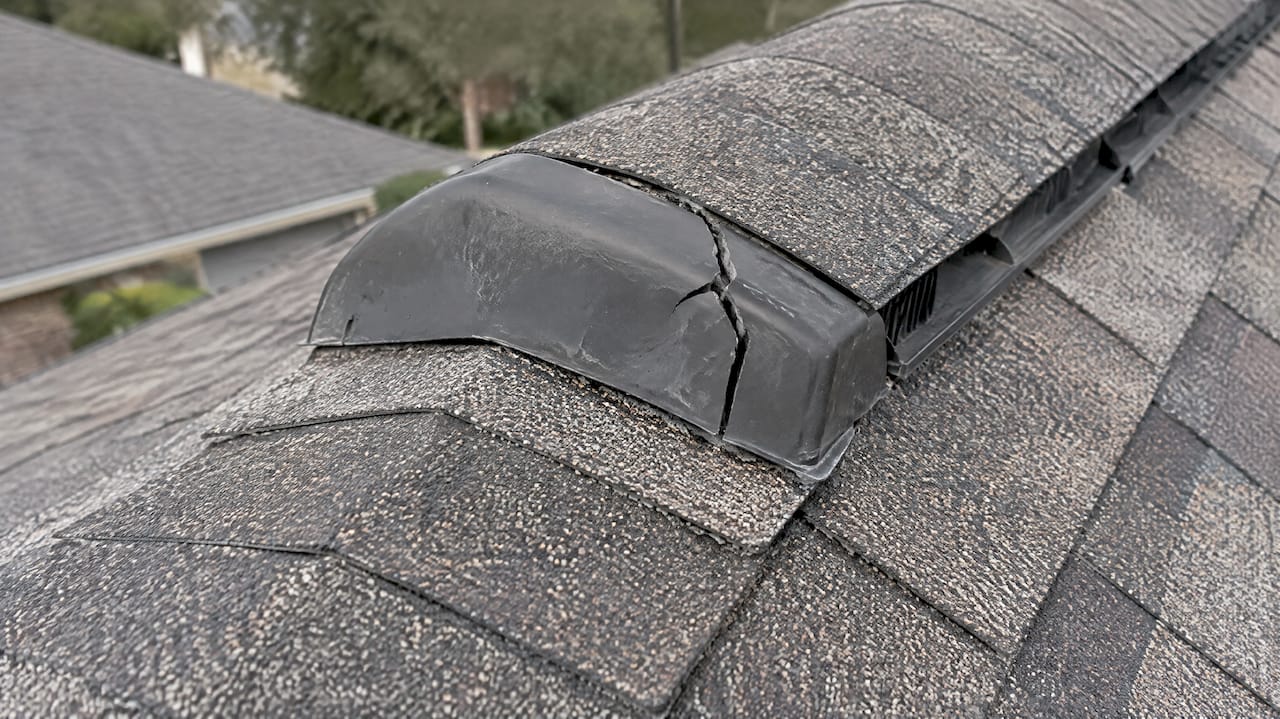
Cracked end caps, crushed segments and sun-damaged plastic should be replaced, not caulked over. Caulk on a failed part is a short-lived fix, and it hides the problem from the next inspection.
Replace the whole vent
If the slot was cut wrong, the vent is warped, or the product has no effective baffle or filter, we recommend replacement. On a Louisiana roof, we favor a baffled design that holds up in wind-driven rain, installed over a correctly sized slot and covered by matching ridge cap shingles.
Fix the ventilation system, not just the vent
If the vent keeps pulling in water, the real problem is a lack of intake. We check soffit vents for blockage, look for insulation covering the vents, and confirm that bathroom and kitchen fans exhaust outdoors. A different style of vent will not cure a starved attic.
What about sealing the ridge vent shut?
It is tempting to caulk the entire vent closed. Don’t. A sealed vent stops exhaust, and the attic then traps heat and moisture, which cooks shingles from underneath and can create condensation and mold. Fix the leak path and keep the vent working.
What a ridge vent repair or replacement costs
We do not publish fixed prices because every roof differs, and we give written estimates after an inspection. For a general benchmark, 2026 industry data puts ridge vent installation or replacement at $300 to $1,200, mostly priced at $7 to $20 per linear foot for labor and materials. Typical homes have 30 to 60 linear feet of ridge. Two-story access can add about 20%, and hard-to-reach roofs 25% or more.
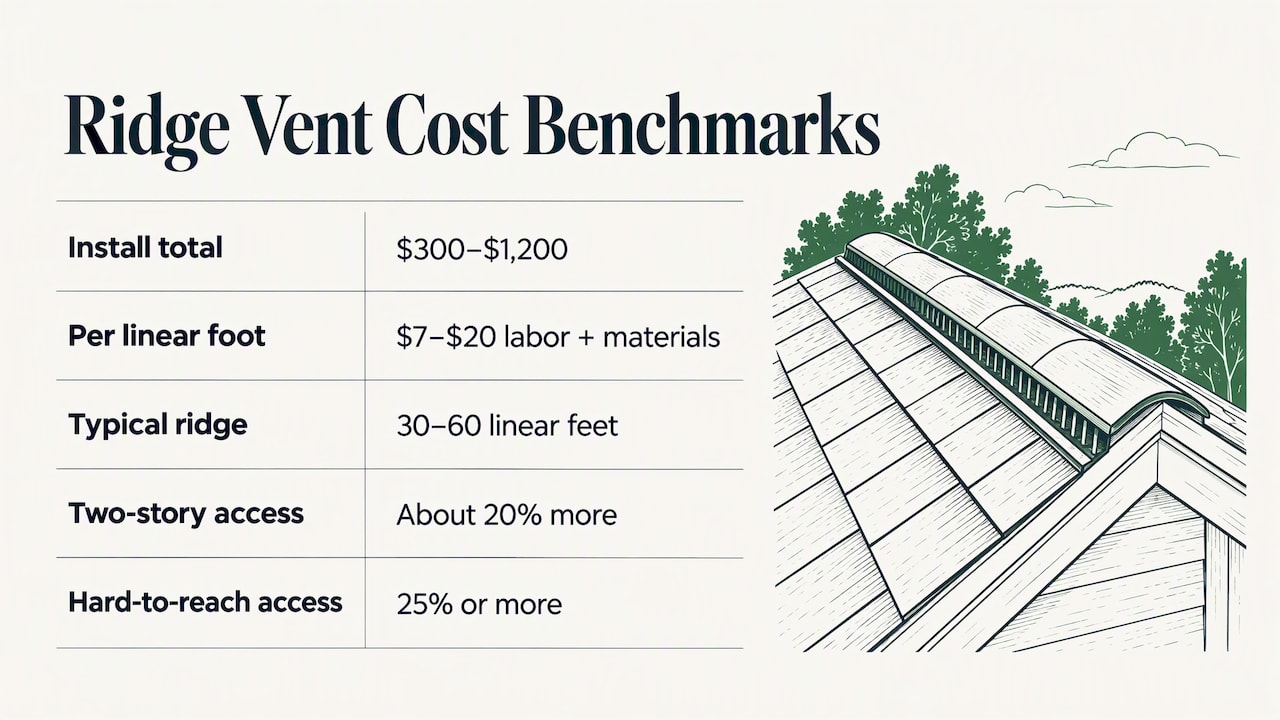
Treat those numbers as national figures, not a quote. Costs rise when damaged decking has to be replaced, when ridge cap shingles are brittle and must be redone, or when soffit intake needs work. Cheap repair attempts that fail and cause interior damage cost more in the end.
Our perspective: why we start with airflow
Over 25 years, we have learned that the vent is often the symptom. A homeowner calls about a stain at the peak, and the first instinct is to replace the vent or smear sealant on it. Sometimes that is right. Often it isn’t.
We start with three questions. How was the vent installed? Is there enough intake at the soffits? What did the weather do the night the leak showed up? Wind-driven rain, a blocked soffit and a badly cut slot all produce the same ceiling stain, but each needs a different repair. A fix that ignores the cause comes back at the next storm.
We also give honest assessments. If a small repair will do, we say so and do not push a replacement. If the roof is near the end of its life and a vent repair would be money wasted, we say that too, and explain how the decision looks next to repair versus replacement in Baton Rouge. Our work carries a five-year workmanship warranty, and we explain the scope before work starts.
Get the leak looked at
If you suspect your ridge vent, our roof inspection covers the ridge, flashing, fasteners, attic side of the decking and the ventilation balance, so you know the source before spending on a repair. If the vent is the culprit, we repair it through our roof repair service. Commercial buildings with ridge or curb ventilation can start with commercial roofing.
Preventing ridge vent problems
- Inspect after major storms. Look for lifted cap shingles and cracked end caps. Our roof inspection frequency guide for Louisiana explains the schedule we suggest.
- Keep soffit vents clear. Do not let insulation cover them.
- Vent fans outdoors. Never into the attic.
- Choose a baffled vent with end caps when replacing, and have it installed over a correctly cut slot.
- Do not stack ventilation types. Mixing ridge vents with powered fans or box vents can short-circuit airflow. Ask a roofer to review before adding anything.
- Look at the attic yearly. Our roof and attic care tips walk through what to look for.
Homeowners also ask about metal ridge vents. They can hold up well, but exposed fasteners are the weak point, so fastener condition matters. Our guide to metal roof flashing covers related details.
FAQ
How much does it cost to repair a ridge vent?
Minor repairs such as resealing or replacing end caps cost less than full replacement. Replacing a vent typically runs $300 to $1,200 nationally, based on published 2026 pricing data. Ridge length, roof height and damaged decking change the final figure, so get a written estimate after an inspection.
What are the downsides of ridge vents?
They are more exposed to wind-driven rain than some other vents, and they can leak when badly installed or worn. They also need enough soffit intake to work. Correctly installed and balanced, they are a standard, effective way to exhaust attic air.
My ridge vent leaks in heavy rain. What should I do?
Protect the inside of your home, photograph the damage and check the attic for the wet spot. Have a roofer inspect the vent, end caps and soffit intake soon, because heavy rain means the problem will repeat. A temporary tarp can bridge the gap if the repair has to wait.
Can I seal a ridge vent myself?
You can reseal small gaps, but we advise against doing it from the roof unless you are experienced and the roof is dry. The risk of falls is real, and sealing without finding the cause often fails. Never seal the vent shut, since the attic needs the exhaust.
Sources
- Roof Ventilation Cost Calculator (2026)
- Roof Ridge Vent Leaking: Causes, Diagnosis, and Steps to Fix
- Why Is My Roof Ridge Vent Leaking?
- Pros and Cons of Roof Ridge Vents, Angi
- Ridge Vent Cost (2026), HomeMatchup
- TAB-R-120 Proper Attic Ventilation, GAF
- Are Ridge Vents Useless? American Society of Home Inspectors
- Ridge Vent Installation Instructions & Errors, InspectApedia
- Roof vent leak prevention, InspectApedia
- Ridge vent leaking? r/Roofing