Hurricane roof damage usually starts at the edges and corners, where wind suction pulls shingles, flashing and decking loose, and then continues inside as water finds the openings. Your first steps are to stay off the roof, shut off power or gas if you suspect damage, photograph everything from the ground, cover openings with a tarp, and call your insurer. Then have a licensed roofer assess the damage before any permanent repair. We are a Baton Rouge roofing company, and this is the order we follow when Louisiana homeowners call us after a storm.
TL;DR
- Wind damage tends to begin at roof edges and corners, so check there first, from the ground or with binoculars. Never climb a storm-damaged roof.
- Shut off electricity and gas if you suspect damage, then call your insurer as soon as you can.
- Photograph and video the damage before and after emergency tarping, and keep every receipt.
- Temporary tarping is appropriate. Permanent repairs should wait until you have talked to your insurance agent.
- Be wary of anyone who knocks on your door offering roof work. Hire a licensed, insured local contractor.
Table of Contents
- How hurricanes damage a roof
- Signs of hurricane roof damage you can check safely
- What to do first after hurricane roof damage
- Tarping: the right temporary fix
- Documenting damage for your insurance claim
- When the adjuster and your roofer disagree
- Choosing a roofer after a hurricane
- Our perspective: what we see after Louisiana hurricanes
- Reducing your risk before the next hurricane
- Get your roof checked by a Baton Rouge roofer
- FAQ
- Sources
How hurricanes damage a roof
A hurricane is not one event for your roof. It is hours of sustained wind, gusts, flying debris and rain driven sideways, all working on the same surfaces.
According to the National Roofing Contractors Association (NRCA), strong winds load a roof unevenly: suction on one side, pressure on the other. The damage often starts at the roof edges and can peel material back, exposing the deck or insulation underneath. That pattern explains why you often see a roof that looks fine in the middle but has bare strips along the eaves and ridge.
There are three main damage paths:
- Wind. Shingles lift, curl or blow off entirely. Flashing around chimneys, vents and valleys bends or tears. Ridge caps go.
- Debris. Branches and wind-borne objects puncture or bruise roofing. The NRCA notes that a roof assessment should account for debris that has blown onto or across the roof.
- Water. Once the protective layer is breached, rain reaches the underlayment, decking, insulation and ceilings. In Louisiana’s heat and humidity, a wet attic can grow mildew within days, which is why speed matters even when the roof still looks mostly intact.
A fourth problem is less obvious: a roof that was already aging. Granule loss, brittle shingles and worn sealant strips give wind something to grab. If your roof was near the end of its life before the storm, the damage will usually be worse, and the repair-or-replace question gets harder. We cover that further down.
Signs of hurricane roof damage you can check safely
You can learn a lot without leaving the ground. The NRCA advises owners not to climb ladders to inspect storm-damaged structures that may not be sound, and we agree. A saturated deck can give way, and a loose shingle sheet can slide.
Walk the perimeter of your home, ideally with binoculars, and look for the following. Florida PACE lists these among the common signs of storm damage:
- Missing, cracked or curled shingles, especially along seams and joints
- Granule loss, which you may notice as grit in gutters or at downspout outlets
- Bent, loose or missing flashing
- Sagging areas of the roofline
- Water stains on ceilings and walls inside
- Moisture, leaks or mildew in the attic
From the ground
Look at the ridge line, the eaves and the corners first. Check the yard for shingle pieces, metal flashing and fallen limbs, which tell you where wind hit hardest. Look at gutters and downspouts, which are often dented or pulled away when debris hits the roof edge. For a more detailed walk-through, see our guide to four ground checks for wind-damaged shingles.
From the inside
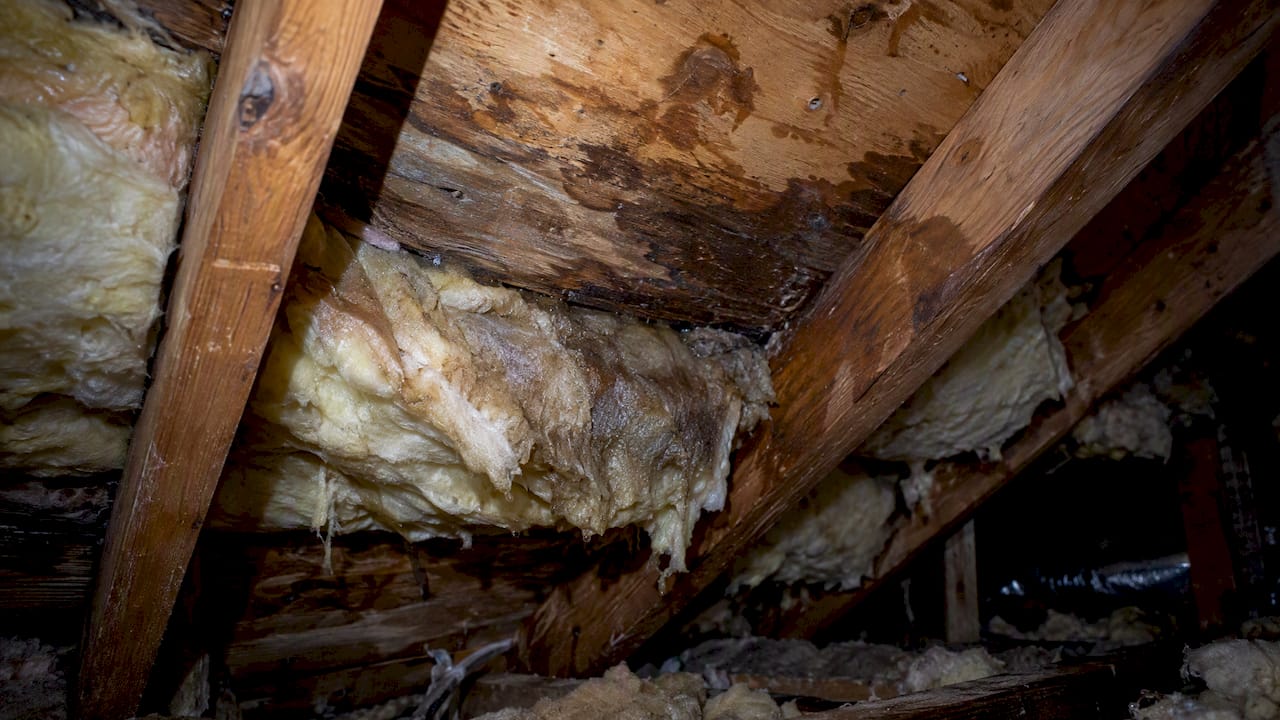
Once the storm has passed and it is safe, step into the attic with a flashlight if you can reach it without climbing onto unsafe surfaces. Look for daylight where there should be none, damp insulation, dark stains on the underside of the decking and a musty smell. Check ceilings for brown rings or bubbling paint. Poor airflow can also make a wet attic worse, and these signs of poor attic ventilation are worth knowing when you evaluate what you find up there.
If you see sagging in a ceiling that is holding water, do not stand under it. Puncturing a small hole to drain a bulge can relieve pressure, but only do it from a safe position with a bucket below, and stay out of rooms with any sign of electrical contact with water.
What to do first after hurricane roof damage
The order matters. Here is the sequence we recommend, based on guidance from the NRCA and state insurance regulators.
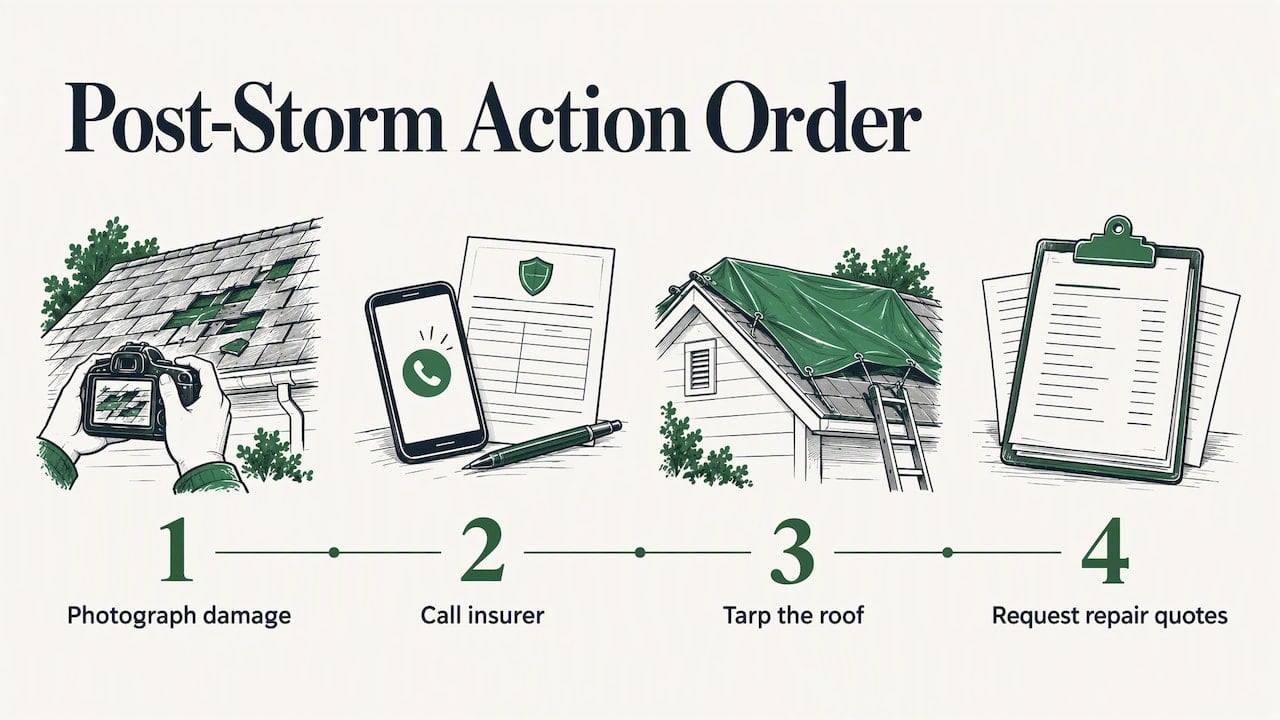
- Make the house safe. The NRCA says to shut off electrical power, natural gas and propane if you suspect damage, and to follow precautions for frayed wiring or a suspected gas leak. If you smell gas, leave the house and call from outside.
- Photograph and video the damage. Do this before anything is moved or covered.
- Call your insurer. The NRCA advises calling the insurance company as soon as possible to request an assessment. Do not wait until you have a repair estimate.
- Protect the house from more water. Cover openings with tarps. More on this below.
- Get a professional roofing assessment. Your own contractor’s findings are useful if they differ from the adjuster’s.
- Hold off on permanent repairs until you have talked to your agent or adjuster.
Our own guide to the first moves after roof storm damage in Louisiana goes into the same sequence for local homeowners, and our page on post-hurricane roof safety covers what to avoid on a damaged roof, in the yard and around downed lines.
Tarping: the right temporary fix
Emergency tarping is the one repair that you should do quickly. The NRCA recommends temporarily covering roof openings with tarpaulins to limit rain damage, and notes that the insurer is likely to reimburse the cost of temporary repairs if you keep receipts. The Florida Department of Financial Services gives similar guidance in its post-hurricane claims guide: emergency repairs such as tarping should be made to protect the property from further damage.
A few practical points from our crews:
- A tarp is only as good as how it is fastened. Properly secured tarps run over the ridge and are anchored to solid decking or boards, not simply weighed down. Loose tarps in a tropical storm’s tail winds can do more harm than good.
- Do not attempt it yourself from a ladder on a wet roof. Except in extreme situations, the NRCA says not to attempt roof system repairs yourself, and tarping on a steep, wet surface carries real fall risk.
- Take photos before and after the tarp goes on.
We explain how it works in understanding emergency roof tarping after a storm, and our storm damage restoration team handles tarping as part of the restoration process.
Temporary versus permanent repair
| Temporary protection | Permanent repair | |
|---|---|---|
| Purpose | Keep rain out until the roof can be fixed | Restore the roof system to full performance |
| Typical form | Tarp, sheeting, board-over | New shingles, flashing, underlayment, decking or full replacement |
| Timing | As soon as it is safe | After documentation and insurer contact |
| Insurance | Receipts usually reimbursable under the policy terms | Talk to your agent or adjuster first |
| Who | Experienced crew, or a roofer | Licensed roofing contractor |
The Palm Beach County Office of Emergency Management advises against permanent repairs without first consulting your insurance agent or broker. The reason is simple: if the adjuster has not seen the damage, you may have trouble proving what it was.
Documenting damage for your insurance claim
A clean paper trail is the most useful thing you can bring to a claim. State guidance is consistent on what that looks like:
- Photos or video of the damage, and photos before and after emergency repairs
- Receipts for every temporary repair
- A list of damaged items with specific product descriptions, as the Florida CFO guide recommends
- A log of every conversation and expense, which the Palm Beach County emergency office and the Texas Department of Insurance both suggest
If you own a commercial building, the same Palm Beach County page advises not discarding furnishings, fixtures, machinery or other apparent total losses until an adjuster has examined them.
Add a few habits of your own. Date-stamp photos. Shoot wide, then close, with something for scale. Include shots of the whole house so the adjuster can see the damage in context. If you have pre-storm photos of the roof, such as from a past inspection or a real estate listing, keep them.
For how this process plays out with Louisiana policies, see our roof insurance claims guide.
Deadlines and deductibles
Claim rules differ by state and by policy, so read yours. As one example, Florida’s consumer guide says to report the claim immediately, and sets one year to ask for a closed claim to be reopened for additional damage, or 18 months from the date of loss to notify the insurer of added damage on an open claim. Those are Florida figures and do not apply in Louisiana. Your policy and the Louisiana Department of Insurance are the authority for your deadlines, and your agent can confirm them in one call.
One more point about deductibles: Texas regulators note that state law makes it illegal for contractors or roofers to offer to waive a deductible or promise a rebate on one. Rules differ by state, but a contractor who offers to cover your deductible is a red flag wherever you live. Many Gulf Coast policies also carry a separate wind or hurricane deductible, usually a percentage of the home’s insured value, so look at your declarations page before the next storm instead of after it.
When the adjuster and your roofer disagree
It happens often. The adjuster may say repairs are enough and your roofer may say the roof needs replacing. The NRCA explains that the insurer decides whether damage is enough to declare a total loss and determines the roof size and the number of shingles needed. It recommends that you get a professional roofing contractor’s assessment, and that you request a reinspection if the findings differ. In a reinspection, both parties meet on the roof and review it together, and many discrepancies get resolved that way.
What tips the decision between repair and replacement?
- Extent. Isolated missing shingles on a young roof point to repair. Widespread lifting, torn flashing and exposed decking on many slopes point to replacement.
- Age and condition. A roof near the end of its service life may not hold a patch. Our page on signs it is time to replace your roof covers what we look for.
- Matching and repairability. Older shingles can be brittle, and lifting them to patch can break neighboring ones.
- Deck and water damage. Soaked or rotted decking has to be replaced whatever the shingle condition.
We explain how we think through the decision in roof repair versus replacement in Baton Rouge.
Choosing a roofer after a hurricane
After a major storm, out-of-town crews arrive and door knockers multiply. The Louisiana Insurance Commissioner has warned residents about contractor fraud after hurricanes, advising people to contact their insurer first, hire licensed, insured and well-reviewed contractors, and be wary of anyone who offers work they did not request.
A short checklist we would use ourselves:
- Verify the license and insurance. Ask for proof, and check it yourself.
- Look for a local address and track record. A contractor who has worked in your parish for years will still be there when a warranty question comes up.
- Get a written scope and price. No vague line items.
- Never sign over your insurance claim or pay in full upfront.
- Walk away from deductible offers or pressure. If someone says the offer expires today, it is a sales pitch, not an inspection.
- Ask what the warranty covers and for how long. Ours is a five-year workmanship warranty.
The Louisiana-specific roof repair guidance we publish also explains where DIY stops making sense.
Our perspective: what we see after Louisiana hurricanes
We have been roofing in Louisiana for more than 25 years, and certain patterns repeat after every storm.
The homeowners who come through best are rarely the ones with the newest roofs. They are the ones who acted in the right order: photographed first, called the insurer, tarped, and only then asked for repair quotes. The ones who struggle usually lost time. They waited a week to see whether the stain “dried out,” or let a stranger put a tarp on and sign a contract on the hood of a truck.
We also see how often minor damage turns out to be bigger. A few missing shingles on the ground often means broken seals across the slope that you cannot see from the yard. That is why we offer free inspections, and why we give you an honest assessment, including when the answer is that you need nothing more than a small repair. We would rather lose a job than sell you a roof you do not need, and our work stays under a five-year workmanship warranty either way.
Finally, damage does not always show up the day after the storm. Wind-lifted shingles can leak in the next heavy rain, weeks later. If your roof has been through a hurricane, even without visible damage, a professional look is cheap protection.
Reducing your risk before the next hurricane
You cannot make a roof hurricane-proof, but you can make failure less likely. Wind uses weak points: roof edges, old flashing, loose ridge caps and tired sealant. So:
- Schedule an inspection before the season, and after any major storm. Louisiana’s climate is hard on roofs. Our page on roof inspection frequency in Louisiana’s climate explains how often we suggest.
- Fix small problems early. Lifted tabs, cracked flashing and failed sealant are cheap now and expensive in a hurricane.
- Trim overhanging limbs. Branches are the most common source of impact damage.
- Keep gutters clear, so water does not back up under the roof edge.
- Check attic ventilation and insulation, which affect moisture buildup.
- Review your policy before the season, including the wind deductible, and keep a folder with photos of the roof in good condition.
- Replace when repair no longer makes sense. A roof past its service life is the one most likely to fail. Our roof replacement timeline shows how quickly a replacement can be done.
Business owners and property managers should also look at flat and low-slope systems and metal roofing. Drainage, flashing and seam condition matter just as much, and our commercial roofing team handles maintenance programs for that reason.
Get your roof checked by a Baton Rouge roofer
If a hurricane has passed through and you are not sure what it did to your roof, we can help. Our crews tarp, inspect, repair and replace, and we work with homeowners, businesses and property managers across the Baton Rouge area. We give you a straight assessment, clear communication and no pressure. Start with a roof inspection, or call us about emergency roof repairs if water is already getting in.
For storm-related repairs and rebuilds, our storm damage restoration service covers tarping through full replacement.
FAQ
How can I tell if my roof has hurricane damage?
Look from the ground for missing, curled or cracked shingles, bent flashing, sagging sections and debris on the roof. Inside, check for ceiling stains and a damp or musty attic. If you see any of these, or are unsure, have a roofer inspect it, because damage is often not visible from the yard.
Should I tarp my roof before the insurance adjuster arrives?
Yes, if it can be done safely. Insurers expect you to protect the home from further damage, and the NRCA says reimbursement of temporary repairs is likely if you keep receipts. Photograph the damage before and after the tarp goes on.
Does homeowners insurance cover hurricane roof damage?
Usually, wind damage is covered under a standard homeowners policy, but flooding is not, and many Gulf Coast policies have a separate wind or hurricane deductible. Your declarations page and your agent can tell you what applies to your policy. Report the claim as soon as you can.
Can I repair my roof myself after a hurricane?
The NRCA says to avoid roof system repairs yourself except in extreme situations, and not to climb a storm-damaged roof. A wet, damaged roof is dangerous to walk on. Leave tarping and permanent work to a professional.
How soon should I call a roofer?
Call your insurer first, then a licensed local roofer right away if water is entering the house. A same-week inspection gives you documentation and a clear scope before any permanent repairs start.
Sources
- Roof Repair After a Hurricane, NRCA
- Signs of Roof Damage After Storms, Florida PACE
- What to Expect After Filing a Homeowners Claim, Florida CFO
- Managing Your Insurance Claim, Palm Beach County Office of Emergency Management
- Help after a storm, Texas Department of Insurance
- Louisiana Commissioner Warns Against Contractor Fraud Post-Hurricane Francine, Insurance Journal
- Signs of Poor Attic Ventilation and What to Do Next