
Most skylight leaks come from the flashing, the layer of metal and membrane that joins the skylight to your roof, not from the glass. The fix is usually to reflash the unit, not to smear sealant around it. Some “leaks” turn out to be condensation, and a few are a sign the skylight has reached the end of its life. Below we explain how to tell them apart, what to do the day you see a drip, and when a roofer needs to get on the roof.
TL;DR
- Skylights are among the most common points of water entry in a roof, and flashing problems are the usual culprit when water shows up around one.
- Check for condensation first: fog between the two panes means a failed glass seal, and moisture on the room side of the glass often means humid indoor air.
- Sealant alone is a short-term patch. A lasting repair means lifting the roofing around the unit and rebuilding the flashing in the right order.
- Place a bucket, move belongings, photograph everything, and book an inspection. A dry moisture reading does not prove the skylight is fine.
- Insurance generally covers sudden damage, not wear and tear, so document maintenance and act early.
Table of Contents
- Why skylights leak
- Signs your skylight is leaking
- Condensation, glass or flashing: finding the real source
- What to do the day your skylight leaks
- How a skylight flashing leak is actually repaired
- Cost: what we can and cannot tell you
- Does homeowners insurance cover a leaking skylight?
- Perspective: what we see on Louisiana skylights
- Have us look at your skylight
- Preventing skylight leaks from coming back
- FAQ
- Sources
Why skylights leak
A skylight is a hole cut in the one part of your house designed to shed water. The unit sits in the roof plane, and every side of it has to be tied into the shingles, underlayment and decking so water runs around it and keeps going downhill. The U.S. Department of Energy’s building science resources describe skylights as a weak spot in the roof’s water-management system that needs properly integrated flashing. When any one layer is wrong, water finds it.
The usual causes fall into a handful of groups:
- Flashing failure. Metal or membrane pieces that were installed in the wrong order, were never fully integrated with the underlayment, have corroded, or have been pushed out of position by years of heat and movement.
- Dried or cracked sealant. Caulk and roofing cement harden in sun and heat. Someone often applied them as a quick fix, and they split along the same line the original leak followed.
- Failed gaskets or frame joints. Rubber gaskets and joints in the frame wear out, particularly on operable skylights where the sash meets the frame.
- Failed insulated glass. When the seal around the two panes breaks, moisture gets between them and the unit fogs.
- Debris and pooling. Leaves, pine needles and grit pile up on the uphill side of the curb, hold water against the flashing and push it past weak points.
- Age. Skylights do not last as long as a well-built roof around them, and an old unit can have several small failures at once.
Where you live matters too. In south Louisiana, a roof goes through intense sun, heavy afternoon downpours, tropical storm wind that drives rain sideways, and humidity that rarely lets up. Wind-driven rain is the test that exposes weak head flashing, the piece at the top of the unit, because water gets pushed uphill under shingles that would shed it in ordinary rain.
Signs your skylight is leaking
The obvious sign is a drip during rain. Many leaks start quieter. The Department of Energy lists peeling interior paint and water stains on framing among the signs of infiltration. In practice, look for:
- A brown or yellow ring on the drywall around the skylight shaft or on the ceiling beside it
- Paint that bubbles, peels or turns chalky near the frame
- Soft or crumbling drywall when you press gently
- Dark streaks or mold spots on the shaft walls
- Water marks on rafters or insulation if you can see them from the attic
- A musty smell in the room that comes and goes with the weather
Our guide to roof leak signs covers the same symptoms across the whole roof, which helps if the stain is a few feet from the skylight and you are not sure the skylight is the source.
Water rarely drips where it enters. It can run along decking, a rafter or the top of a vapor barrier before it shows itself. A stain on the ceiling below the skylight can start at the head flashing several feet higher up the slope. Trace the stain upward before you decide where the problem is.
Condensation, glass or flashing: finding the real source
Before anyone climbs on a roof, work out what kind of leak you have. The three explanations call for three very different repairs.
Condensation
If water beads on the room side of the glass, or runs down the shaft in humid weather or after showers, you may have no leak at all. Warm, moist indoor air meets cool glass and turns to water. This is common in bathrooms, kitchens and lofts. Skylights often include a small condensation channel for this reason. The fix is ventilation and humidity control, not a roofer. If you want to understand how trapped moist air produces damp in enclosed spaces, this piece on ventilation to stop damp shows the same principle at work in a closet.
A useful clue is timing. Condensation tracks indoor humidity and outdoor temperature. A true leak tracks rain. If the drip appears on a dry, humid morning, look at ventilation first. If it appears twenty minutes into a storm, look at the roof.
Failed glass seal
Condensation or fogging between the inner and outer panes means the seals of the insulated glass unit have failed. The Department of Energy’s guidance notes that fogging between panes indicates seal failure. That is a glass problem. It does not usually mean water is entering the house, but it will not fix itself. Depending on the unit, the repair is a new glass insert or a new skylight.
Flashing or frame leak
This is the one that stains ceilings. Common entry points include joints in the frame, the gap between frame and sash on operable units, and the junction where the skylight meets the roof. The same federal guidance recommends looking at the roof covering, underlayment, sheathing, framing, skylight unit and frame-to-sash area, because water can travel from several pathways before it appears inside.
A note on hose testing
You will see videos of people running a garden hose over a skylight. A controlled test can separate causes: water on the glass that appears around the frame points to a glazing problem, while water that only shows up when it runs down the roof toward the unit points to flashing. The Department of Energy cautions that this needs care and is best left to someone experienced in building-envelope testing. Soaking a roof with a hose can push water into places that rain would not reach, and a person on a wet roof is at real risk of falling. We do this ourselves in a controlled sequence, working from the bottom of the unit up, so we can isolate each variable.
Why a dry reading is not an all-clear
The American Society of Home Inspectors points out that a dry moisture-meter reading is inconclusive, because leaks can be intermittent or seasonal. If the stain is there and the meter reads dry, the leak may only occur in wind-driven rain from one direction. Keep a note of the weather each time you see water.
What to do the day your skylight leaks
You do not need to fix it in the storm. You need to limit damage and gather information.
- Protect the room. Put a bucket under the drip, lay towels or plastic sheeting, and move furniture and electronics. If water is pooling in a light fixture or you see a bulging ceiling, turn off power to that circuit and keep people away from the area. A sagging, water-filled ceiling can be punctured carefully to drain into a bucket, standing off to the side.
- Write down the details. Note when the water appeared, how hard it was raining, wind direction, where the drip started and how old the skylight is.
- Take photos. Photograph the stain, the skylight and the surrounding ceiling. Photos with dates help if you file an insurance claim later.
- Rule out condensation. Check whether water is on the room side of the glass and whether it showed up without rain.
- Look from the attic. If you have access, a flashlight shows wet insulation, dark wood or drips running along framing. The American Society of Home Inspectors recommends inspecting skylights from above, below and, where possible, from the attic.
- Do not climb on a wet roof. Skylight glass is also not meant to hold weight. Stay off it.
- Book an inspection. If you see a stain or hear a drip during rain, get it looked at soon rather than waiting for the next season. One industry source suggests having it inspected within one to two weeks, and in our experience that is reasonable: slow leaks soak decking and insulation and turn a small repair into a bigger one.
If the weather is severe and water is coming in heavily, a temporary cover can bridge the gap until crews can work safely. We cover what is realistic in our guide to fixing a roof temporarily, and our team offers roof tarping as part of storm damage restoration.
How a skylight flashing leak is actually repaired
Homeowners often ask what the best way to seal a leaky skylight is. The honest answer is that sealing is rarely the answer. Roofing professionals on public forums say the same thing: sealants only do so much and are temporary, and a leaking corner usually needs the unit reflashed. We agree. Sealant has a place as a short-term stop, or for sealing a small gap at a gasket, but when it is the only repair, it fails along the same crack.
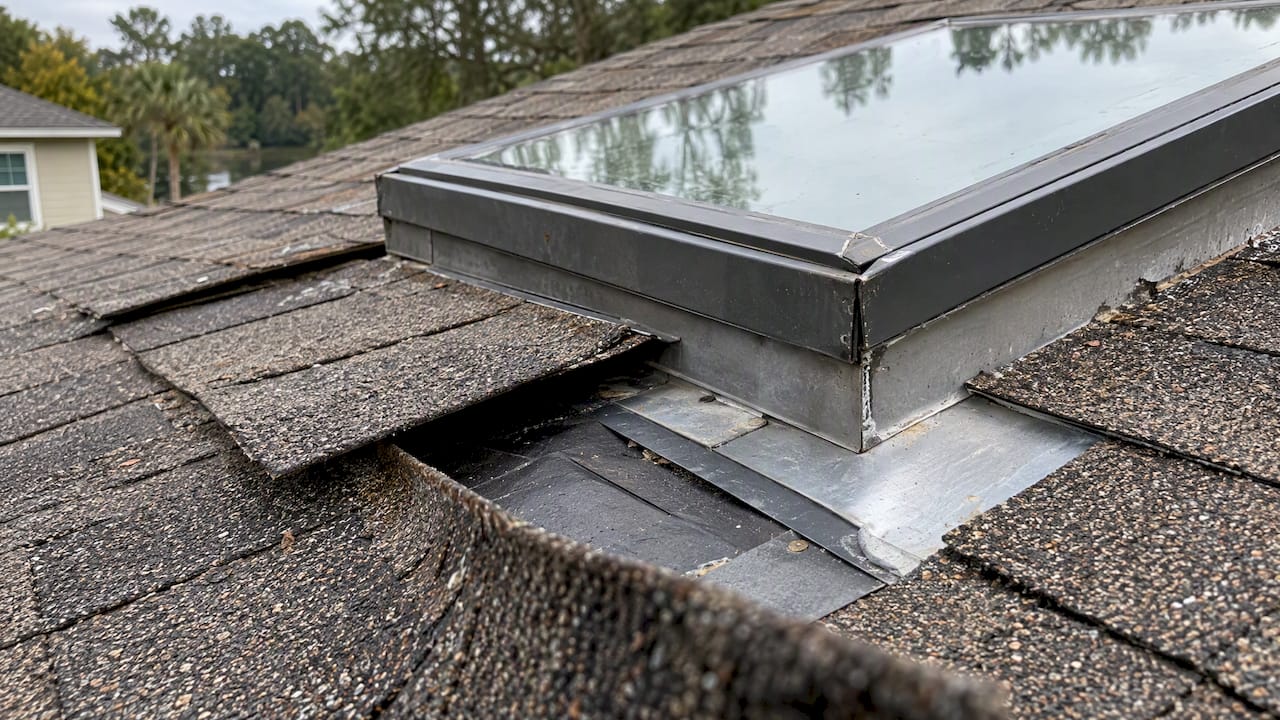
A proper reflash follows how water moves. The Department of Energy’s building science guidance for a curb-mounted unit describes the sequence: cut back the shingles and underlayment, wrap the sill and jamb with self-adhered membrane, and tuck it below the shingles but above the underlayment. The layers must overlap in shingle fashion, or be sealed, so water drains down and never collects on the roof. Its flashing guidance also notes that replacing skylight flashing requires cutting back existing roofing materials and integrating correctly with the drainage plane.
In practice, a good repair looks like this:
| Step | What happens | Why it matters |
|---|---|---|
| Find the source | Interior, attic and roof-side inspection, sometimes a controlled water test | Prevents repairing the wrong spot |
| Open the roof edge | Shingles and old flashing are carefully removed around the unit | Reveals the damaged decking and failed layers |
| Repair the deck | Wet or rotted wood is replaced | Flashing needs a solid base |
| Rebuild the flashing | Membrane, step flashing and head and sill pieces go back in order, top layers lapped over lower ones | Water sheds downhill instead of behind the metal |
| Close the roof | Shingles are replaced and sealed | Restores the roof plane |
| Check the interior | Drywall, insulation and the shaft are dried and checked | Stops hidden mold and rot |
The step many quick repairs miss is the interior. If water has been getting in for a season, the shaft drywall and insulation can be damp even after the roof is fixed.
When to repair and when to replace the skylight
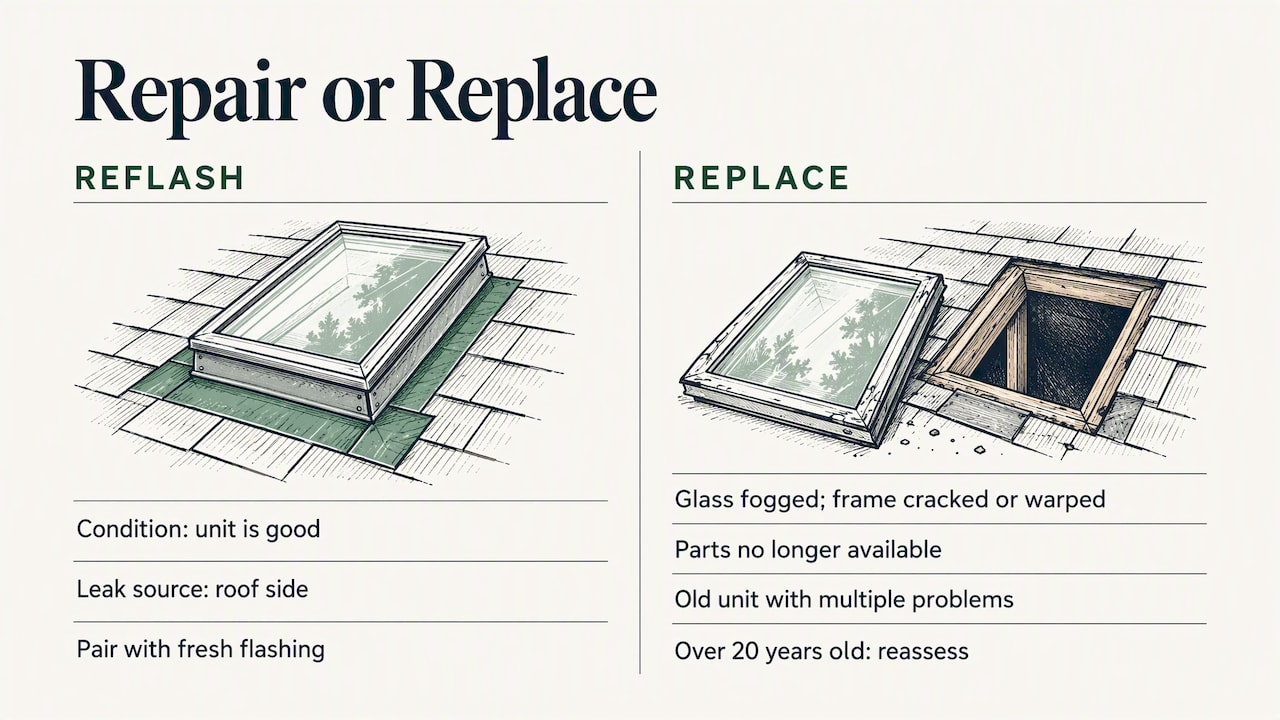
Reflashing makes sense when the unit is in good condition and the leak traces to the roof side. Replacement makes more sense when the glass is fogged, the frame is cracked or warped, parts are no longer available, or the unit is old and has more than one problem. One roofing publication suggests replacing any skylight over about 20 years old regardless of where the leak shows up. We would not apply that number as a rule, but it is a useful prompt: if the skylight is older than that, ask whether you want to pay to reflash a unit that is about to fail anyway. Since replacing a skylight means opening the roof around it, we usually recommend doing it with fresh flashing.
If your whole roof is also near the end of its life, it is often better to coordinate the skylight with the roofing work. Our pages on roof repair versus replacement in Baton Rouge and roof lifespan can help you decide.
Cost: what we can and cannot tell you
Prices for skylight work vary widely with the type of roof, the size and style of the unit, how many layers have to be opened and whether the decking is damaged. A small flashing repair on an accessible unit is a different job from replacing a large, curb-mounted skylight on a steep roof with water damage below it. Published figures online come mostly from contractors and content sites, and they vary a lot, so we will not quote you a number we cannot stand behind. The only way to price the job accurately is to see it.
We inspect first, explain what is failing in plain language and give you a clear, itemized price before work starts. That is the way we work on all repairs, with no pressure to commit on the spot.
Does homeowners insurance cover a leaking skylight?
Usually it depends on the cause. The Insurance Information Institute’s roof toolkit explains that policies typically cover sudden or accidental roof damage from events like wind, hail or falling objects, while homeowners are responsible for maintenance and normal wear and tear. So a skylight torn loose or damaged by a storm or a fallen limb is more likely to be a claim than one that has slowly leaked because the flashing aged.
Three habits help in either case:
- Keep maintenance receipts and before-and-after photos, which the same toolkit recommends alongside a yearly roof inspection.
- Report storm damage promptly and take temporary steps to prevent further loss.
- Read your policy, especially the wind and hurricane deductibles that are common on the Gulf Coast. Our guide to wind damage insurance coverage in Louisiana explains what to look for. For your own policy, ask your insurer or agent directly.
Perspective: what we see on Louisiana skylights
We have worked on Louisiana roofs for more than 25 years, and the pattern is consistent: a skylight leak is rarely a skylight problem alone. It is a roofing detail problem. The unit may be fine, but the flashing was installed by someone who did not integrate it with the underlayment, or an earlier repair covered the problem with roofing cement and hid the real source.
The second thing we see is how often the first fix is a tube of caulk. We understand why. It is cheap, it takes ten minutes, and it often works until the next heavy rain. But it also makes the real repair harder, because we have to clean off layers of old sealant before the new flashing can be integrated. Our advice is simple: if the skylight has leaked twice, stop patching and have the flashing rebuilt.
Third, we give honest assessments. Sometimes the answer is that the leak is condensation and you need a bathroom fan. Sometimes it is a ten-year-old skylight with a fixable flashing problem. Sometimes it is a worn-out unit and replacement is the only sensible repair. We would rather tell you what is wrong than sell you the largest job. Our five-year workmanship warranty backs the work we do.
Have us look at your skylight
If your skylight is leaking, or you are not sure whether it is a leak at all, our team will trace the source, explain it in plain terms and show you what we find. We offer roof inspections and roof repairs across the Baton Rouge area, including emergency repairs when water is coming in. Every repair we do carries a five-year workmanship warranty.

If you are comparing options, our free residential roof inspection guide shows what an inspection covers so you know what to expect.
Preventing skylight leaks from coming back
A skylight does not need much attention, but it needs some.
- Inspect yearly. The Insurance Information Institute toolkit recommends a yearly roof inspection. In Louisiana we would add one after any major storm. Our page on roof inspection frequency in Louisiana’s climate goes into more detail.
- Keep the uphill side clear. Brush off leaves, needles and debris gently from the ground with a soft tool or have a professional do it, so water can run past the unit.
- Trim overhanging limbs. They drop debris and can damage glass and flashing in a storm.
- Control indoor humidity. Run bath and kitchen fans, and keep a loft or stairwell ventilated, to cut condensation on the glass.
- Do not paint over a stain. Repair the cause first, then dry and repaint. Fresh paint hides active moisture.
- Reflash when the roof is replaced. New shingles around old flashing are the most common source of future skylight leaks. Our page on roof replacement in Baton Rouge explains how we plan the work.
FAQ
Is it common for skylights to leak?
Yes. Skylights are among the most common sources of water infiltration in a roof, because every edge of the unit has to be integrated with the roofing around it. Most leaks come from flashing or sealant that has aged or was installed incorrectly, not from defective glass.
What is the best way to seal a leaky skylight?
A temporary sealant can slow a small leak at a gasket or a minor gap, but it is not the long-term answer for a flashing leak. The lasting repair is to cut back the roofing around the unit and rebuild the flashing with membrane and overlapping pieces. If it has leaked more than once, ask a roofer to reflash it.
How can I tell if my skylight is leaking or just condensing?
Condensation forms on the room side of the glass, tends to appear in humid conditions and does not need rain. A leak appears during or after rain and usually leaves stains on the drywall. Fog between the two panes is a failed glass seal, which is a separate issue.
Does homeowners insurance cover skylight leaks?
Policies typically cover sudden or accidental damage, such as from wind, hail or a fallen tree, but not wear and tear or poor maintenance. Whether your claim qualifies depends on your policy and the cause, so photograph the damage and call your insurer or agent.
Can I fix a skylight leak myself?
You can protect the room, check for condensation and clear debris from the ground. Reflashing needs roof access and removal of shingles. It carries a fall risk and is easy to get wrong, so we recommend leaving it to a roofer.
Sources
- Existing Skylights Repaired or Replaced and Fully Flashed (Building America Solution Center)
- Inspecting Skylights for Water Damage and Infiltration (U.S. Department of Energy)
- Flashing around a Skylight without Roof Removal (U.S. Department of Energy)
- Skylights (American Society of Home Inspectors)
- How Your Roof Influences Your Home and Business Insurance (Insurance Information Institute)